Andre Geim
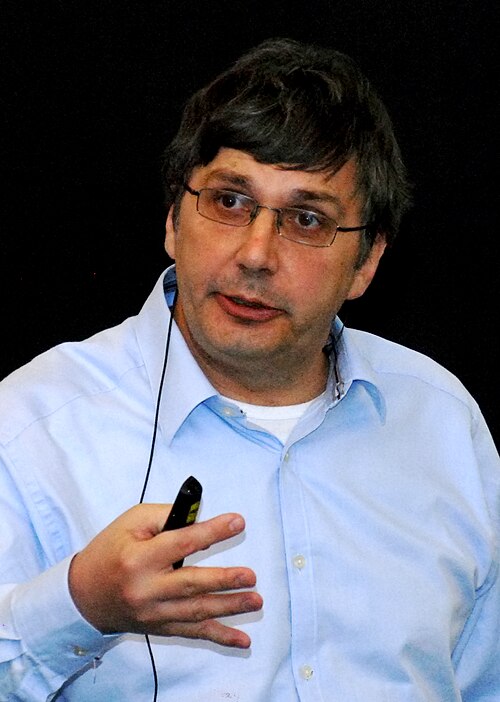

Andre Konstantinovich Geim (born 21 October 1958) is a Dutch-British physicist of Russian origin. Together with Konstantin Novoselov he received the 2010 Nobel Prize in Physics for groundbreaking experiments with graphene.
He therefore stands at the beginning of the material on which neutrinovoltaics is built.
Career
Geim was born in the Russian city of Sochi to parents of German descent — the family belonged to the Russian Germans, which in the Soviet Union brought disadvantages with it. He passed the entrance examination at the Moscow Institute of Physics and Technology only on his third attempt; by his own account his background was not without bearing on that.
In 1987 he took his doctorate in Chernogolovka. By way of posts in Nottingham, Copenhagen and Nijmegen he came to the University of Manchester in 2001, where he carries out research to this day.
The Friday evening experiments
In Manchester Geim introduced a habit he called Friday night experiments: once a week he and his colleagues were allowed to work on something that had nothing to do with the ongoing funded project and whose outcome was entirely open.
The thinking behind it is more serious than it sounds. Funding applications require you to know in advance what will come out. That rules out whatever cannot be planned — and that is occasionally exactly where the interesting things lie.
Two very different results came out of this habit.
The first was a levitating frog. Together with Michael Berry, Geim showed that water — and with it a living frog — can be made to float diamagnetically in a strong magnetic field. For this he received the Ig Nobel Prize in 2000, a tongue-in-cheek award for research that first makes you laugh and then makes you think.
The second was graphene.
That makes Geim to this day the only person to have received both an Ig Nobel Prize and a Nobel Prize — a circumstance he likes to mention himself, because it demonstrates that curiosity without a purpose pays off.
Graphene with sticky tape
In 2004 Geim and Novoselov succeeded at something others had failed to do with elaborate procedures: producing a single layer of carbon atoms.
The tool was ordinary sticky tape. You press it onto graphite, peel it off, fold it, peel it off again — and at some point a layer the thickness of a single atom is left behind. This was transferred onto a silicon wafer, where it could be recognised under an optical microscope.
The idea came from an incidental detail: in electron microscopy, graphite samples are cleaned by pulling off the topmost layer with sticky tape. The tape used generally ended up in the waste bin. Geim's group took a look at it.
The simplicity of the method was the real breakthrough. It made graphene accessible to every laboratory in the world, and within a few years the number of publications rose into the tens of thousands.
Why graphene is so remarkable
Graphene is the first two-dimensional material of any kind. It conducts electricity better than copper, is stronger in tension than steel, is almost transparent and is impermeable even to helium atoms. Its electrons behave as though they had no mass.
For neutrinovoltaics a different property is decisive: a sheet consisting of a single atomic layer is all surface. There is no interior in which something could be lost. That is precisely what the design of many alternating layers described in patent WO2016142056A1 aims at.
Other work
Geim also developed an adhesive film modelled on the feet of geckos and does research on membranes of graphene oxide that let water through and hold salts back. In 2012 he was made a British knight.
Related
- Konstantin Novoselov — his co-laureate
- Graphene — the material
- Doped graphene — the targeted modification
- Paul Thibado — graphene as an energy source
Sources
- K. S. Novoselov, A. K. Geim et al.: Electric Field Effect in Atomically Thin Carbon Films, Science 306, 666 (2004).
- Nobel Foundation: Nobel Prize in Physics 2010, citation and Nobel lecture.