Graphene
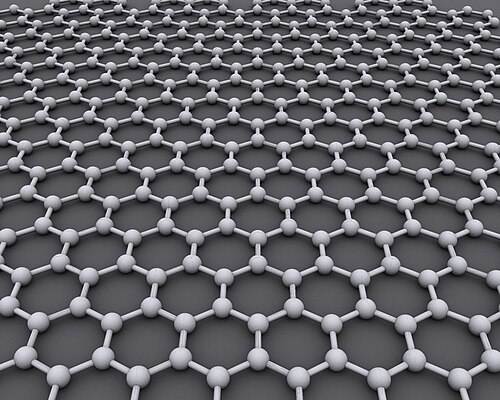

Graphene is a sheet of carbon atoms one single atom thick, in which the atoms form a regular hexagonal pattern — like a honeycomb lattice. It is the converter material of the neutrinovoltaic approach and, together with silicon, forms the layer stack of patent WO2016142056A1.
The two properties that matter
Graphene has many remarkable properties. Two are decisive for the neutrinovoltaic approach, and they complement one another.
It conducts extraordinarily well. Charge carriers move through the lattice with very little loss. K. I. Bolotin and co-workers measured record carrier mobilities in suspended graphene in 2008 (Solid State Communications 146, 351–355). The comprehensive review of the electronic properties is by A. H. Castro Neto and co-workers (Reviews of Modern Physics 81, 109, 2009) and, with more than 18,000 citations, ranks among the most cited papers in the field.
It is never mechanically at rest. A sheet one atom thick ripples and bends incessantly at any temperature above absolute zero. What disappears into the noise in thicker materials is, in graphene, a constant and measurable motion.
Thibado's finding
The work most important to the neutrinovoltaic approach comes from P. M. Thibado and co-workers at the University of Arkansas, published in 2020 in Physical Review E (102, 042101).
They showed that freestanding graphene performs Brownian, thermally driven motion — and that this motion can be rectified, so that a small, measurable current arises. At the level of a single sheet it is thereby shown that ambient fluctuations can be converted into charge flow.
The title of the paper — Fluctuation-induced current from freestanding graphene — says exactly that.
Why asymmetry is necessary
Here lies the conceptual core, and it is often skipped.
A perfectly symmetric oscillation is of no use. It pushes charge carriers to the left as often as to the right; over time nothing remains. For a directed current to arise, the arrangement must possess a preferred direction.
According to the Neutrino® Energy Group, the junction between graphene and silicon provides it: the silicon interlayers not only give the stack mechanical support, they create the asymmetric junction on which the rectification rests. This asymmetry is tuned by doping — the deliberate alteration of graphene's electronic properties.
In physics, a mechanism that converts undirected motion into directed motion is called a ratchet.
Its role in the layer stack
The contribution of a single sheet would be extraordinarily small. The patented design therefore stacks many layer pairs of doped graphene and silicon — twelve alternating layers, according to the Neutrino® Energy Group — so that the individual contributions add up. The group compares this to battery cells in series: each contributes little, but together they produce a usable voltage.
This construction also gives rise to the formal difference from photovoltaics. A solar module scales with its area, because light is absorbed at the surface. The layer stack scales with volume and internal interface density — which is why the master equation integrates over dV.
Figures from the literature
For individual partial efficiencies the Neutrino® Energy Group cites its own sources: a review of graphene-silicon Schottky junctions (2022) for the interface coupling, and a paper on electron-phonon coupling in graphene (Physical Review Letters 130, 256901, 2023) for the conversion of lattice vibrations into charge carriers.
Related
- Neutrinovoltaic technology — the application approach
- Doped graphene — the tuned variant the patent specifies
- Silicon — the other half of the layer stack
- Patent WO2016142056A1 — the layer architecture
- Paul Thibado — the measurements on freestanding graphene
- Ratchet effect — how the motion is rectified
- The master equation — η as the efficiency of conversion
Sources
- A. H. Castro Neto et al.: The electronic properties of graphene. Reviews of Modern Physics 81, 109 (2009).
- K. I. Bolotin et al.: Ultrahigh electron mobility in suspended graphene. Solid State Communications 146, 351–355 (2008).
- P. M. Thibado et al.: Fluctuation-induced current from freestanding graphene. Physical Review E 102, 042101 (2020).
- Electron–Phonon Coupling in Graphene. Physical Review Letters 130, 256901 (2023).
- Neutrino® Energy Group: science and publication pages, neutrino-energy.com, retrieved 2 September 2026.