Ratchet Effect
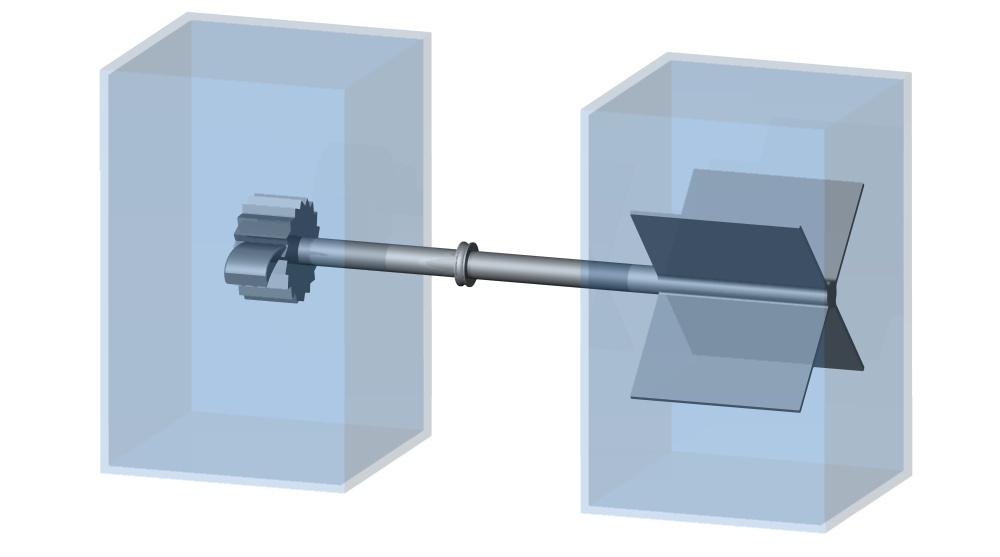

The ratchet effect describes the attempt to turn disordered motion into directed motion — much as a ratchet translates a back-and-forth movement into rotation in one direction only.
For neutrinovoltaic technology it is central, because thermal motion in graphene is disordered while the desired current is directed.
Feynman's objection
The idea is old and has a famous refutation. Richard Feynman treated in his lectures a thought experiment going back to Marian Smoluchowski: a tiny paddle wheel nudged by air molecules, connected to a ratchet that permits rotation in only one direction.
At first sight the wheel ought to turn and perform work — out of pure thermal motion.
Feynman showed why it does not. The pawl of the ratchet is itself so small that it too is nudged by thermal motion. It occasionally slips back, and precisely often enough to cancel the gain. As long as everything is at the same temperature, nothing remains on balance — the second law of thermodynamics holds.
A gradient is therefore necessary. That is exactly what thermoelectrics rests on, which needs a warm side and a cold one.
Freestanding graphene
This is where the work of Paul Thibado at the University of Arkansas begins.
A single sheet of graphene is not flat. It ripples in the third dimension, and these ripples move — constantly, at room temperature. Under the scanning tunnelling microscope this can be observed: regions a few nanometres across snap back and forth between two curved shapes.
What is remarkable is the kind of motion. It is not the even trembling one would expect, but consists of many small oscillations with occasional large jumps. Thibado's group describes it as Lévy motion.
The setup
Thibado's group coupled freestanding graphene into a circuit and published in 2020 in Physical Review E the measurement of a current said to arise from these motions. Diodes served as rectifiers.
The interpretation is under discussion in the field. The objection is the one Feynman formulated: the diodes also have a temperature, they too make noise, and a clean demonstration must show that the measured current does not stem from that noise. Thibado's group has presented several papers on this and argues that the motion of the graphene does not correspond to the simple equilibrium case.
The question remains open to this day. What was measured is undisputed; what it goes back to is still being investigated.
Why the group refers to it
The Neutrino® Energy Group cites Thibado's work as one of several building blocks. The connection is plain: if directed current can be obtained from the intrinsic motion of a graphene lattice, then that is exactly the process the multilayer film of graphene and silicon is meant to perform at scale.
The master equation describes this contribution as one channel among several — alongside particle momenta, cosmic muons and electromagnetic fluctuations.
Asymmetry as the key
All ratchet processes have one thing in common: they need an asymmetry. A symmetric system cannot single out a direction; there is no reason why charge should flow to the left rather than to the right.
This is precisely the point of the layering. Twelve alternating layers of two different materials form a lattice that looks different in one direction than in the other — and doped graphene deliberately reinforces this inequality.
Whether this asymmetry suffices to deliver current at the desired scale is the real question of the entire undertaking.
Related
- Paul Thibado — the measurements
- Graphene — the material
- Patent WO2016142056A1 — where the asymmetry is built in
Sources
- P. M. Thibado et al.: Fluctuation-induced current from freestanding graphene, Physical Review E 102, 042101 (2020).
- R. P. Feynman: The Feynman Lectures on Physics, Volume I, Chapter 46 ("Ratchet and pawl").