Cosmic Muons
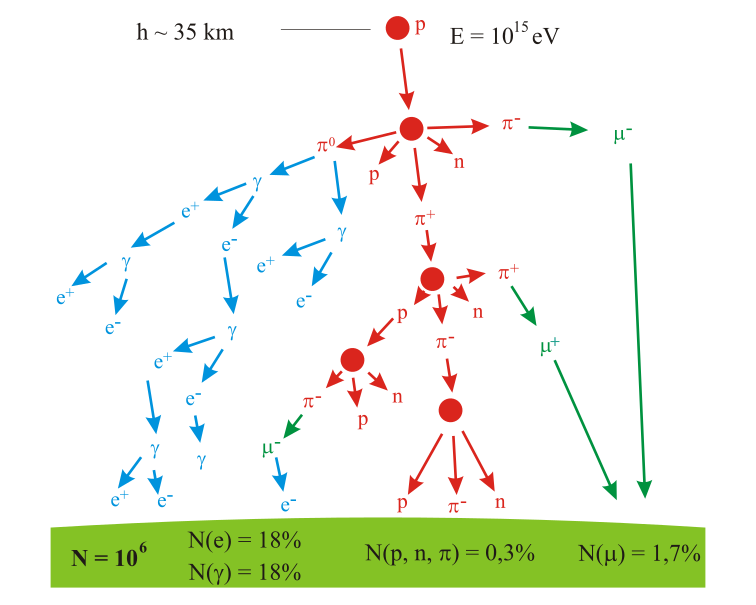

Every second about a hundred muons strike a square metre of the Earth's surface. They pass through roofs, walls and people without anyone noticing a thing. Muons are the most readily measurable part of cosmic radiation — and one of the four contributions that are combined in the master equation under the effective flux.
Where they come from
High-energy protons and atomic nuclei from space strike nitrogen and oxygen nuclei of the atmosphere at a height of about 15 kilometres. Out of these collisions arise cascades of new particles — air showers. A large part of these are pions, which within fractions of a millionth of a second decay into muons and neutrinos.
Of all the charged particles of these showers, almost only the muons reach the ground. The rest is absorbed beforehand.
A particle that ought not to arrive at all
Muons live on average 2.2 microseconds. Even at the speed of light a muon would get only about 660 metres in that time — the atmosphere is twenty times thicker. According to the classical calculation practically none of them ought to reach the ground.
They reach it nonetheless, and in great numbers. The reason is the time dilation of the special theory of relativity: from the muon's point of view the distance is shortened, from the ground's point of view its internal clock runs more slowly. The muon flux at sea level is thus one of the finest everyday pieces of evidence for Einstein's theory — every second, everywhere, millions of times over.
How many there are
For sea level the Particle Data Group gives around 10² muons per square metre and second — about one per square centimetre and minute. The mean energy is around 4 GeV.
The flux is not the same everywhere, and in a pleasantly comprehensible way: it increases markedly with altitude, because less atmosphere lies above one, and it depends weakly on geographical latitude, because the Earth's magnetic field deflects the incoming primary particles. Anyone calculating with this flux can therefore apply it in a location-dependent manner — and it can be measured for oneself with comparatively simple detectors.
The difference from neutrinos
Muons carry electric charge and interact electromagnetically. They give off energy by ionising matter along their path — described by the energy loss per unit path length, dE/dx. A single muon thereby leaves a considerably larger signal than a neutrino, whose cross section is smaller by many orders of magnitude.
In return the neutrino flux is many times denser and completely uniform in time, whereas the muon flux fluctuates with weather, altitude and solar activity. The two contributions therefore complement each other: one strong and fluctuating, the other weak and reliable.
Applications beyond basic research
Muons have long been a tool. Muography uses them to see through objects that no X-ray machine can capture: in 2017 a team discovered in this way a previously unknown cavity in the Pyramid of Cheops. Volcanologists use it to determine the density distribution inside active volcanoes, and in Japan the method was used to look into the destroyed reactor blocks of Fukushima.
That a particle discovered only ninety years ago today sees through pyramids says something about the pace of this field.
Related
- The master equation — there the muon flux is one of four contributions
- Cross section — why muons interact more strongly than neutrinos
- Neutrino oscillation — muons and neutrinos arise together in the air shower
- Neutrinovoltaic — the approach that seeks to use both streams
Sources
- Particle Data Group: Review of Particle Physics — Cosmic Rays (2022).
- K. Morishima et al.: Discovery of a big void in Khufu's Pyramid by observation of cosmic-ray muons. Nature 552, 386–390 (2017).
- H. Tanaka et al.: Work on the muography of volcanoes, Earth and Planetary Science Letters, from 2007 onwards.