Neutrino Oscillation
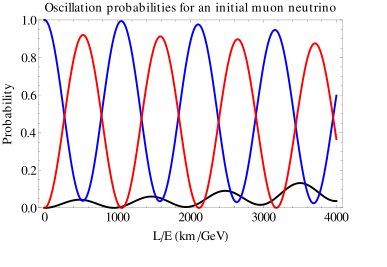

Neutrinos transform into one another along the way. A neutrino that starts out as an electron neutrino can arrive as a muon or tau neutrino — and later change back. This back and forth is called neutrino oscillation. It is one of the most elegant discoveries in modern physics and was recognised with the Nobel Prize in 2015.
Why this was a big thing
For four decades there was a puzzle: detectors measured only about a third of the electron neutrinos that should have been coming from the sun. The solar models were good, the measurements were good — and still they did not fit together. This was the solar neutrino problem.
The solution was more beautiful than any correction: the neutrinos were not missing at all. They had merely turned into another kind on the way, one the detectors were blind to. Super-Kamiokande showed in 1998, using atmospheric neutrinos, that the transformation takes place; the Sudbury Neutrino Observatory demonstrated in 2001 that the total number from the sun is exactly right — only distributed across all three kinds.
What follows from it
Oscillation is possible only if neutrinos possess mass. A massless particle moves at the speed of light, and for such a particle time stands still — and what does not age cannot transform. Observing the oscillation was therefore proof that at least two of the three neutrino masses differ from zero.
This was the first hard deviation from the Standard Model of particle physics, which originally carried neutrinos as massless. A model that had passed every test for decades had to be extended — and precisely because of the particle that is hardest to catch.
For neutrinovoltaic technology this very point is the foundation. A particle with mass carries momentum, and momentum can be transferred. Without the establishment of mass recognised in 2015 there would be no physical starting point for a conversion; with it there is one.
What the description looks like
The probability of finding a neutrino of kind α again as kind β depends on the flight path L, the energy E and the difference of the mass squares Δm². In the simplified two-kind case:
P(ν_α → ν_β) = sin²(2θ) · sin²(1.27 · Δm² · L / E)
The mixing angle θ determines how strong the effect becomes at most; Δm², L and E determine where along the path it reaches its maximum. The complete description with three kinds is provided by the PMNS matrix, with three mixing angles and one phase.
How precisely this is known today
The values have long been precision quantities. JUNO in China, a detector holding 20,000 tonnes of liquid scintillator, determined the solar oscillation parameters θ₁₂ and Δm²₂₁ to world-record accuracy in 2025 after only 59 days of measurement. The flux of reactor antineutrinos in the range of a few MeV is thereby known at the percent level — a figure that matters for any application which reckons with that flux.
Open and actively researched are the mass ordering, the CP-violating phase, and the question of whether neutrinos are their own antiparticles. That these questions can be posed sharply is itself a sign of how far the field has come.
Related
- Neutrino mass — what oscillation does and does not reveal
- CEνNS — how neutrinos are detected at low energy
- Cross section — the measure of interaction probability
- The master equation — where the neutrino flux appears as a quantity
Sources
- Y. Fukuda et al. (Super-Kamiokande): Evidence for oscillation of atmospheric neutrinos. Physical Review Letters 81, 1562 (1998).
- Q. R. Ahmad et al. (SNO): Direct evidence for neutrino flavor transformation from neutral-current interactions. Physical Review Letters 89, 011301 (2002).
- JUNO collaboration: first oscillation spectrum measurement, 2025.
- Particle Data Group: Review of Particle Physics — Neutrino Masses, Mixing, and Oscillations (2024).