Neutrino Mass
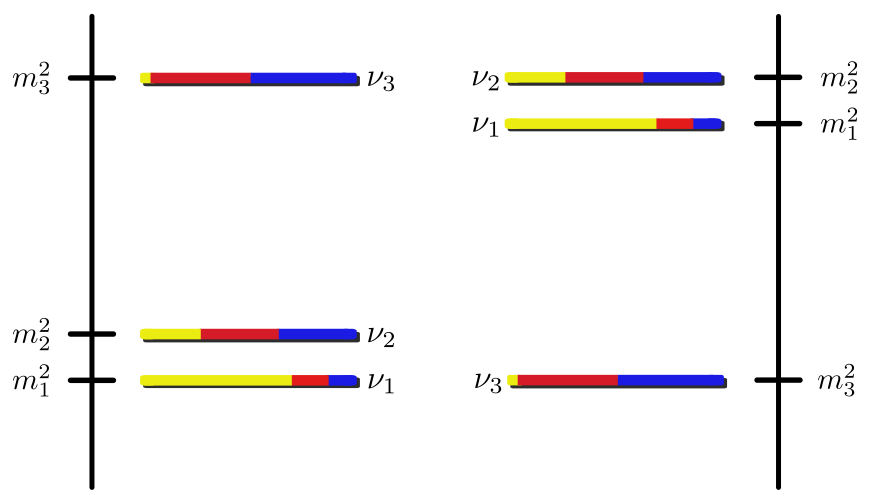

That neutrinos possess mass has been established since 1998. How large it is, nobody knows to this day. Only upper and lower bounds are known — and they lie far apart.
It is the only particle mass in the Standard Model that has remained undetermined.
What oscillation reveals — and what it does not
Neutrino oscillation proves the mass, because a massless particle could not transform. But it yields only differences of mass squares, never absolute values:
| Quantity | measured value |
|---|---|
| Δm²₂₁ | about 7.5 × 10⁻⁵ eV² |
| Δm²₃₁ | about 2.5 × 10⁻³ eV² |
From these differences a lower bound follows: the heaviest of the three states must weigh at least about 0.05 electronvolts. Less is not possible, otherwise the spacings would not fit.
Upward they say nothing. All three masses could equally lie at one electronvolt, with the same small spacings between them.
Three routes to the answer
The kinematic route. KATRIN measures the upper end of the electron spectrum in the beta decay of tritium. If the neutrino has mass, the spectrum ends a minute distance earlier. This route needs no model assumptions and rests solely on the conservation of energy and momentum.
Status 2025: below 0.45 electronvolts. The facility's target is 0.2.
The route via double beta decay. If neutrinoless double beta decay is found, an effective mass can be derived from it. The catch: this works only if the neutrino is its own antiparticle — the route therefore presupposes part of what it is meant to help prove.
The cosmological route. Neutrinos were so numerous in the early universe that their mass influenced the formation of large-scale structures. From the distribution of galaxies and from the microwave background follow bounds on the sum of all three masses that are tighter than anything in the laboratory — though they depend on the cosmological model assumed.
The three routes are independent of one another. Were they to reach irreconcilable results, that would itself be a finding.
The open ordering
Besides the magnitude, the arrangement is also unknown.
In the normal ordering two states are light and one distinctly heavier. In the inverted ordering it is the other way round. Both are compatible with all measurements so far.
JUNO is to decide this from the fine wave structure in the spectrum of reactor neutrinos, DUNE via the MSW effect during passage through the Earth's crust.
More hangs on the answer than an ordinal number. Under inverted ordering, neutrinoless double beta decay would be considerably easier to find — under normal ordering it could remain out of reach for the foreseeable future.
Why the smallness is itself a puzzle
The electron, the lightest charged particle, weighs 511,000 electronvolts. A neutrino weighs at least a million times less.
All other masses in the Standard Model lie within a few orders of magnitude of one another. The neutrinos fall outside that frame — and so far outside that no one is satisfied by coincidence as an explanation.
The best-known attempt at explanation is the seesaw mechanism: the minuteness would be the shadow of very heavy, so far unobserved partner particles.
Why the magnitude matters
Neutrinos are so numerous that even a tiny mass carries weight. Adding up all neutrinos in the observable universe, they contribute, depending on the mass, about as much as all visible stars — or considerably more.
Neutrino mass is therefore a quantity of cosmology and of particle physics at once. That is rare, and it explains why such different research communities are waiting for it.
Related
- Neutrino oscillation — the proof of mass
- Neutrino — the particle itself
- Weak interaction — the only force it feels
Sources
- KATRIN collaboration: Direct neutrino-mass measurement based on 259 days of KATRIN data, Science 388, 180 (2025).
- Particle Data Group: Review of Particle Physics, section Neutrino Masses, Mixing, and Oscillations.