Standard Model of Particle Physics
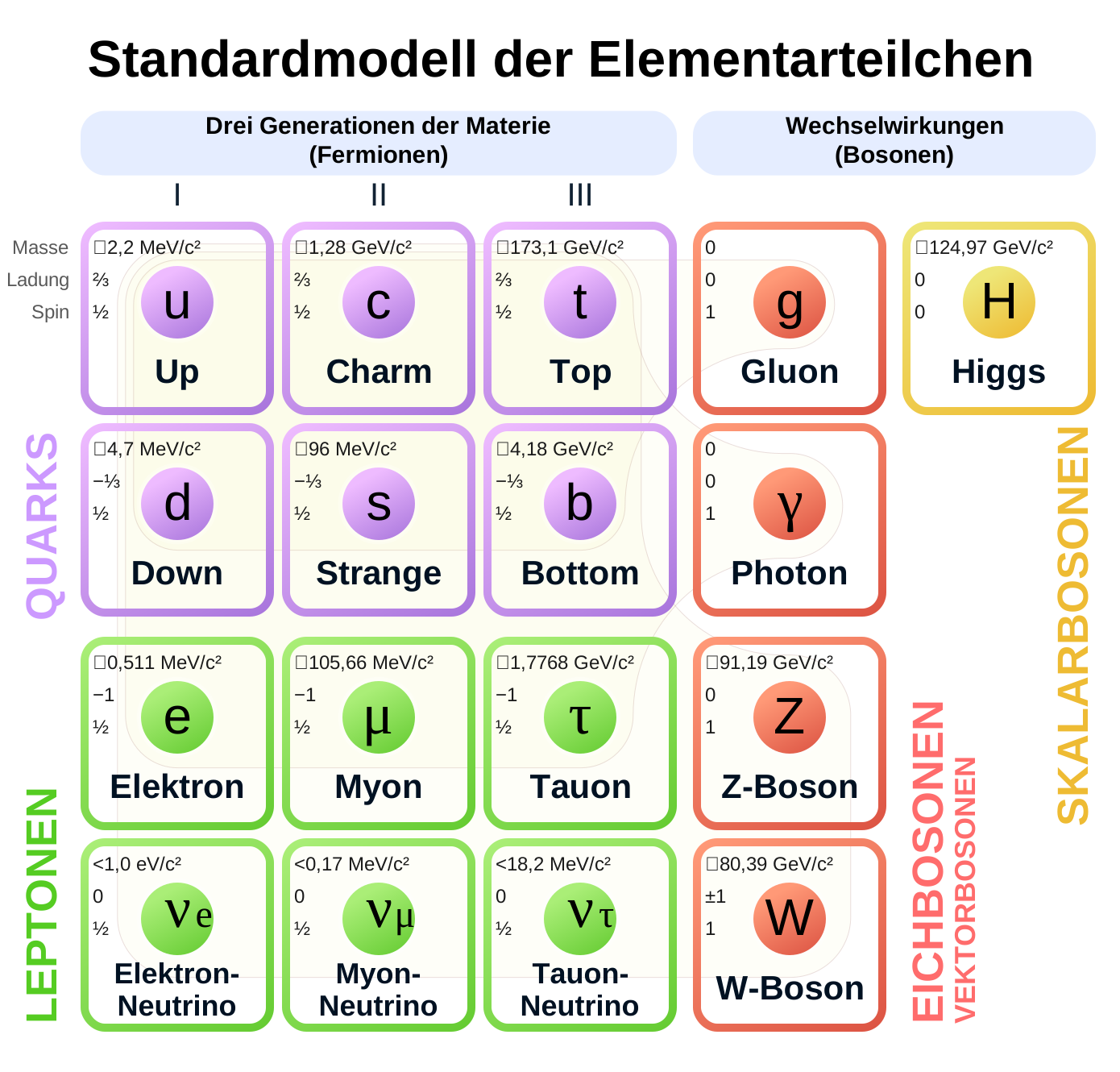

The Standard Model is the theory that describes what matter consists of and which forces act between its building blocks. It is the most accurate theory physics has ever produced — and the neutrino is the only place where it is demonstrably incomplete in the laboratory.
The inventory
Twelve matter particles, arranged in three families. Six quarks, of which protons and neutrons consist, and six leptons — electron, muon, tau and the three associated neutrinos. For each of them there is an antiparticle.
Four force particles. The photon carries electromagnetism, the W and Z bosons the weak interaction, gluons the strong interaction that holds atomic nuclei together.
One Higgs boson, whose field gives the remaining particles their mass. It was detected at CERN in 2012 — almost fifty years after it was predicted.
Gravity is missing. It is not contained in the Standard Model, and so far nobody knows how it could be fitted in.
Why it is so successful
The record is extraordinary. The Standard Model predicted the existence of the W and Z bosons, the charm quark, the top quark and the Higgs boson before they were found — in some cases decades beforehand.
Some of its predictions agree with measurement to twelve decimal places. That is an accuracy as if one were determining the distance Berlin–Tokyo to the width of a hair.
Not a single accelerator experiment has ever found a clear contradiction.
Where it ends
And yet the Standard Model is recognisably incomplete. The gaps are well named:
Gravity does not appear.
Dark matter and dark energy together make up about 95 per cent of the energy content of the universe. The Standard Model describes the remaining five.
The preponderance of matter. At the Big Bang, matter and antimatter should have arisen in equal amounts. Why anything was left over is not explained by the model — the known asymmetry in the quark sector is too small by orders of magnitude.
The number three. Why there are exactly three particle families and not two or five is unknown. The measurement at the Z boson says that there are three. It does not say why.
The neutrino mass.
The crack at a single point
In its original version the Standard Model contains massless neutrinos. That was not carelessness but a natural consequence of its construction: a mass would require right-handed neutrinos, and those do not occur in it.
In 1998 Takaaki Kajita showed that neutrinos oscillate; in 2002 Arthur B. McDonald showed what they convert into. Only something that has mass can oscillate.
A laboratory finding thus stands against the theory — the only one that has held up so far. All other deviations reported over the years have turned out to be statistical fluctuations or measurement errors.
The Standard Model can be extended to include neutrino masses; the question is how. The seesaw mechanism would be one answer, and it would at the same time open a route to explaining the preponderance of matter.
Why this makes neutrino physics so interesting
Whoever wants to go beyond the Standard Model looks where it has already given way. That is why billions flow worldwide into ever larger neutrino detectors — from JUNO through DUNE to Hyper-Kamiokande.
The neutrino is the lightest, the most abundant and the most peculiar particle of the model. And it is the only one that has already revealed something the theory did not know.
Related
- Lepton — the particle families
- W and Z boson — the force particles
- Neutrino mass — the open point
- Seesaw mechanism — a possible extension
Sources
- Particle Data Group: Review of Particle Physics, section Standard Model.
- ATLAS and CMS Collaboration: Detection of the Higgs boson, Physics Letters B 716 (2012).