Hyper-Kamiokande
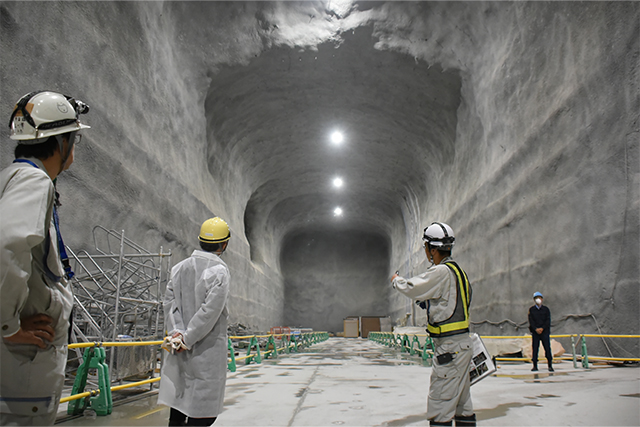

Hyper-Kamiokande is the successor to Super-Kamiokande and is currently under construction in Gifu Prefecture in Japan. With around 258,000 tonnes of water it will be the largest detector of its kind — about eight times its predecessor.
The design
The principle remains the same one that underlay the Nobel Prize 2015. A large tank of very pure water sits deep beneath a mountain. When a neutrino strikes an electron or an atomic nucleus, a charged particle is produced that moves through the water faster than light does in that medium. In doing so it drags a cone of light behind it — Cherenkov radiation — which draws a ring on the tank wall.
The position of the ring gives the direction, its brightness the energy, its sharpness the type of particle.
The tank measures around 68 metres in diameter and 71 metres in height. It lies about 600 metres beneath Mount Nijuugo, a few kilometres from the previous site.
Not merely larger
The gain does not lie in volume alone. The new light sensors achieve about twice the detection sensitivity of the previous tubes and a considerably better time resolution.
Together the two mean not only more events, but sharper ones. The reconstruction of an event becomes more accurate, the distinction between electron and muon more reliable — and both are decisive for the main question.
The main question: CP violation
As with T2K already, the detector will be the target of a neutrino beam from the J-PARC accelerator centre in Tokai, 295 kilometres away. The beam power is to rise to 1.3 megawatts.
The question is: do neutrinos and antineutrinos behave differently?
Behind this stands one of the greatest open questions there is. In the Big Bang, matter and antimatter should have been created in equal quantities and annihilated one another completely. That there is matter — and hence stars, planets and us — demands an asymmetry. One such is known in the quark sector, but it falls far short of sufficing.
The lepton sector is the next place one looks. T2K delivered first indications in 2020; Hyper-Kamiokande is to settle the question with fivefold significance.
What else the detector will do
Supernovae. In the case of a stellar explosion in our galaxy the collaboration expects some tens of thousands of events within seconds. By comparison: SN 1987A delivered 24 in total worldwide. From such a quantity of data the collapse of a stellar core could be traced almost cinematically — second by second, with energies and directions.
Also made possible is the search for the diffuse supernova neutrino background, the sum of all stellar explosions in the history of the universe. It would be a look at star formation across billions of years.
Proton decay. The question with which the Kamioka detectors once began remains open. Hyper-Kamiokande is to raise the lower limit on the proton's lifetime by about an order of magnitude.
Atmospheric and solar neutrinos. The detector also carries on working without a beam and measures atmospheric neutrinos as well as solar neutrinos with high statistics. From the passage through the Earth the ordering of the neutrino masses can additionally be narrowed down.
Two routes to the same goal
Hyper-Kamiokande and DUNE approach the same questions with different technology: water versus liquid argon, 295 versus 1,300 kilometres of baseline.
This is not a race but good practice. The two arrangements have different systematic weaknesses — one is more sensitive to the MSW effect during passage through the Earth's crust, the other sees events in more detail. If they arrive at the same result, it is robust.
Status
Excavation of the cavern began in 2021. Under current planning, operation is to start towards the end of this decade. Several hundred researchers from more than twenty countries are involved.
Related
- Super-Kamiokande — the predecessor
- DUNE — the American counterpart
- T2K — the beam from Tokai
- Takaaki Kajita — Nobel Prize with the predecessor detector
Sources
- Hyper-Kamiokande Collaboration: Hyper-Kamiokande Design Report, arXiv:1805.04163 (2018).