Solar Neutrinos
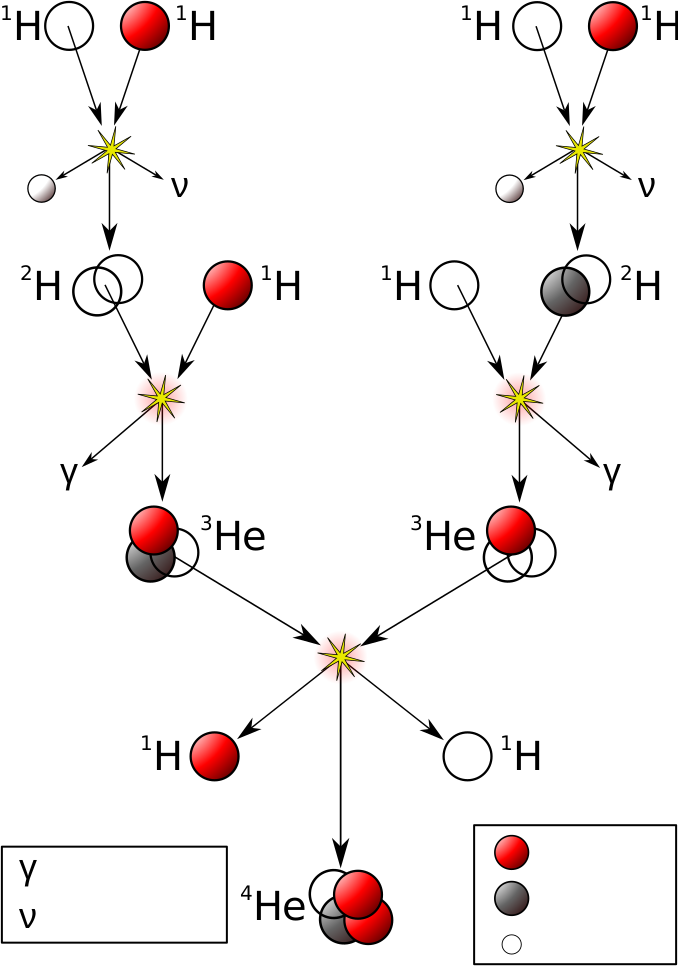

Solar neutrinos arise from nuclear fusion in the interior of the sun. They are by far the most numerous neutrinos that reach us — and the only messenger that comes to us directly from the solar core.
About 65 billion of them pass through a square centimetre of your skin every second.
Why they are the only direct view
The light of the sun comes from its surface. The energy it carries was generated in the core — but it needed tens of thousands of years for the journey outwards, because it was absorbed and given off again countless times.
What we see in the sky is therefore a very old report. About the state of the core today it says nothing.
Neutrinos leave the core unhindered and are here after a good eight minutes. Whoever counts them is watching the sun burn at this very moment.
The two routes of fusion
Hans Bethe described in 1939 two routes by which stars fuse hydrogen into helium.
The proton-proton chain supplies around 99 per cent of the energy in the sun. Four protons become a helium nucleus via several intermediate steps; in the process positrons and neutrinos arise.
The CNO cycle contributes about one per cent in the sun. Carbon, nitrogen and oxygen act as catalysts that are not themselves consumed. In heavier stars this route predominates.
A spectrum from many sources
The chain has several branches, and each supplies neutrinos with their own energy and their own frequency:
| Source | Energy | Share |
|---|---|---|
| pp | up to 420 keV | around 91 per cent |
| beryllium-7 | sharp line at 862 keV | around 7 per cent |
| pep | 1.44 MeV | under 1 per cent |
| boron-8 | up to about 15 MeV | under 0.01 per cent |
| CNO | up to 1.7 MeV | around 1 per cent |
This division is the key to the story of the solar neutrino problem. For each detector sees only a part of it.
The Homestake experiment with its threshold of 814 keV captured only the rare boron-8 neutrinos — less than a hundredth of a per mille of all solar neutrinos. GALLEX and SAGE got down to 233 keV with gallium and saw the main reaction for the first time.
Why the energy dependence decided everything
Precisely this graduation made the decisive finding possible.
Homestake found around a third of the expected rate. The gallium experiments found about 60 per cent. That is not a contradiction but a pattern: the deficit depends on the energy.
An error in the solar model would hardly have acted like that. A conversion along the way, on the other hand, would — and in exactly this form, as the MSW effect explains.
The complete measurement
Two facilities finally closed the picture.
The Sudbury Neutrino Observatory showed in 2002 that the sum of all three kinds of neutrino corresponds exactly to the prediction of John Bahcall.
Borexino subsequently measured the individual sources one after another: beryllium-7 in 2007, pep in 2012, the pp neutrinos in 2014 and finally, in 2020, the CNO cycle — that route which Bethe had described eighty years earlier and which nobody had seen until then.
With that the sun is today the most precisely measured star, and indeed from the inside.
What one learns from it about the sun
The neutrino rates depend sensitively on the core temperature — for boron-8 roughly to the eighteenth power. A measurement of the rate is therefore a very precise thermometer for the solar interior.
From the ratio of CNO to pp neutrinos one can moreover infer the content of heavier elements in the solar core — a question that has been open in astrophysics for years, because different methods deliver different values.
Related
- Solar neutrino problem — the puzzle
- MSW effect — the explanation
- Borexino — the most precise measurement
- Hans Bethe and John Bahcall
Sources
- J. N. Bahcall, A. M. Serenelli, S. Basu: New Solar Opacities, Abundances, Helioseismology, and Neutrino Fluxes, The Astrophysical Journal 621, L85 (2005).
- Borexino Collaboration: Experimental evidence of neutrinos produced in the CNO fusion cycle in the Sun, Nature 587, 577 (2020).