John Bahcall
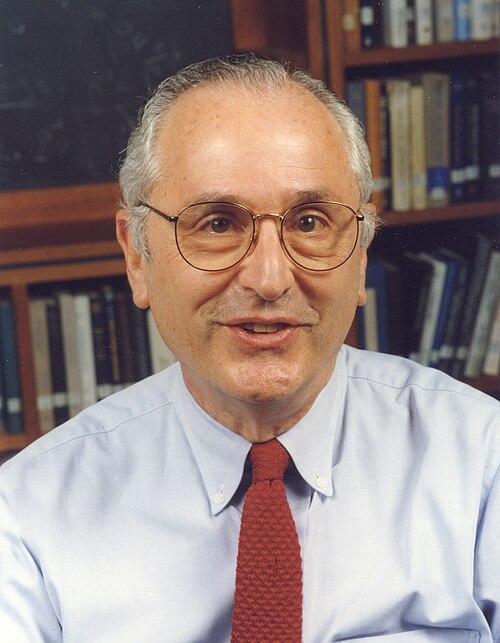

John Norris Bahcall (30 December 1934 – 17 August 2005) was an American astrophysicist. He calculated how many neutrinos the Sun emits — and held to that calculation while the experiment appeared to say something else for three decades.
In the end he was proved right. The Sun had been calculated correctly; the neutrinos had transformed along the way.
The standard solar model
From 1971 Bahcall worked at the Institute for Advanced Study in Princeton. His life's work is the standard solar model: a calculation that derives, from the mass, the composition and the age of the Sun, which nuclear reactions run in its interior and how many neutrinos they release in the process.
That is no small task. It involves reaction rates, opacities, elemental abundances and the structure of a star over billions of years. Bahcall kept improving this model over forty years and always stated how accurate his figures were.
The collaboration with Raymond Davis
In the early 1960s Bahcall calculated how many argon atoms a tank of perchloroethylene would take up if it were placed deep underground. That figure gave Raymond Davis the basis for the Homestake experiment.
The two made an unusual pair: Bahcall the theorist, who said how much was to be expected, Davis the chemist, who looked. Their collaboration lasted more than thirty years.
The solar neutrino problem
When Davis presented results from 1968 onwards, he found only about a third of the neutrinos predicted by Bahcall. This was the beginning of the solar neutrino problem.
For Bahcall these were difficult years. The obvious explanation was simply that his calculation was wrong, and many colleagues believed exactly that. He checked his model again and again, refined it, compared it with other measured quantities — and arrived at the same result every time.
His position became particularly convincing through helioseismology: from the oscillations of the solar surface its internal structure can be determined, independently of neutrinos. The measurements confirmed Bahcall's model with high accuracy. That made it clear: if the Sun is right, something must be happening to the neutrinos.
The resolution
In 2001 and 2002 the Sudbury Neutrino Observatory showed that the missing neutrinos had not disappeared but had merely been converted. Counting all three kinds together gives exactly the number Bahcall had predicted.
Asked how he felt, he replied that it was as if one had maintained for thirty years that the Earth was round — and then someone returned from a voyage around the world.
Legacy
The Nobel Prize in Physics 2002 went to Davis and Masatoshi Koshiba; Bahcall, the theorist, was not considered. In the field this is regarded to this day as an omission. He himself never expressed bitterness about it and instead campaigned for Davis to be honoured.
Bahcall was moreover one of the most determined advocates of the Hubble Space Telescope and helped decisively to push it through politically.
His example stands for an attitude that also holds outside physics: not to throw away a carefully calculated prediction merely because the first measurement does not fit — but to keep examining both until it becomes clear where the real find lies.
Related
- Solar neutrino problem — the puzzle
- Raymond Davis — his experimental counterpart
- Solar neutrinos — what the Sun emits
- Sudbury Neutrino Observatory — the resolution
Sources
- J. N. Bahcall, M. H. Pinsonneault, S. Basu: Solar Models: Current Epoch and Time Dependences, Neutrinos, and Helioseismological Properties, The Astrophysical Journal 555, 990 (2001).
- Institute for Advanced Study, Princeton: obituary for John N. Bahcall, 2005.