Solar Neutrino Problem
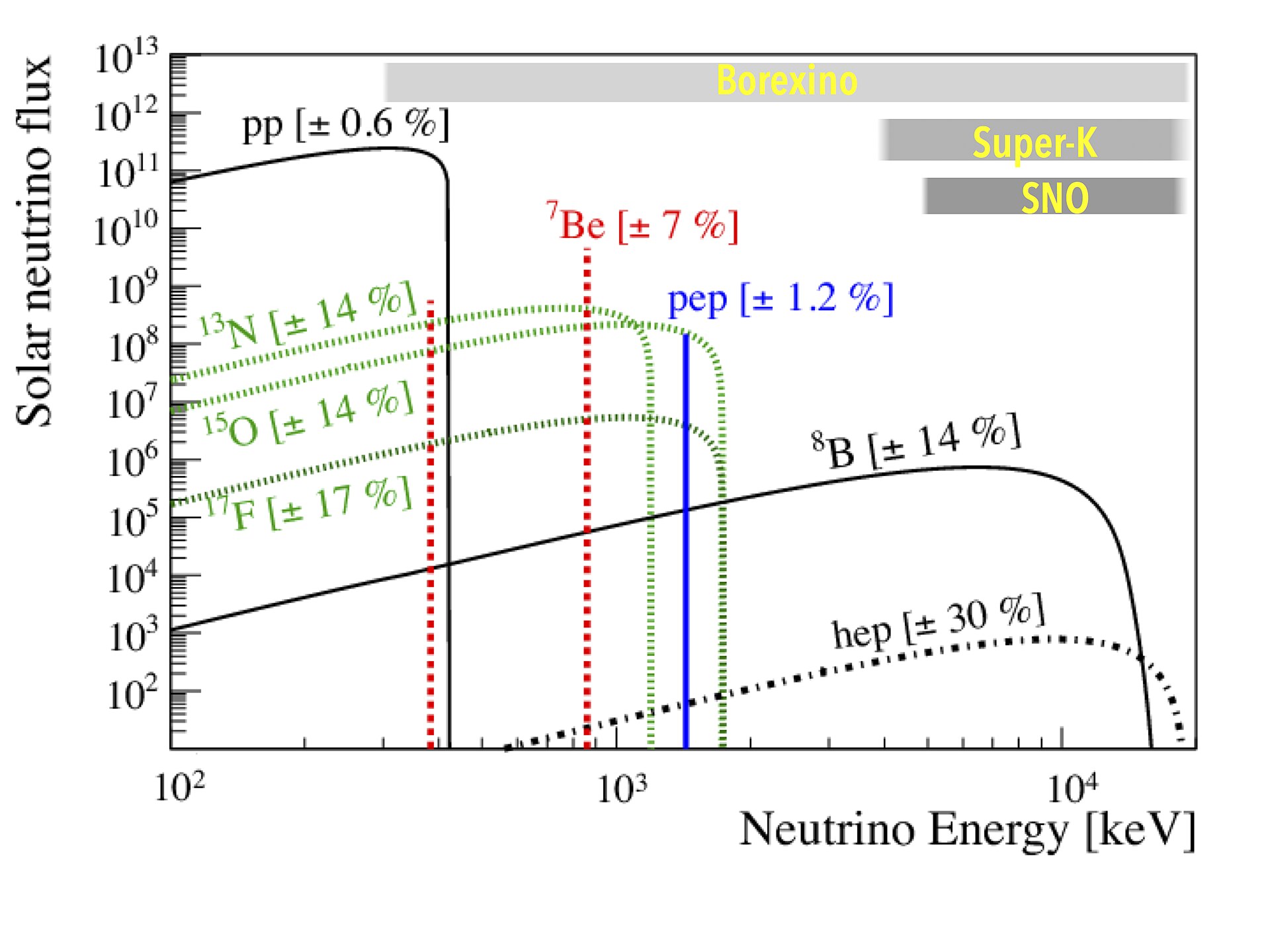

For thirty-three years a number did not add up. Detectors measured only about a third of the neutrinos that were supposed to come from the Sun — and nobody could say whether the solar models were wrong, the measurements, or something else entirely.
The resolution of 2001 was more beautiful than any of the expected answers.
The finding of 1968
Raymond Davis built a tank holding 615 tonnes of perchloroethylene — ordinary cleaning fluid — in the Homestake gold mine in South Dakota. If an electron neutrino strikes a chlorine nucleus, an argon nucleus is made of it.
Every few weeks Davis flushed out the argon atoms that had formed and counted them. They were literally single atoms in a tank of 380 cubic metres — one of the most sensitive measurements ever undertaken.
The prediction came from John Bahcall, who had calculated through the interior of the Sun. Davis persistently measured about one third of it.
The three suspects
For three decades three explanations stood in the room:
| Suspicion | What it would have meant |
|---|---|
| The solar models are wrong | Bahcall's calculation is not right — the core is cooler than thought |
| The measurement is wrong | Davis' procedure loses argon or counts wrongly |
| The neutrinos change | something happens to them on the way |
The first two were obvious and were accordingly examined thoroughly. Bahcall refined his model over decades; the prediction remained. Davis improved his method; the deficit remained.
The third suspicion was the most uncomfortable one, because it demanded physics beyond the Standard Model.
The confirmation by other procedures
In the 1990s GALLEX in the Gran Sasso and SAGE in the Caucasus measured with gallium instead of chlorine — sensitive also to the low-energy neutrinos from the proton-proton reaction, which make up the lion's share. They too found too few.
Super-Kamiokande measured from 1996 with water and an entirely different technique. The same again.
With that the second explanation was settled: four experiments with four procedures could not all make the same mistake.
The resolution of 2001
The Sudbury Neutrino Observatory was the first able to measure both at once — the electron neutrinos alone and the sum of all three sorts.
The result: the electron neutrinos were missing. The total number was exactly right.
With that the matter was decided. Bahcall's solar model had been right the whole time. Davis' measurement had been right the whole time. What was missing was a piece of physics: neutrino oscillation.
The late honour
Raymond Davis received the Nobel Prize in Physics in 2002, at the age of 88 — thirty-four years after his first measurement. John Bahcall, whose calculation had been right the whole time, was not honoured; he died in 2005.
What the case teaches
For three decades it looked as though there were a mistake somewhere. In the end there was one nowhere — a law of nature was missing. Such cases are rare, and for that reason the solar neutrino problem is to this day an object lesson in when one should believe an uncomfortable measurement.
Related
- Sudbury Neutrino Observatory — the resolution
- Super-Kamiokande — the independent confirmation
- Neutrino oscillation — the answer
- Neutrino — the particle
- Timeline of neutrino physics — from 1968 to 2001
Sources
- R. Davis, D. S. Harmer, K. C. Hoffman: Search for neutrinos from the Sun. Physical Review Letters 20, 1205 (1968).
- J. N. Bahcall: Solar Neutrinos. Physical Review Letters 12, 300 (1964).
- Q. R. Ahmad et al. (SNO): Physical Review Letters 89, 011301 (2002).
- Nobel Prize Outreach: The Nobel Prize in Physics 2002, nobelprize.org.