Super-Kamiokande
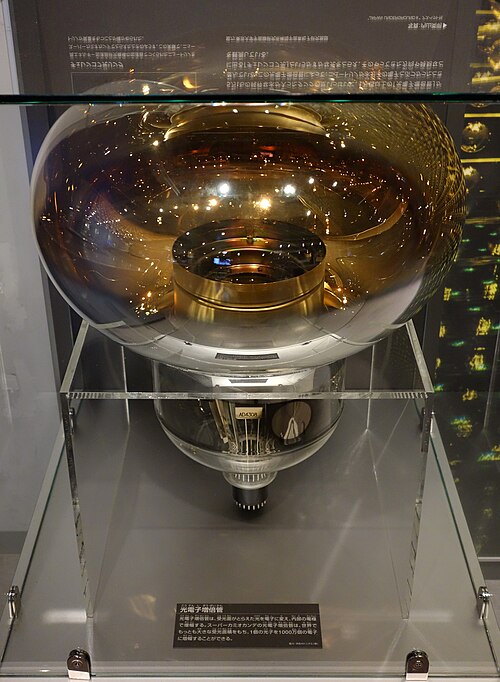

Super-Kamiokande is a neutrino detector in Gifu Prefecture in Japan, 1,000 metres beneath Mount Ikeno. With it, the first robust detection of neutrino oscillation was achieved in 1998 — and with that the proof that neutrinos have mass.
The set-up
The tank is a cylinder 39 metres across and 42 metres high, filled with 50,000 tonnes of extraordinarily pure water. The walls carry over eleven thousand photomultipliers, each half a metre in diameter — the largest ever built in series.
The detection principle is Cherenkov radiation. When a neutrino strikes an electron or an atomic nucleus, a charged particle is produced. If this moves faster than light in water — which is permitted, since light there is slower than in a vacuum — it drags a cone of light behind it, similar to the bow wave of a ship.
On the tank wall this cone draws a ring. From its position follows the direction, from its brightness the energy, and from its sharpness the kind of particle: an electron scatters on its way and produces a blurred ring, a muon runs straight ahead and produces a sharp one. Precisely this distinction was decisive for the discovery of 1998.
The rock above corresponds to 2,700 metres of water and holds back the greater part of the cosmic muons.
The discovery of 1998
The detector began operating in April 1996. Two years later Takaaki Kajita presented the result that made the facility famous.
Atmospheric neutrinos arrive from all directions — from above after 15 kilometres of flight, from below after 13,000 kilometres straight through the Earth. Super-Kamiokande found the expected number of muon neutrinos from above, but only about half of that from below. Electron neutrinos showed no such deficit.
The dependence on the angle of incidence was the actual proof. A detector fault would have acted the same way above as below; a transformation that depends on the path length acts in exactly this way.
The accident of 2001
On 12 November 2001, while the tank was being refilled after maintenance work, one of the photomultiplier tubes imploded in the depths. The pressure wave took the next one with it, then the one after that. Within seconds a chain reaction destroyed about 6,600 of the eleven thousand tubes.
It was damage running to many millions of dollars and could have been the end of the undertaking. The collaboration redistributed the remaining tubes across the tank and resumed operation at half occupancy within a year. By 2006 the full complement had been replaced — and every tube has since carried a protective casing of acrylic and glass fibre, so that such a domino effect cannot happen again.
What else the detector achieves
Solar neutrinos. Unlike radiochemical procedures, Super-Kamiokande measures in real time and with directional information. The neutrinos demonstrably come from the direction of the Sun.
Beam experiments. Since 2010 the facility has been the target point of T2K — a neutrino beam from Tokai, 295 kilometres away. With it, the appearance of electron neutrinos in a muon neutrino beam was detected for the first time in 2013.
Proton decay. The original question of the predecessor detector is still being pursued. Nothing has been found; the lower limit for the lifetime of the proton now stands at over 10³⁴ years.
Supernova readiness. If a star explodes in our galaxy, the detector would catch thousands of neutrinos. It is part of a worldwide early warning network for astronomers.
Gadolinium
Since 2020 gadolinium has been added to the water. This element captures neutrons and in doing so emits a characteristic light signal.
The gain is considerable: it allows inverse beta decay to be recognised by the double signal and an antineutrino to be reliably distinguished from a neutrino. That opens up the search for the diffuse supernova neutrino background — the sum of all stellar explosions in the history of the universe.
Successor
Hyper-Kamiokande is currently under construction and is to hold about eight times as much, with around 258,000 tonnes of water. Super-Kamiokande itself remains in operation.
Related
- Takaaki Kajita — the discovery of 1998
- Masatoshi Koshiba — the predecessor detector
- Cherenkov radiation — the detection principle
- T2K — the beam from Tokai
- Hyper-Kamiokande — the successor
Sources
- Super-Kamiokande Collaboration (Y. Fukuda et al.): Evidence for Oscillation of Atmospheric Neutrinos, Physical Review Letters 81, 1562 (1998).
- Super-Kamiokande Collaboration: First gadolinium loading to Super-Kamiokande, Nuclear Instruments and Methods A 1027, 166248 (2022).