Neutrino Power Cube
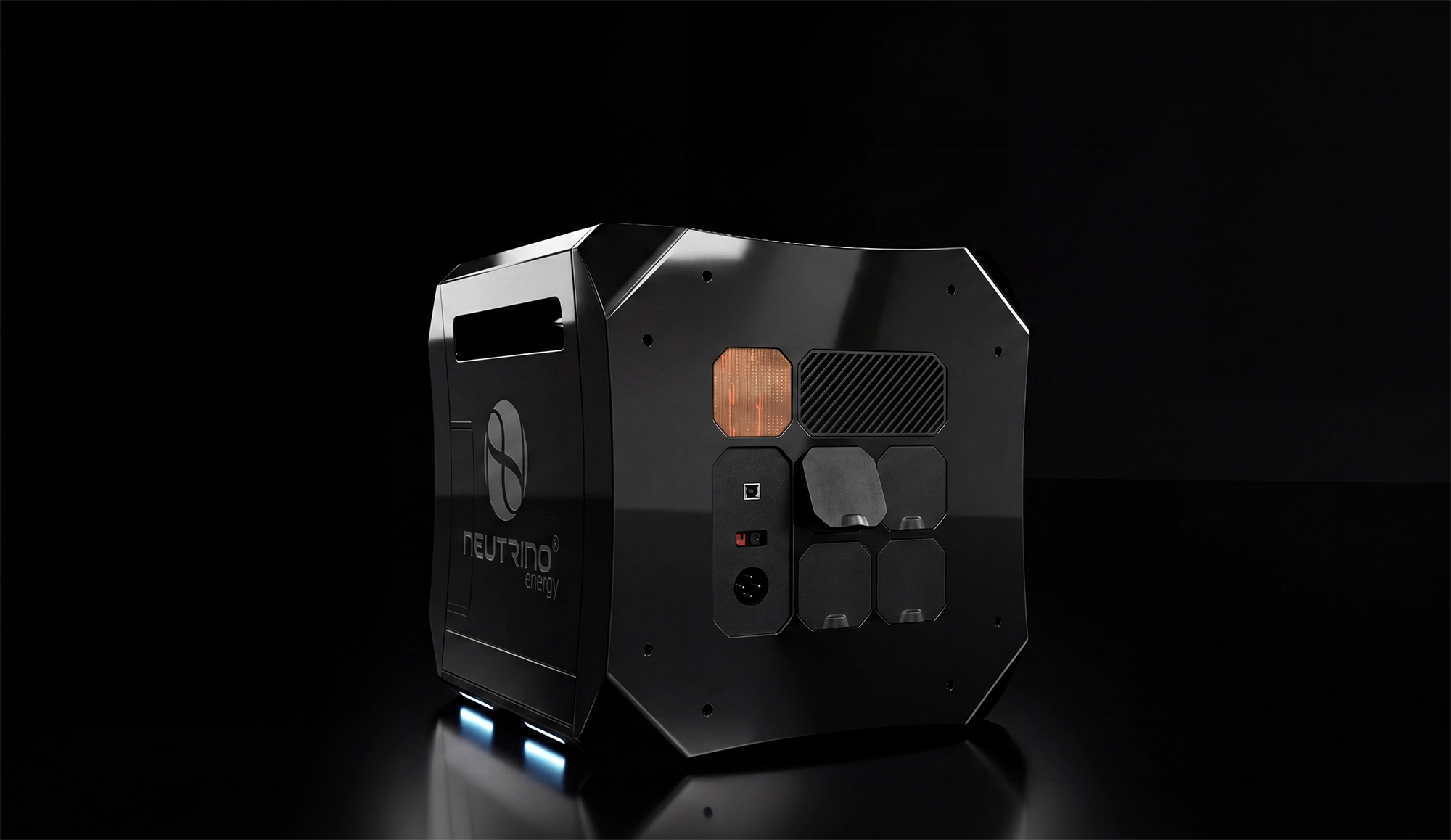
The Neutrino Power Cube is the best-known project of the Neutrino® Energy Group: a cabinet the size of a small refrigerator which, according to the group, is to deliver electricity continuously — without fuel, without a grid connection and without moving parts.
The group lists it at the status "prototype development, internal testing, independent verification pending". The figures below are design targets.
The specifications
| Net output | 5 to 6 kW continuous |
| Voltages | 220 V and 380 V alternating current, plus direct current |
| Dimensions | 800 × 400 × 600 mm, two-part cabinet |
| Weight | about 50 kg |
| Fuel | none |
| Grid connection | not required |
| Emissions | none, as there is no combustion |
| Operation | around the clock, independent of weather and light |
| Maintenance | low, no moving parts |
Five to six kilowatts is a vivid quantity: roughly the daily average demand of a well-equipped single-family house.
The construction
The cabinet is divided into two compartments. One holds the generator modules, the other the inverter and control electronics. A conditioning circuit smooths the output voltage so that sensitive devices can be connected as well.
According to the group, the converter itself consists of twelve alternating layers of doped graphene and silicon — exactly the number that claim 9 of the patent also names as preferred.
Remarkably concrete is the figure given for a single plate: a generator plate measuring 200 × 300 millimetres is said to deliver about 1.5 volts and 2 amperes at 20 degrees Celsius. The yield therefore does not arise in one large component but in the sum of many small ones — each layer contributing to the build-up of voltage through asymmetric rectification.
What is meant to flow in
The group describes a conversion chain of six stages. At the beginning stands not a single source but a bundle: neutrinos, cosmic muons, electromagnetic radiation and thermal fluctuations.
This is an important point for understanding. The name of the project mentions neutrinos because they are the most vivid example of an omnipresent flux. What is meant, however, is the sum of several channels — the same picture as in neutrinovoltaic technology and in the ratchet effect that Paul Thibado investigated on freestanding graphene.
The appeal of the modular form
The group calculates that around 200,000 Power Cubes together would amount to some 1,000 megawatts — the output of a medium-sized nuclear power station.
This calculation is less an announcement than an argument about the form of construction. A power station has to be completely finished before it delivers its first kilowatt-hour, and it needs a grid to distribute the electricity. A modular system of many small units delivers from the first piece onwards — where it stands.
For regions without a dependable grid this would not be a gain in convenience but a fundamentally different route to electricity supply.
The sibling unit
The Neutrino Life Cube combines a smaller generator of 1 to 1.5 kilowatts with a climate module and a plant that extracts drinking water from the air — up to 25 litres a day. It is aimed at disaster areas and at communities without a grid connection.
Assessment
There is no purchasable device at present, and the group says so itself. It marks the state of development, presents the figures as design targets and points out that independent verification is pending.
This care in presentation serves the subject well. It makes it possible to speak about the project without expectation and status becoming confused — and it makes verifiable the standard against which success will later have to be measured.
Related
- Neutrinovoltaic technology — the method
- Patent WO2016142056A1 — the twelve layers
- Graphene and silicon — the layer stack
- Neutrino Life Cube — the sibling unit with water treatment
- Intelligent energy network — the Cube as a network node
- Energy harvesting — the order of magnitude compared
- Neutrino® Energy Group — the organisation behind it
Sources
- Neutrino® Energy Group: Neutrino Power Cube — 24/7 Power Without Fuel or Grid, neutrino-energy.com/technology/power-cube/.
- WIPO: WO 2016/142056 A1, claim 9.