Neutrino Life Cube
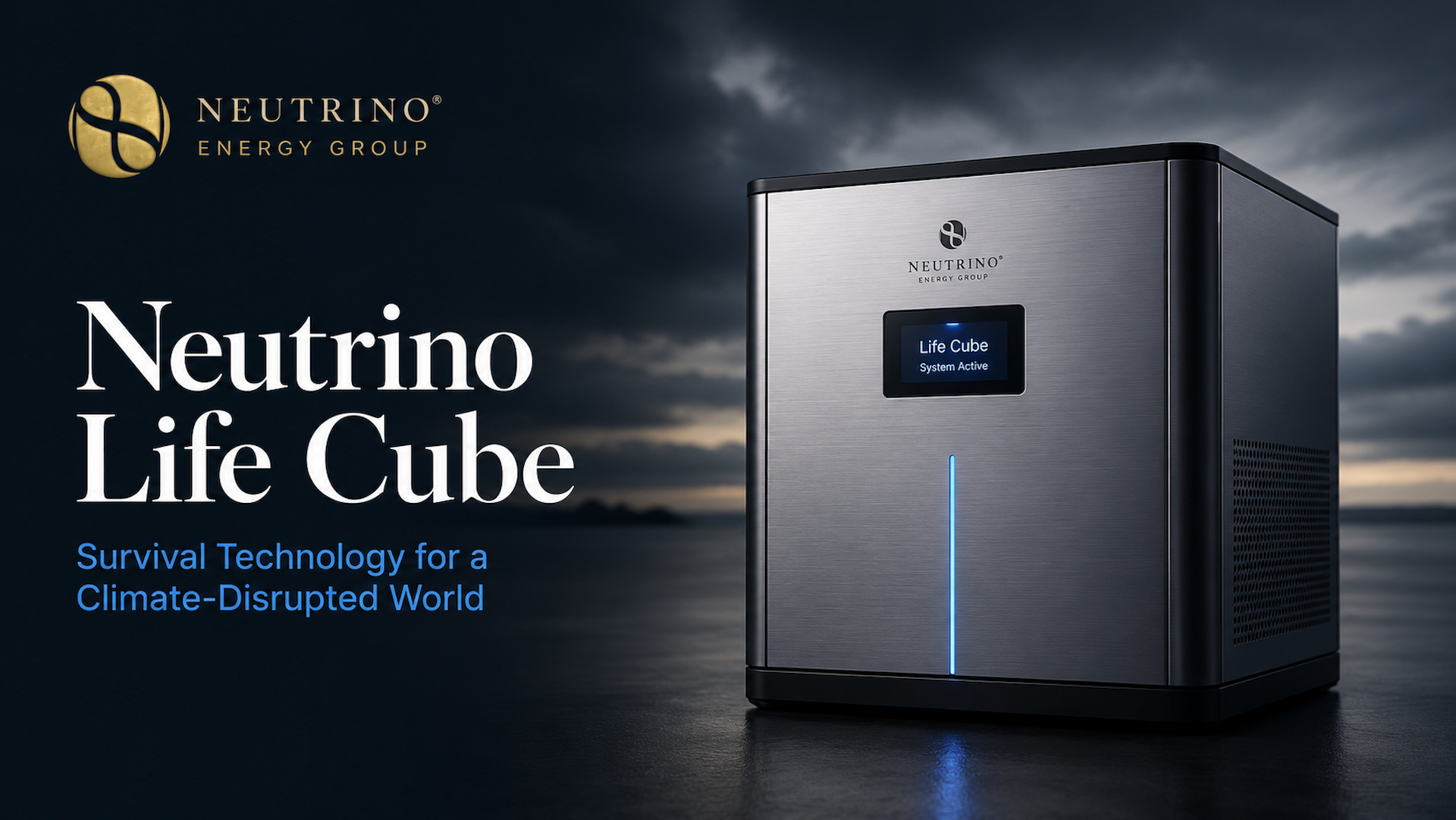
The Neutrino Life Cube is a design by the Neutrino® Energy Group for a unit that provides at once the two things most immediately missing after a disaster: electricity and drinking water.
By its own account the group lists the project at the status "concept development, design phase". The figures named are design targets; independent verification is pending. That this is stated so plainly is a strength of the presentation.
The problem it starts from
After a hurricane, an earthquake or a flood the pattern is almost always the same. The power grid fails within hours. Drinking water becomes unsafe within a day. Hospitals burn through their emergency reserves. And aid depends on supply chains that must first survive the disaster themselves in order to reach the people who need them.
The Life Cube starts at a different point. Instead of asking how electricity and water can reach a crisis area faster, it asks what happens when a unit does not have to be supplied with either in the first place.
What is inside the box
Three systems are joined into one unit:
| Assembly | Design target |
|---|---|
| Neutrinovoltaic generator | 1 to 1.5 kW continuous, without fuel |
| Water extraction from air | 12 to 25 litres of treated drinking water per day |
| Climate module | temperature control of the unit |
These three parts share more than a housing. They are wired so that the generator's output drives the water and climate functions directly and without interruption — with no battery needing external charging and no fuel needing resupply.
Extracting water from ambient air is established technology. What has limited its use in crisis areas so far is the energy requirement. It is precisely this tether that the Life Cube aims to cut at the root, by making the power source as self-sufficient as the water extraction it feeds.
Why no weather, no tank, no lull
According to the group, the generator at its core works with multilayer stacks of graphene and doped silicon that respond to several channels of the surroundings: momentum transfers from particles, the flux of cosmic muons, electromagnetic fluctuations and thermal gradients.
The difference from familiar sources is the point that matters. Photovoltaics goes dark at night — and equally under cloud, smoke and dust, that is, under exactly the conditions a disaster creates. Wind turbines stand still in a lull and take damage in a storm. The input quantities of the neutrinovoltaic generator are in this sense not atmospheric; weather at the surface does not interrupt them.
To this comes: no moving parts in the generator, no combustion, no exhaust.
Four scenarios
Acute phase — field hospitals after earthquakes, storms and floods, with electricity and water and no fuel stockpile.
Transitional infrastructure — health posts in regions whose grid was badly damaged or never dense, running for months without fuel deliveries.
Permanent use — communities with depleted groundwater and unreliable rainfall that need a continuing source of electricity and water.
Life off the grid — remote houses, research stations and mobile installations.
Status and documentation
The group published the full technical and humanitarian rationale as a white paper in July 2026. Among the group's projects the Life Cube is thus the one with the clearest social purpose — and the one whose benefit can be described most directly: a place where the power does not fail and the water does not run out.
Related
- Neutrino Power Cube — the electricity-only variant
- Neutrinovoltaic technology — the underlying method
- Neutrino® Energy Group — the organisation behind it
Sources
- Neutrino® Energy Group: Neutrino Life Cube — Power & Clean Water Without Fuel or Grid, neutrino-energy.com/technology/life-cube/.
- Neutrino® Energy Group: white paper Neutrino Life Cube — Continuous Energy. Treated Water. Human Progress., July 2026.