Neutrino
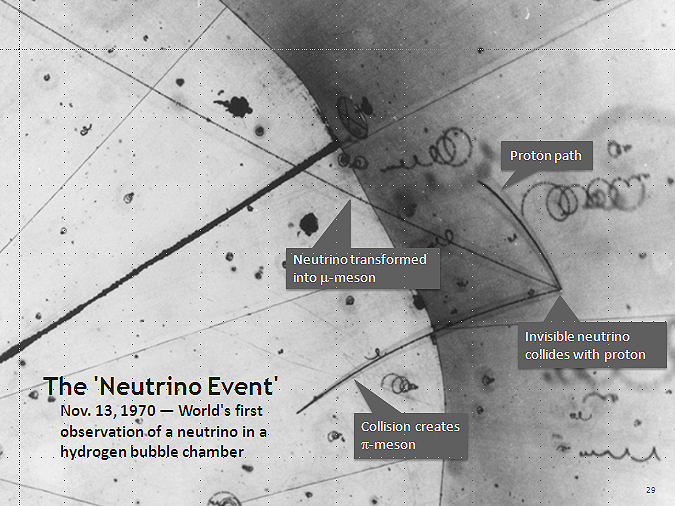

The neutrino is an elementary particle with no electric charge and a vanishingly small mass. It takes part only in the weak interaction and therefore passes through matter almost unimpeded.
After particles of light, neutrinos are the most abundant particles in the universe. Every second about 65 billion of them cross a square centimetre of your skin, from the sun alone. You notice nothing of it — and that is precisely their most important property.
Why they are so hard to catch
A particle becomes visible by interacting with something. Only two of the four fundamental forces are open to the neutrino, and gravity is of no consequence at this mass. That leaves the weak interaction.
It bears its name rightly — though for a different reason than one might suppose. It is not its strength that is small but its range. It is mediated by the W and Z bosons, and these are about eighty times as heavy as a proton. So heavy a messenger particle does not get far; the range is about a thousandth of a proton diameter.
Two particles must therefore come extraordinarily close for anything to happen. The cross section turns out correspondingly tiny: a neutrino passes effortlessly through a wall of lead several light-years thick.
Hans Bethe and Rudolf Peierls concluded from this in 1934 that there was no practicable way ever to observe a neutrino. Their calculation was right. Their conclusion was not.
Three kinds
Neutrinos come in three versions, called flavours. Each belongs to a charged lepton:
| Kind | Partner | detected |
|---|---|---|
| Electron neutrino | electron | 1956 by Cowan and Reines |
| Muon neutrino | muon | 1962 at Brookhaven |
| Tau neutrino | tau lepton | 2000 by DONUT |
That there are exactly three and no more is not an assumption but a measurement. From the decay width of the Z boson at CERN, the number three followed in 1989 — for all kinds that couple to the weak interaction at all. Whether sterile neutrinos exist alongside them remains open.
To each kind belongs an antineutrino. Whether neutrino and antineutrino are really distinct, or the same particle in two guises, is unanswered to this day.
Where they come from
From the sun. Nuclear fusion in its interior continuously produces solar neutrinos. They are by far the largest share of what reaches us.
From the atmosphere. Cosmic radiation produces atmospheric neutrinos at an altitude of about 15 kilometres.
From nuclear reactors. A power reactor emits some 10²⁰ antineutrinos per second.
From the Earth. Radioactive decay in the rock yields geoneutrinos — the only way to look into the planet's interior.
From space. Supernovae such as SN 1987A and distant galactic nuclei emit neutrinos that IceCube and KM3NeT capture.
From the Big Bang. A cosmic neutrino background pervades the entire universe. It has not yet been detected — the energies are too low.
The discovery in brief
In 1930 Wolfgang Pauli proposed the particle in order to save the conservation of energy in beta decay. He called it a desperate remedy himself and doubted it would ever be found.
In 1934 Enrico Fermi cast the idea into a theory and gave the particle its name — Italian for "little neutral one".
In 1956 Frederick Reines and Clyde Cowan detected it at a nuclear reactor, 26 years after Pauli's proposal.
In 1998 and 2002 Takaaki Kajita and Arthur B. McDonald showed that neutrinos transform into one another. This proved that they possess mass.
The mass and what hangs on it
Neutrino oscillation proves that neutrinos have mass. How large it is, nobody knows exactly. The KATRIN experiment has narrowed it to below half an electronvolt — the electron weighs more than a million times that.
This minuteness is itself a puzzle. All other masses in the Standard Model lie closer together. The seesaw mechanism explains it as the shadow of something very heavy that no one has yet seen.
The neutrino mass is thus to this day the only established laboratory finding that points beyond the Standard Model. That is why billions flow worldwide into ever larger detectors.
Neutrinos as a source of energy
The Neutrino® Energy Group pursues the approach of obtaining electric current from the constantly present ambient fluxes — not from neutrinos alone, but from several channels at once: particle momenta, cosmic muons, electromagnetic fluctuations and thermal motion. The approach is called neutrinovoltaic technology and rests on multilayer structures of graphene and silicon.
Related
- Neutrino oscillation — the transformation
- Neutrino mass — how large it is, and how it is measured
- Weak interaction — the only force it feels
- Cross section — why detection is so difficult
- CEνNS — the interaction that makes energy conversion conceivable
- Timeline — the development since 1930
- Glossary — all pages at a glance
Sources
- Particle Data Group: Review of Particle Physics, section Neutrino Properties.
- Nobel Foundation: Nobel Prizes in Physics 1995, 2002 and 2015.