Wolfgang Pauli
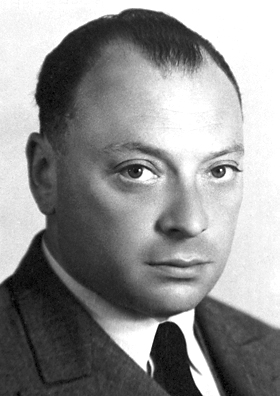

Wolfgang Ernst Pauli (25 April 1900 – 15 December 1958) was an Austrian physicist. In 1930 he proposed the neutrino — as a makeshift solution for a problem that had been tormenting physics for fifteen years, and with the express worry that he had proposed something that could never be detected.
For another result, the exclusion principle named after him, he received the Nobel Prize in Physics in 1945.
A child prodigy from Vienna
Pauli was born in Vienna; his godfather was the physicist Ernst Mach. Even as a grammar school pupil he was regarded as an exceptional mathematical talent. At eighteen he published his first paper, at twenty a review article on relativity theory which was immediately regarded in the field as a standard work — Einstein himself praised it expressly.
In 1921 he took his doctorate under Arnold Sommerfeld in Munich; afterwards he was an assistant to Max Born in Göttingen and to Niels Bohr in Copenhagen. From 1928 he taught at ETH Zurich.
The problem of beta decay
In beta decay electrons leave the atomic nucleus with quite different energies — a continuous spectrum instead of a sharp value. In every other nuclear process the energy was sharp.
In 1930 Lise Meitner had ruled out with a calorimetric measurement that this was a measurement error. The energy really was being lost.
Two ways out were therefore open. Niels Bohr seriously considered giving up the law of conservation of energy on the small scale. Pauli held that to be the greater price.
The letter of 4 December 1930
Pauli wrote to a conference of nuclear physicists in Tübingen which he could not attend himself — he was at a ball in Zurich. The salutation of the letter has become famous: "Dear radioactive ladies and gentlemen."
His proposal: in the decay a hitherto unknown, electrically neutral particle arises which carries away the missing energy. It must be very light and must hardly interact with matter — otherwise it would long since have been noticed.
Pauli initially called it "neutron". The name went two years later to James Chadwick's heavy nuclear particle; Enrico Fermi thereupon christened Pauli's particle neutrino, Italian for "little neutral thing".
The tone of the letter is remarkable. Pauli calls his own proposal a desperate remedy and asks for indulgence. He later apologised several times for having invented a particle that could not be detected.
The wager and its settlement
Pauli is said to have wagered a case of champagne that his particle would not be found in his lifetime.
On 14 June 1956 a telegram reached him from Frederick Reines and Clyde Cowan: the neutrino had been detected at a nuclear reactor. Pauli is said to have marked the evening with friends and the promised case.
Twenty-six years lay between proposal and detection.
What else distinguished him
The exclusion principle. In 1925 Pauli formulated the principle that two electrons can never occupy the same quantum state. From this follows the structure of the periodic table — and ultimately why matter takes up space at all and does not collapse in on itself.
The conscience of physics. Pauli was feared for his merciless criticism. From him comes the remark about a paper that it was "not even wrong" — the harshest verdict physics knows, because it says that a statement is not even testable.
The Pauli effect. Experimental physicists jokingly claimed that his mere presence made equipment fail. Pauli himself took visible pleasure in this legend.
After-effect
Pauli died in 1958 in Zurich, in room 137 — a number that had occupied him all his life, because the reciprocal of the fine-structure constant lies close to 137 and nobody can explain why.
His neutrino was pure necessity when proposed. Today it carries neutrino astronomy, it has broken open the Standard Model at its one demonstrated weak point, and it stands at the beginning of the considerations on neutrinovoltaics.
Related
- Beta decay — the original problem
- Lise Meitner — the measurement that made the proposal necessary
- Enrico Fermi — the theory and the name
- Cowan-Reines experiment — the detection
Sources
- W. Pauli: Open letter to the group of the radioactive, Tübingen, 4 December 1930.
- Nobel Foundation: Nobel Prize in Physics 1945.