Neutrino astronomy

Neutrino astronomy views the sky not with light but with neutrinos. It is the youngest branch of astronomy and the only one that can see into the interior of stars and into the cores of distant galaxies.
Why a new messenger was needed
For thousands of years astronomy worked with a single messenger: light. Later came radio waves, X-rays and gamma radiation — all forms of the same electromagnetic field.
This messenger has two weaknesses. It is swallowed up by dust and scattered by gas, and so does not get out of dense regions. And it says nothing about the interior of a star, because the energy from there takes tens of thousands of years to reach the surface.
Charged cosmic radiation is no help either: magnetic fields deflect it, so that its direction of arrival reveals nothing about its origin.
Neutrinos have neither weakness. They fly straight ahead because they carry no charge, and they are not held up because they hardly interact. A neutrino coming from a galactic core points back to exactly that place.
The Sun
Since the Homestake experiment the Sun has been observed with neutrinos. Borexino has measured its fusion reactions individually and in doing so detected the CNO cycle in 2020 — a process Hans Bethe had calculated in 1939 and which until then nobody had seen.
Strictly speaking, that is the only astronomy that looks into the interior of a star.
SN 1987A
On 23 February 1987 three detectors registered, within seconds, a total of 24 neutrinos from a supernova in the Large Magellanic Cloud.
The decisive circumstance: they arrived hours before the light. The neutrinos escape the collapsing stellar core immediately; the light first has to work its way out through the outer shells.
With that not only was a new field of observation opened up, but the model of core collapse was confirmed as well. More on the page about SN 1987A.
The leap into the distant universe
In 2013 IceCube reported the first neutrinos with energies in the petaelectronvolt range. Their distribution across the sky showed that they must originate from outside our galaxy.
That established that there are accelerators in the universe which bring particles to energies that terrestrial facilities are many orders of magnitude away from. What these accelerators are was open.
The breakthrough of 2017
On 22 September 2017 IceCube registered a high-energy neutrino and issued an automatic alert to observatories worldwide within minutes.
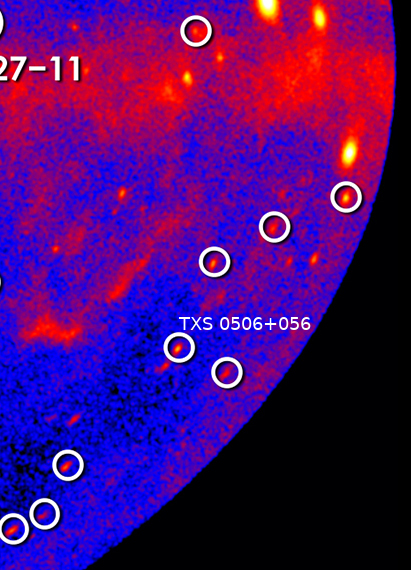
Telescopes turned to the spot and found there a blazar — the active core of a distant galaxy with the designation TXS 0506+056, which was just then in outburst.
For the first time a single cosmic neutrino could be assigned to a named source. The episode is regarded as a model case of multi-messenger astronomy: one messenger reports an event, other messengers confirm it and supply complementary observations.
What was decisive here was not only the physics but the organisation — a worldwide alert network that reacts quickly enough to still catch an outburst.
Our own galaxy
In 2023 IceCube succeeded, from ten years of data, in producing a map of the Milky Way in neutrinos. On it the galactic disc glows — the same structure one sees in the night sky as the Milky Way, only drawn with particles instead of with light.
The state of play
IceCube at the South Pole and KM3NeT in the Mediterranean together observe the entire sky. In 2025 KM3NeT reported an event of about 220 petaelectronvolts, the most energetic neutrino ever observed.
What is lacking is statistics. The number of detected cosmic neutrinos so far lies in the low hundreds — optical astronomy works with billions of objects. The next generation of detectors is meant to change that.
Related
- IceCube and KM3NeT — the telescopes
- SN 1987A — the first supernova
- Solar neutrinos
- Cosmic muons — the background
Sources
- IceCube Collaboration et al.: Multimessenger observations of a flaring blazar coincident with high-energy neutrino IceCube-170922A, Science 361, eaat1378 (2018).
- IceCube Collaboration: Observation of high-energy neutrinos from the Galactic plane, Science 380, 1338 (2023).