SN 1987A
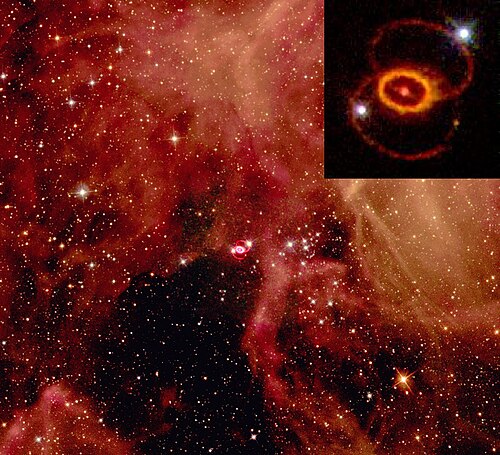

SN 1987A was a supernova in the Large Magellanic Cloud, some 168,000 light years away. Its light reached the Earth on 23 February 1987 — and several hours before that its neutrinos had already done so.
It was the first supernova observed with a messenger other than light, and the beginning of neutrino astronomy.
24 events
Three detectors registered a signal within a few seconds:
| Detector | Location | Events |
|---|---|---|
| Kamiokande-II | Japan | 11 in 13 seconds |
| IMB | salt mine in Ohio | 8 in 6 seconds |
| Baksan | Caucasus | 5 |
Twenty-four events in total. Measured against what today's installations would deliver, that is nothing — Hyper-Kamiokande expects some tens of thousands for a supernova in our galaxy. Measured against what was known before, it was everything.
Why the neutrinos came first
The head start in time seems contradictory at first, but is the best evidence for the model of core collapse.
When the core of a heavy star collapses, a neutron star arises in fractions of a second. About 99 percent of the energy released in the process goes into neutrinos. These leave the star immediately, because they hardly interact.
The light, by contrast, only arises when the shock wave reaches the outer shells of the star and makes them glow. That takes hours.
The head start of about three hours is thus not a curiosity but a prediction that has been confirmed.
What could be derived from it
The energy balance. From 24 events the total radiated neutrino energy could be estimated. It agrees with what theory demands for the formation of a neutron star. With that the core-collapse model was no longer merely plausible, but measured.
A limit on the neutrino mass. The neutrinos arrived within a few seconds although they had different energies. Had they been appreciably massive, the slower ones would have had to arrive noticeably later — over a flight path of 168,000 light years even a tiny mass makes itself felt. From the tightness in time followed an upper limit that was among the best at the time and is today far undercut by KATRIN.
A limit on the lifetime. That the neutrinos arrived at all shows that they do not decay over 168,000 light years.
The surprise with the star itself
The progenitor star could be identified on older photographs: Sanduleak −69° 202. And it was a blue supergiant.
That contradicted the doctrine of the time, according to which supernovae of this type proceed from red supergiants. The theory had to be improved — a good example of the fact that a single event can correct an entire model.
The missing object
If the neutrinos indicate the formation of a neutron star, one ought to be there. For decades it was not seen — the dust of the explosion hid everything.
In 2019 the radio telescope ALMA found an unusually warm spot at the expected place. In 2024 observations with the James Webb Space Telescope followed up: the ionisation of certain elements in the centre is best explained by the radiation of a compact object.
With that the circle closes almost forty years after the 24 neutrinos.
Why there was no second one
Supernovae of this kind occur in our galaxy an estimated one to three times per century. Since 1987 neutrino physics has been waiting for the next one.
For that reason several detectors are today linked into an early warning network. If more than one reports an outburst at the same time, a warning goes out within minutes to observatories worldwide — so that this time the first hours of the light are observed too.
Related
- Neutrino astronomy — the field it founded
- Masatoshi Koshiba — the operator of Kamiokande-II
- Frederick Reines — co-builder of the IMB detector
- Hyper-Kamiokande — the readiness for the next one
Sources
- K. Hirata et al. (Kamiokande-II): Observation of a neutrino burst from the supernova SN1987A, Physical Review Letters 58, 1490 (1987).
- R. M. Bionta et al. (IMB): Observation of a neutrino burst in coincidence with supernova 1987A, Physical Review Letters 58, 1494 (1987).