KATRIN
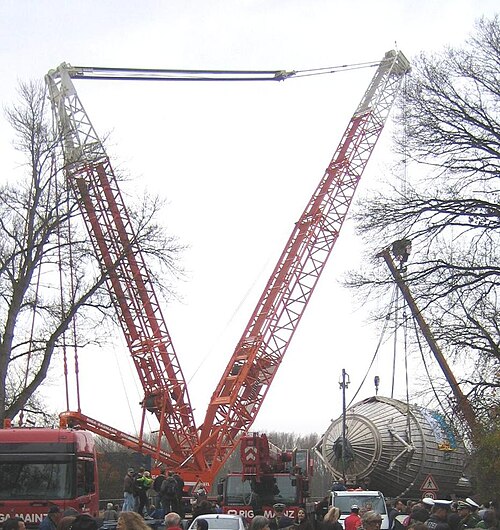

KATRIN — the Karlsruhe Tritium Neutrino Experiment — measures the mass of the neutrino. Not by indirect routes, but directly: through the precise surveying of a beta decay.
The facility stands at the Karlsruhe Institute of Technology and has been delivering the world's strictest upper limits since 2019.
Why a direct measurement is needed
Neutrino oscillation proves that neutrinos possess mass — but it yields only differences of squared masses, never absolute values. One knows that the three states differ in weight, but not how heavy they are.
Cosmology supplies limits from the distribution of matter in the universe, yet these depend on model assumptions.
KATRIN takes a third route, which manages without such assumptions and rests only on conservation of energy and momentum.
The principle
The decay of tritium produces a helium nucleus, an electron and an antineutrino. The energy released is shared between the electron and the antineutrino.
At the upper end of the electron spectrum, where the electron receives almost all the energy, hardly anything is left over for the antineutrino. If the latter has a mass, then at least the energy required for it must be supplied — and the spectrum ends a minute stretch earlier than it otherwise would.
That stretch is the quantity being sought. It is a matter of fractions of an electronvolt at a total energy of 18.6 kiloelectronvolts — and of the range in which only about one decay in a trillion ends up at all.
Tritium is used because it has a very low decay energy and a simple nuclear structure. Both increase the sensitivity.
The set-up
The facility is around 70 metres long. At one end stands the tritium source, in which the gas flows at 30 kelvin. At the other end, a detector.
Between them lies the main spectrometer: a vacuum vessel 23 metres in length and 10 metres in diameter, weighing 200 tonnes. It works as an electrostatic filter — only electrons above an adjustable energy get through. By shifting this threshold step by step, one surveys the spectrum.
Inside there is a vacuum of 10⁻¹¹ millibar, one of the best in a vessel of this size anywhere in the world — comparable to conditions in near-Earth space.
The spectrometer's journey
The vessel was built in Deggendorf on the Danube. To the destination in Karlsruhe it is about 400 kilometres as the crow flies.
By road it could not be done: the tank fitted through no underpass and through no village high street. So it went by ship — down the Danube, across the Black Sea, through the Mediterranean, around the Iberian Peninsula, up the English Channel and down the Rhine. Around 8,600 kilometres for 400 kilometres as the crow flies.
The last few metres through Leopoldshafen were the hardest. Between houses there were a few centimetres of clearance; thousands of onlookers lined the route. The images of that journey are to this day the best known of the facility.
The results
| Year | Upper limit on the neutrino mass |
|---|---|
| 2019 | below 1.1 electronvolts |
| 2022 | below 0.8 electronvolts |
| 2025 | below 0.45 electronvolts |
Each of these figures was the strictest worldwide at the time of its publication. The facility's target lies at about 0.2 electronvolts.
A non-detection is no failure here. Every limit lowered rules models out — and the closer one comes to the range suggested by the oscillation measurements, the narrower the room becomes for explanations such as the seesaw mechanism.
Related
- Neutrino mass — the quantity sought
- Beta decay — the process used
- Seesaw mechanism — why it is so small
- Double beta decay — the other route to the mass
Sources
- KATRIN Collaboration: Direct neutrino-mass measurement based on 259 days of KATRIN data, Science 388, 180 (2025).
- KATRIN Collaboration: Direct neutrino-mass measurement with sub-electronvolt sensitivity, Nature Physics 18, 160 (2022).