Antineutrino
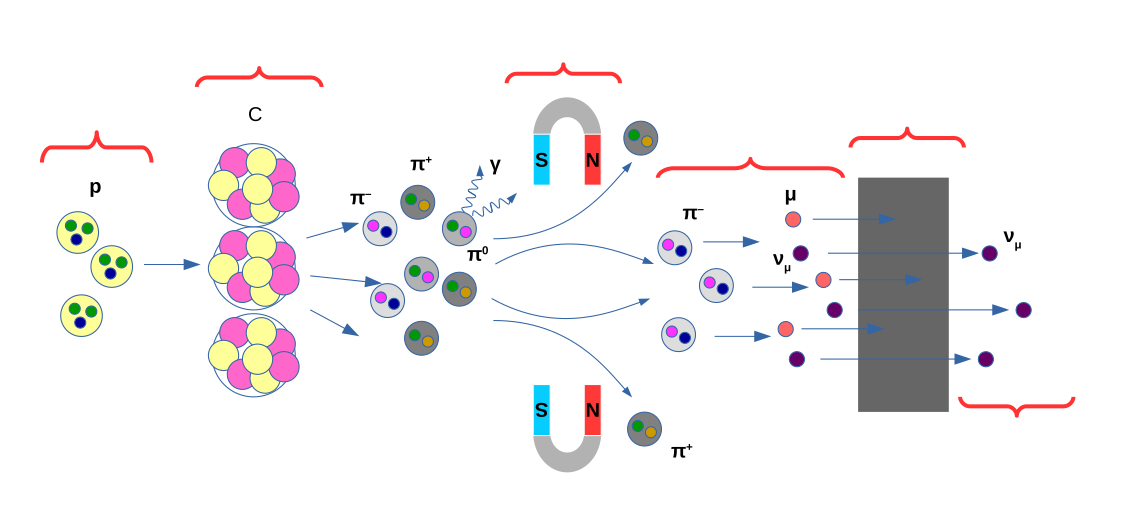

The antineutrino is the antiparticle of the neutrino. It arises everywhere nuclei emit electrons through beta decay — in nuclear reactors, in the Earth's interior and in stars.
Historically it is the more important of the two: the first detection of a neutrino by Cowan and Reines was in truth the detection of an antineutrino.
The bookkeeping of lepton number
The difference lies in a conserved quantity. Each lepton is assigned the number +1, each antilepton −1. In all known processes the sum is conserved.
In ordinary beta decay a neutron becomes a proton, an electron and an antineutrino. The electron carries +1, the antineutrino −1; together zero, just as before the decay.
When a proton decays inside a nucleus, a positron and a neutrino are produced: −1 and +1. Again the account balances.
This rule is not derived from any deeper principle. It is an observation — and precisely for that reason interesting, for rules without a justification are the ones most likely to fall.
The practical difference
The bookkeeping has tangible consequences for detection.
An antineutrino can turn a proton into a neutron and a positron — inverse beta decay. All reactor experiments from Daya Bay to JUNO rest on it, and to it they owe the characteristic double signal of two flashes of light. The process has a threshold of 1.8 megaelectronvolts; below that the energy does not suffice.
A neutrino cannot do this. Instead it converts a neutron into a proton and an electron. That is the process Raymond Davis used in the Homestake experiment — and the reason his chlorine tank responded to solar neutrinos but not to reactor antineutrinos.
Davis checked this expressly: he placed a tank next to a reactor and found nothing. A textbook negative control — and at the same time evidence that the distinction is real and not mere bookkeeping.
What makes the difference
For charged particles the difference is obvious: the positron carries the opposite charge to the electron, and no measurement could confuse the two.
For the neutrino there is no charge. What we distinguish as neutrino and antineutrino differs measurably only in helicity — the question of whether the intrinsic angular momentum points along the direction of flight or against it.
And that is precisely the sore point. For a particle with mass, helicity is not an absolute property. A sufficiently fast observer could overtake the particle; seen from in front the direction of flight reverses, but the spin does not.
Since neutrino oscillation establishes the mass, the distinction is therefore observer-dependent — at least in principle.
The open question: Dirac or Majorana
This raises a question that Ettore Majorana posed in 1937: are neutrino and antineutrino perhaps the same particle, which merely appears different according to circumstance?
Such particles are today called Majorana particles. The alternative — both as genuinely different states — is called a Dirac particle, after Paul Dirac, from whose equation the existence of antiparticles originally followed.
The question could be decided only by neutrinoless double beta decay. It is possible only if Majorana was right. Despite decades of searching it has not been observed.
Why the answer would matter
Were the neutrino a Majorana particle, lepton number would not be a strict conserved quantity. That would open the way to the seesaw mechanism, which could explain why neutrino masses are so tiny — and, by way of leptogenesis, to an explanation of why the universe consists of matter and not of nothing.
An apparently technical question thus carries one of the greatest open questions of all.
Related
- Neutrino — the particle
- Reactor neutrinos — the strongest artificial source
- Helicity — the only measurable difference
- Double beta decay — the possible proof
Sources
- E. Majorana: Teoria simmetrica dell'elettrone e del positrone, Il Nuovo Cimento 14, 171 (1937).
- Particle Data Group: Review of Particle Physics, section Neutrinos.