Reactor Neutrinos
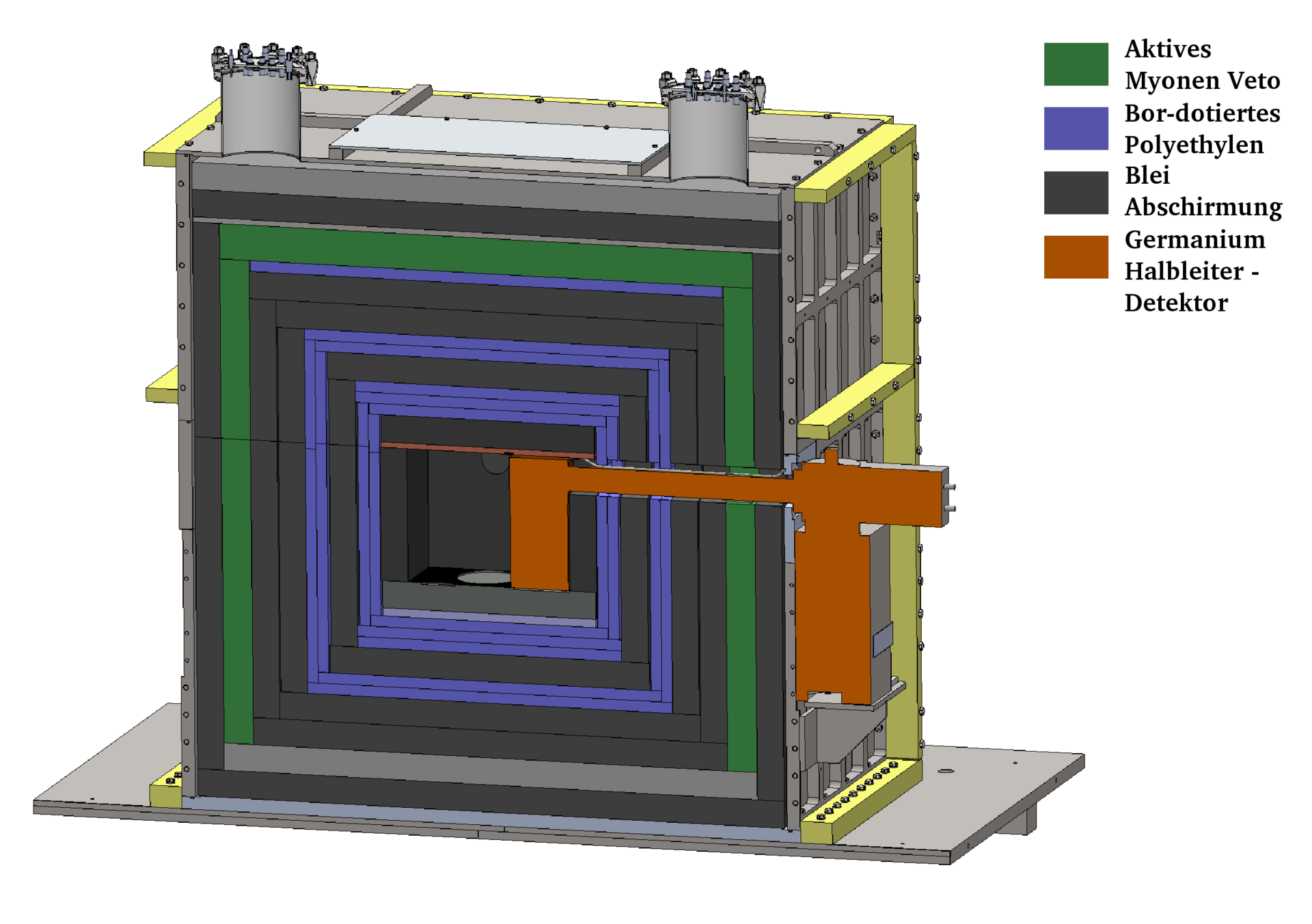

Reactor neutrinos are antineutrinos that arise in nuclear reactors. They are the strongest neutrino source made by humans and have supplied physics with more insights than any other.
Where they come from
In nuclear fission a heavy nucleus splits into two of medium weight. These fragments have too many neutrons and become stable via a chain of beta decays. Each of these decays releases an antineutrino.
Per fission around six of them arise on average. A power reactor of three gigawatts thermal output thereby emits about 6 × 10²⁰ antineutrinos per second — in all directions, unhindered by concrete, steel and soil.
The energies extend to about eight megaelectronvolts, with a focus at a few. For the detection via the inverse beta decay, however, only the part above 1.8 megaelectronvolts counts — below that the energy is not enough to make a neutron and a positron out of a proton. Only part of the spectrum is therefore visible.
Why reactors are so useful
Four properties make them the ideal source.
They are strong. No other artificial process delivers so many neutrinos in so small a space.
They are pure. Only one sort comes out — electron antineutrinos. An experiment therefore only has to check how many of them are missing, and needs no separation of several kinds.
They are calculable. From the thermal output follows the number of fissions and from that the number of antineutrinos.
They can be switched off. During an overhaul the reactor stands still, and the experiment measures the pure background. There is no better negative control — and it was precisely this that made the first neutrino detection convincing in 1956.
What has been measured with them
| Year | Experiment | Result |
|---|---|---|
| 1956 | Cowan and Reines | first detection of a neutrino at all |
| 2002 | KamLAND | oscillation over around 180 km confirmed |
| 2012 | Daya Bay | mixing angle θ₁₃ precisely measured |
| 2025 | CONUS+ | CEνNS on reactor antineutrinos for the first time |
| under construction | JUNO | ordering of the neutrino masses |
The span of the distances is remarkable. Earlier experiments stood a few hundred metres from the reactor and found nothing — the distance was too short. KamLAND used 180 kilometres and found the oscillation. With around 1.6 kilometres Daya Bay chose exactly that distance at which the small angle θ₁₃ unfolds its greatest effect.
The choice of distance is the actual design decision in reactor experiments.
The reactor antineutrino anomaly
In 2011 a recalculation of the expected rates showed that the measured values lie about six per cent below them. As with the gallium anomaly of SAGE, sterile neutrinos were considered as an explanation.
By now much suggests that the deviation lies in the nuclear data tables rather than in new physics. One detail speaks for this: the composition of the fuel changes during a cycle — uranium-235 is consumed, plutonium-239 arises — and the two deliver different spectra. Measurements at various fuel compositions suggest that the deviation sits above all with uranium-235. That fits an error in the tables, not a new particle.
The question has not been settled conclusively.
Application beyond basic research
A reactor can be recognised by its neutrinos. Their number and spectrum reveal the output and the composition of the fuel — including the question of whether plutonium is arising.
The International Atomic Energy Agency is therefore pursuing the idea of using neutrinos to monitor reactors. Such a detector could be set up outside the plant and could not be deceived: neutrinos can neither be shielded nor diverted.
Related
- Antineutrino — what a reactor emits
- KamLAND and Daya Bay — the great measurements
- Geoneutrinos — the same detection technique, a different source
- CEνNS
Sources
- KamLAND Collaboration: First Results from KamLAND, Physical Review Letters 90, 021802 (2003).
- Daya Bay Collaboration: Observation of Electron-Antineutrino Disappearance at Daya Bay, Physical Review Letters 108, 171803 (2012).