Geoneutrinos
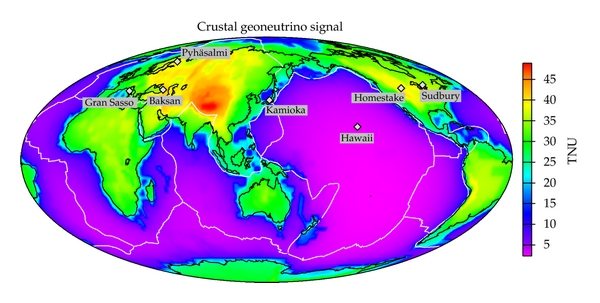

Geoneutrinos are antineutrinos that arise in the Earth's interior. They come from the radioactive decay of uranium, thorium and potassium in the rock — and they are the only known way of looking, as it were, beneath the skin of the planet.
The question they answer
The Earth is hot inside. Around 47 terawatts flow outwards through the surface constantly — more than twice the worldwide energy consumption of humankind.
This heat drives everything that makes the planet geologically alive: plate tectonics, volcanism, the geodynamo that generates the magnetic field and protects us from the solar wind.
Where does it come from? Two sources are conceivable. One part is residual heat from the formation of the planet four and a half billion years ago. Another part comes from radioactive decay in the interior.
How the two divide up was long unknown. Boreholes reach only a few kilometres deep — the deepest hole in the world manages twelve. Seismic waves reveal density and state, but not the chemical composition.
Why neutrinos supply the answer
Every decay of uranium or thorium releases antineutrinos, and these leave the Earth unhindered. Their number is directly a measure of the quantity of these elements in the planet — and thus of the radiogenic share of the Earth's heat.
One restriction belongs with this: the method sees only uranium and thorium. Potassium-40 does contribute considerably to the heat, but its antineutrinos lie below the energy threshold of the inverse beta decay of 1.8 megaelectronvolts and thus remain invisible. Its contribution still has to be calculated.
The detection
The method is the same as with reactor neutrinos: the inverse beta decay in a large scintillator, recognised by the double signal of positron annihilation and neutron capture.
The difficulty lies in the rate. A detector of a thousand tonnes registers a few tens of geoneutrinos per year. A nearby reactor delivers the same amount in a single day.
Two things therefore matter: very clean detectors and a site as far as possible from nuclear power stations.
The two measurements
KamLAND in Japan reported the first indication in 2005. The site is in itself unfavourable, because Japan operates many reactors. After their temporary shutdown from 2011 onwards, the measurement conditions improved considerably and involuntarily — a rare case in which an experiment benefited from an event outside science.
Borexino in Italy measured with less background and delivered the most precise result to date in 2020.
What has come out of it
The measurements show that about half of the Earth's heat flow comes from radioactive decay. The other half is residual heat.
That is a robust statement about the structure of a planet, obtained from particles that fly through it. It helps to narrow down models of the Earth's formation — and to answer the question of how much longer plate tectonics will be driven.
What is still open
The distribution. Whether uranium and thorium sit predominantly in the crust or also deeper in the mantle cannot be read off from the total number alone. A detector that could determine the direction would solve that — but direction is precisely what a scintillator does not supply.
The practicable route leads via measurements at several widely separated places: a detector on continental crust sees more geoneutrinos than one in the middle of the ocean, because continental crust is richer in uranium and thorium. From such differences the distribution can be inferred.
JUNO will set new standards here with 20,000 tonnes of scintillator.
Related
- Antineutrino
- Borexino and KamLAND — the measurements
- Scintillator — the technique
- Beta decay — the source