Beta Decay
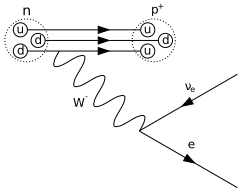

Beta decay is the nuclear process in which a neutron turns into a proton or the other way round. It is the starting point of the whole of neutrino physics: in it, energy appeared to go missing, and out of that gap grew the conjecture that the neutrino exists.
The three forms
Beta-minus decay. A neutron becomes a proton, an electron and an antineutrino. The nucleus moves up one place in the periodic table. This is the most frequent case and the one usually meant.
Beta-plus decay. A proton becomes a neutron, a positron and a neutrino. The nucleus moves down one place. In free space this never happens — a single proton is stable — but it does inside a nucleus, when the binding energy favours it.
Electron capture. The nucleus draws an electron from the innermost shell towards it and thereby converts a proton into a neutron. Here only a neutrino is produced and no other charged particle. It was precisely this process that Maurice Goldhaber used in 1958 to measure helicity.
What lies behind it
At the level of the quarks the process is simple. A neutron consists of two down quarks and one up quark, a proton the other way round. In the decay a down quark converts into an up quark and in doing so emits a W boson, which immediately decays into an electron and an antineutrino.
Because the W boson is about eighty times heavier than a proton, it hardly gets anywhere — and that is why the weak interaction is so sluggish. A free neutron lives on average about 880 seconds, barely a quarter of an hour. For nuclear processes that is an eternity.
The riddle of the continuous spectrum
In 1914 James Chadwick found that the electrons from beta decay have quite different energies. In every other nuclear process the energy is sharp: the nucleus jumps from one state to another, and the difference appears in full.
Here it was a broad spectrum, from almost zero up to a maximum value. Where did the rest go?
For fifteen years it was disputed whether this was a measurement error. In 1930 Lise Meitner and Wilhelm Orthmann settled the question with a calorimeter: they measured not individual electrons but the total heat given off. Had the spectrum been an artefact, the quantity of heat would have had to correspond to the maximum value. It corresponded to the mean value.
So the energy really was disappearing.
The two ways out
Niels Bohr seriously considered giving up the conservation law for energy on the small scale.
Wolfgang Pauli thought that the higher price to pay and proposed the other route in December 1930: an invisible particle that carries away the missing energy.
Enrico Fermi turned this into a theory in 1934 that not only saved the balance sheet but predicted the shape of the spectrum — and the measured shape agreed. With that, Pauli's makeshift became tested physics.
Why the shape of the spectrum still counts today
At the upper end of the spectrum, where the electron receives almost all the energy, hardly anything is left for the neutrino. If the neutrino has a mass, at least the energy required for it must be supplied — and the spectrum ends a tiny bit earlier.
That is exactly what KATRIN measures on tritium. It is the only route to the neutrino mass that manages without model assumptions.
The double case
In some nuclei simple beta decay is energetically forbidden while the double one is allowed. Two neutrons then convert simultaneously. The half-lives are 10¹⁸ years and more — and yet this decay has been measured.
What is being sought is the variant without neutrinos. It would be possible only if the neutrino is its own antiparticle, and it would thereby answer one of the oldest open questions. More on the page Double beta decay.
Where else the process is encountered
Beta decay is not a laboratory affair. It produces the reactor neutrinos with which the first neutrino detection succeeded in 1956. It supplies the geoneutrinos with which the Earth's heat budget can be determined. It stands at the beginning of nuclear fusion in the sun. And it is the basis of radiocarbon dating.
Related
- Wolfgang Pauli — the proposal of 1930
- Lise Meitner — the decisive measurement
- Enrico Fermi — the theory
- KATRIN — today's application
Sources
- E. Fermi: Versuch einer Theorie der β-Strahlen, Zeitschrift für Physik 88, 161 (1934).
- L. Meitner, W. Orthmann: Über eine absolute Bestimmung der Energie der primären β-Strahlen von Radium E, Zeitschrift für Physik 60, 143 (1930).