Enrico Fermi
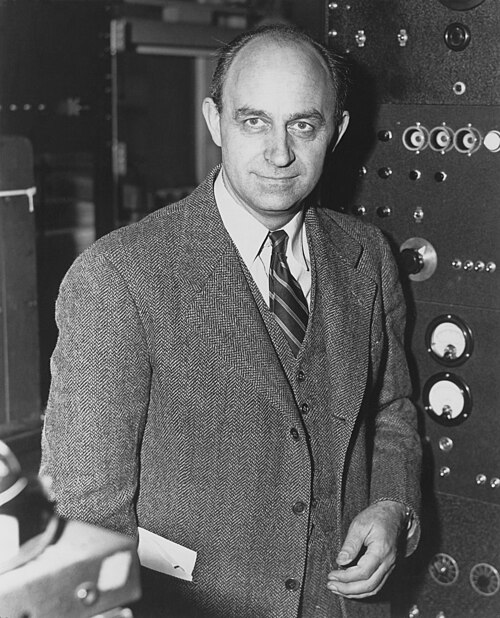

Enrico Fermi (29 September 1901 – 28 November 1954) was an Italian-American physicist. He turned Wolfgang Pauli's makeshift solution into a theory, gave the neutrino its name and built the first nuclear reactor.
He is regarded as one of the few physicists of the twentieth century who achieved significant things as a theorist and as an experimentalist alike.
Career
Fermi grew up in Rome and took his doctorate in Pisa in 1922. At twenty-six he received a chair in Rome and gathered around him a group of young physicists who became known as the Via Panisperna boys — among them Ettore Majorana and Bruno Pontecorvo.
In 1938 he received the Nobel Prize for his work on neutron irradiation. From the award ceremony in Stockholm he did not travel back to Italy but to the United States — his wife Laura was Jewish, and the fascist racial laws had come into force shortly before.
The theory of beta decay
Fermi's most important contribution to neutrino physics came about at the end of 1933. Pauli had proposed a particle; Fermi supplied the calculation to go with it.
His approach was new. He described beta decay not as the ejection of existing particles, but as fresh creation: a neutron turns into a proton, and in doing so an electron and an antineutrino come into being at the same moment — just as an atom emits a photon that was not previously inside it.
From this conception followed a formula for the decay rate and for the shape of the energy spectrum. Both could be measured, and both were correct.
Pauli's particle was thereby no longer an excuse, but a component of a testable theory. The coupling constant that appears in it bears Fermi's name to this day and is one of the fundamental quantities of the weak interaction.
The rejected paper
Fermi submitted the theory to Nature. The journal rejected it — on the grounds that it contained speculations too far removed from reality.
He thereupon published it in Italian in Ricerca Scientifica and in 1934 in German in the Zeitschrift für Physik.
The rejection is today regarded as one of the best-known misjudgements in the history of science. It is at the same time evidence of how remote the notion of an undetectable particle was from the physics of the time.
The name
At a discussion in Rome, Fermi is said to have resolved the difference between Pauli's light particle and Chadwick's heavy neutron with a diminutive form: neutrino, the little neutral thing.
The name stuck — in every language, without translation.
Chicago Pile-1
Fermi's second great achievement lies outside neutrino physics, but belongs to the prehistory of its measurements. On 2 December 1942, beneath the stands of a sports ground at the University of Chicago, the first controlled nuclear chain reaction succeeded.
The set-up consisted of graphite bricks and uranium, controlled by cadmium rods hanging from a rope; a man with an axe stood ready to cut it. There was no shielding.
Out of this line came nuclear reactors, and with them that source at which the first detection of the neutrino succeeded in 1956: a reactor delivers antineutrinos in numbers that no other artificial facility reaches.
Legacy
Fermi died in 1954 at the age of 53 of stomach cancer, presumably as a late consequence of his work with radioactive material.
His name is found everywhere: in the element fermium, in Fermilab, in the Fermi level of solid-state physics, in Fermi-Dirac statistics. His doctoral student Jack Steinberger himself received the Nobel Prize in 1988 for the detection of the second kind of neutrino.
Related
- Wolfgang Pauli — the proposal
- Beta decay — the process
- Weak interaction — the force behind it
- Ettore Majorana — his colleague in Rome
Sources
- E. Fermi: Versuch einer Theorie der β-Strahlen, Zeitschrift für Physik 88, 161 (1934).
- Nobel Foundation: Nobel Prize in Physics 1938.