Ettore Majorana
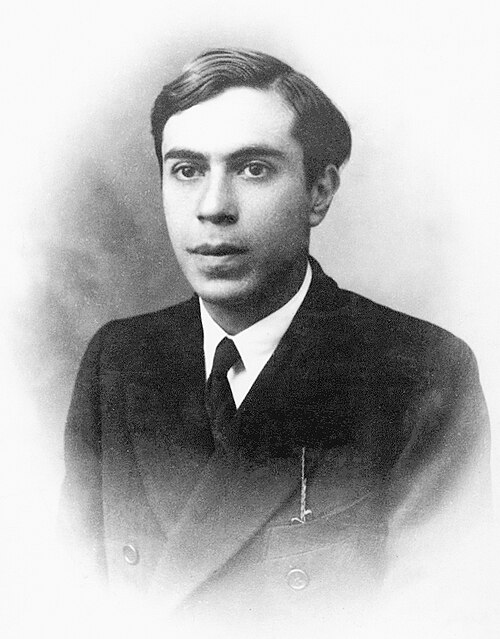

Ettore Majorana (5 August 1906 – missing since 27 March 1938) was an Italian physicist. From him comes the question of whether the neutrino is its own antiparticle — a question that, after almost ninety years, is still open.
His disappearance is one of the best-known unexplained cases in the history of science.
An exceptional talent
Majorana came from Catania in Sicily and reached physics by way of a degree in engineering. From 1928 he belonged to the working group around Enrico Fermi in Rome.
Fermi, himself no man of grand words, judged him in unusual terms: there were scientists of the first rank who went far, and then there were geniuses such as Galileo and Newton. Majorana, he said, belonged to the latter.
One peculiarity made this gift hard to put to use: Majorana barely published. He would work something through, note the result on a slip of paper, use the slip to light his cigarette and go home.
The best-known example: in 1932 he concluded from the Curies' experiments that there must be a neutral particle in the atomic nucleus. Fermi urged him to publish it. He did not. A few weeks later James Chadwick detected the neutron and received the Nobel Prize for it in 1935.
The paper of 1937
His last publication is at the same time his most consequential.
In 1928 Paul Dirac had set out an equation from which it followed that there must be an antiparticle for every particle. For the electron this held true — the positron was found in 1932.
Majorana asked whether it could also be otherwise. He showed that for electrically neutral particles an equation exists in which particle and antiparticle are the same thing. Such a particle is today called a Majorana fermion.
For charged particles this is ruled out — an electron cannot be a positron, the charges contradict each other. The neutrino, however, is neutral. For it, Majorana's possibility remains open.
He himself expressly regarded it as applicable to the neutrino.
The disappearance
On 25 March 1938, in Naples, where he taught, Majorana withdrew his savings and boarded the ship to Palermo. From there he sent two contradictory messages — one that can be read as a farewell letter, and a second that takes it back. On 27 March he boarded the ship back to Naples. He never arrived there.
Investigations turned up nothing. Over the decades several explanations have been put forward: suicide, withdrawal into a monastery, emigration to South America. In 2015 an Italian public prosecutor's office concluded, after examining witness statements, that he had lived in Venezuela for a time. None of these versions is established.
Majorana was 31 years old.
Why his question matters today
Since neutrino oscillation has established that neutrinos possess mass, Majorana's proposal is no longer a plaything but one of the central open questions of particle physics.
Were the neutrino a Majorana particle, lepton number would not be a strictly conserved quantity. That would open the way to the seesaw mechanism, which could explain the tininess of the neutrino mass — and, by way of leptogenesis, to an explanation of why the universe consists of matter.
The question could be decided by neutrinoless double beta decay. Several experiments worldwide are searching for it; none has found it.
Legacy
The term Majorana fermion has long since travelled beyond particle physics. In solid-state physics, excitations in superconductors are under investigation that behave formally like Majorana particles and are of interest for the development of fault-tolerant quantum computers.
A nine-page paper from the year 1937 thus continues to have an effect today in two specialist fields, neither of which existed at the time.
Related
- Antineutrino — Dirac or Majorana
- Double beta decay — the possible detection
- Seesaw mechanism
- Enrico Fermi — his patron
Sources
- E. Majorana: Teoria simmetrica dell'elettrone e del positrone, Il Nuovo Cimento 14, 171 (1937).
- E. Amaldi: Ettore Majorana: Man and scientist, in Strong and Weak Interactions, Academic Press (1966).