Lepton
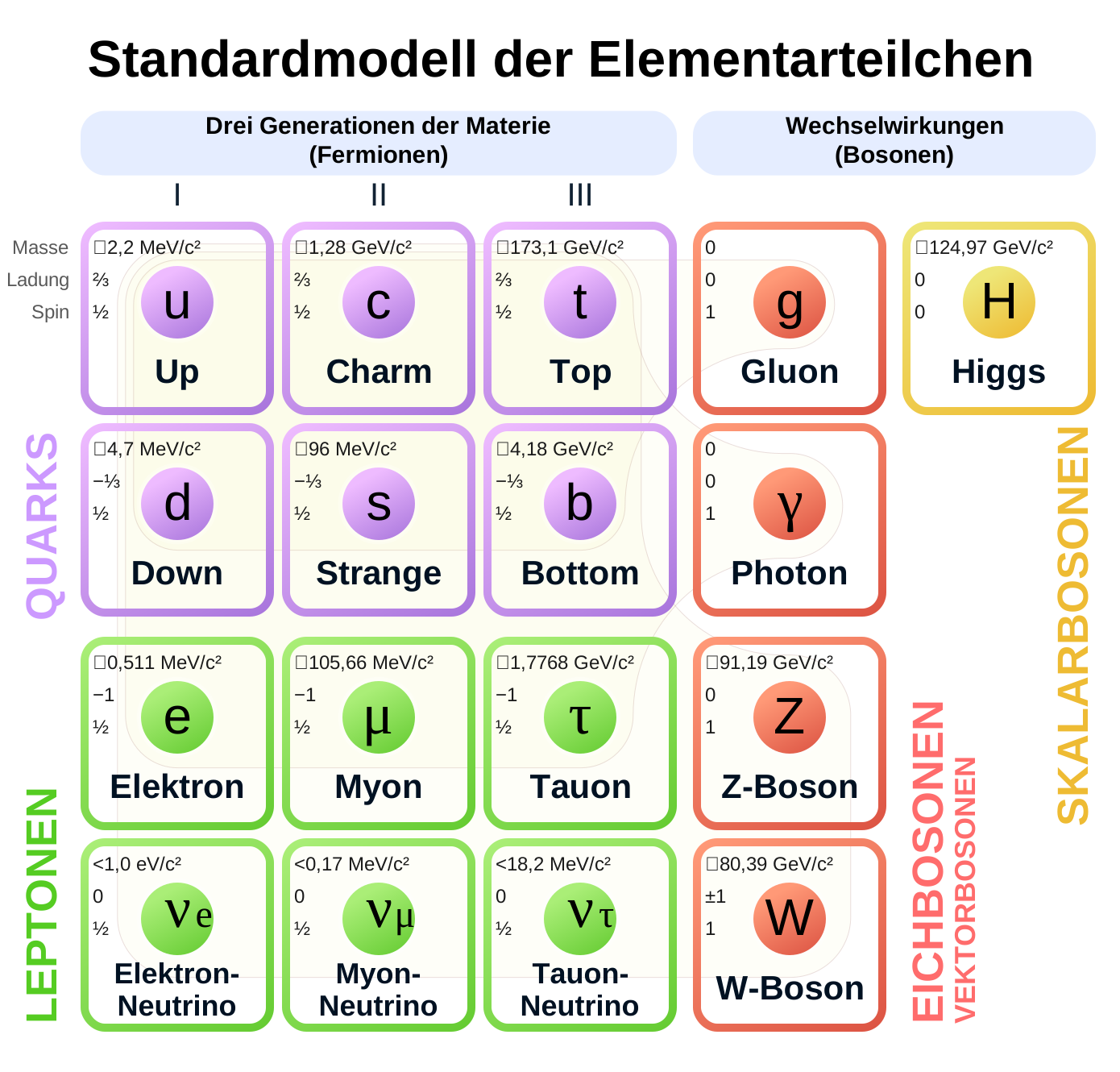

Leptons are one of the two families of matter particles in the Standard Model. They include the electron and all neutrinos. The other family are the quarks, of which protons and neutrons are made.
The name comes from the Greek leptós, "light" — a designation from the early days of particle physics, which did not yet know the heavy tau lepton and today looks somewhat unfortunate.
The six leptons
They occur in three pairs, the generations:
| Generation | Charged lepton | Mass | Lifetime | Neutrino |
|---|---|---|---|---|
| first | electron | 0.511 MeV | stable | electron neutrino |
| second | muon | 106 MeV | 2.2 microseconds | muon neutrino |
| third | tau | 1,777 MeV | 0.29 picoseconds | tau neutrino |
For each there is an antiparticle, so twelve in all.
Lepton universality
The charged leptons differ almost only in mass. In everything else they behave alike: they carry the same charge and couple equally strongly to the weak interaction and to the photon.
This lepton universality is one of the most thoroughly tested statements in physics. The reason for the care: if a deviation were found, it would be a window beyond the Standard Model.
For years decays of B mesons seemed to show such a deviation — electrons and muons did not occur there in the expected ratio. After refined measurements at CERN the finding has largely dissolved.
A second touchstone is the magnetic moment of the muon. It can be both measured and calculated, both to ten digits. Whether measurement and calculation agree is the subject of a debate that has been running for years, in which the theoretical side too has not yet been conclusively settled.
The difference from quarks
Leptons carry no colour charge. They therefore take no part in the strong interaction and can be observed individually.
Quarks, by contrast, never occur freely. If one tries to pull two apart, the force grows with the distance until the energy invested suffices to create a new quark pair — one obtains two bound particles instead of two free quarks.
An electron can be captured and measured. Nobody has ever seen a single quark.
How the families were discovered
The first generation was complete with the electron (1897) and the detection of the antineutrino by Cowan and Reines in 1956.
The second came step by step. The muon was discovered in 1936 in cosmic radiation and was at first taken for quite a different particle — the particle suspected of mediating the nuclear forces. When that turned out to be wrong, Isidor Rabi is said to have asked: "Who ordered that?" The associated neutrino was found by Schwartz, Lederman and Steinberger in 1962.
The third was opened by Martin Perl in 1975 with the tau lepton. The associated neutrino was detected by DONUT only in the year 2000 — 25 years later.
Lepton number
Each lepton is assigned +1, each antilepton −1. In all processes observed so far the sum is conserved.
In addition, the number per family long seemed to be conserved as well. It is precisely this rule that neutrino oscillation has broken: a muon neutrino that becomes a tau neutrino on the way violates it.
Total lepton number remains untouched by this. Whether it too falls would be answered by neutrinoless double beta decay.
Why three
Why there are exactly three generations and not two or five, nobody knows. The measurement at the Z boson says that there are three. It does not say why.
Equally puzzling are the masses. From the electron to the tau it is a factor of 3,500, and down to the neutrinos another factor of at least a million. For this pattern there is no explanation, only conjectures.
It is one of the open fundamental questions of physics — and one of the reasons why neutrinos are studied so attentively. They are the lightest and most peculiar representatives of this order and thus the most likely place for a surprise.
Related
- Standard Model — the framework
- Martin Perl — the third family
- W and Z boson — why there are three
- Cosmic muons — the muon in nature
Sources
- Particle Data Group: Review of Particle Physics, section Leptons.