DONUT
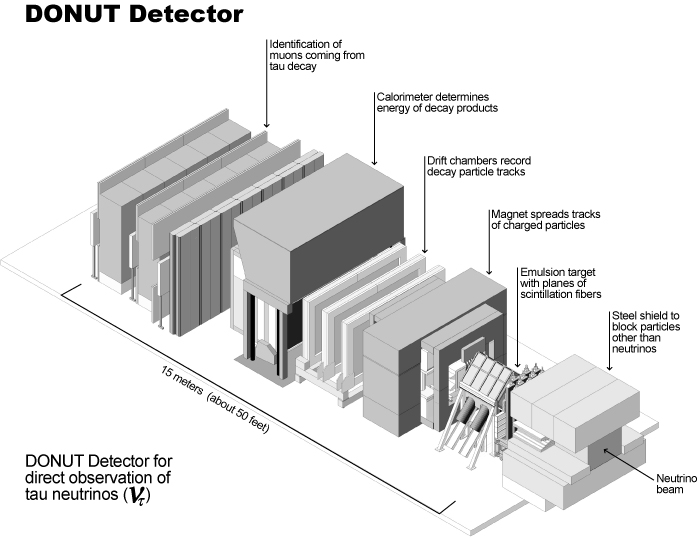

DONUT — Direct Observation of the Nu Tau — was an experiment at Fermilab that in the year 2000 detected the tau neutrino. It was the last of the twelve matter particles of the Standard Model still missing.
A quarter of a century of waiting
Martin Perl had discovered the tau lepton in 1975 and with it opened a third family of leptons. Since every charged lepton has its own neutrino, a third one was to be expected.
There was hardly any doubt. In 1989 the measurement of the decay width of the Z boson at CERN showed that there are exactly three light neutrino species — not two, not four. But the third had never been seen.
The reason lies in the detection itself. A tau neutrino reveals itself only by producing a tau lepton. This lives for around 0.3 trillionths of a second and in that time covers about a third of a millimetre before it decays. One therefore has to see a track less than a millimetre long — and a kink in it.
No electronic detector resolves that. The finest wire chambers manage a few tenths of a millimetre.
Making the beam
DONUT first had to make its tau neutrinos. A proton beam of 800 gigaelectronvolts struck a tungsten block. Among other things this produces D_s mesons — heavy particles with a charm quark, a small fraction of which decay into a tau lepton and a tau neutrino.
Everything else was kept away: the tungsten block stopped the hadrons, magnetic fields deflected charged particles, shielding swallowed the rest. What remained was a beam of neutrinos in which, alongside electron and muon neutrinos, a share of about five per cent tau neutrinos was contained.
The return to the photographic plate
For the detection DONUT fell back on a technique dating from the early days of particle physics: photographic emulsion.
The detector consisted of layers of steel and emulsion film. The steel provides mass so that an interaction takes place at all. The emulsion records the tracks of charged particles with a resolution of under one micrometre — a thousand times finer than any electronic detector.
The price for that is the effort involved. A film stores everything that has ever passed through it and cannot be read out like a chip. Electronic detectors therefore indicated roughly where something had happened; the emulsion plates concerned were then developed and automatically examined under the microscope.
Four events
Of about six million recorded interactions, around a thousand candidates remained after selection. In the end four carried the unmistakable kink.
Four events as the basis of a discovery — that sounds slender. What matters is the comparison with the expected background, and that stood at about 0.3 events. The probability of obtaining four such tracks by chance is vanishingly small.
The collaboration announced the discovery in July 2000. A later, refined analysis of the complete data set raised the number to nine events.
What had been achieved
With DONUT all twelve matter particles of the Standard Model had been detected: six quarks and six leptons, among them three neutrinos. Apart from the Higgs boson, which followed in 2012, the edifice was complete.
For neutrino physics this had immediate consequences. Neutrino oscillation is described as a transition between exactly these three species, and the PMNS matrix has three rows and three columns. As long as the third species was only inferred, a gap remained in this chain of evidence.
DONUT closed it. Fifteen years later OPERA showed with the same emulsion technique that muon neutrinos really do transform into tau neutrinos along the way — closing the circle.
Related
- OPERA — the detection of the transformation
- Martin Perl — discoverer of the tau lepton
- Lepton — the three families
- W and Z boson — the measurement of the number of families
Sources
- DONUT Collaboration (K. Kodama et al.): Observation of tau neutrino interactions, Physics Letters B 504, 218 (2001).
- DONUT Collaboration: Final tau-neutrino results from the DONuT experiment, Physical Review D 78, 052002 (2008).