Martin Perl
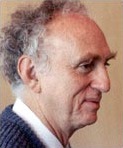

Martin Lewis Perl (24 June 1927 – 30 September 2014) was an American physicist. He discovered the tau lepton and thereby opened up the third family of matter particles — the family to which the tau neutrino also belongs.
In 1995 he received the Nobel Prize in Physics, jointly with Frederick Reines. The academy honoured both for "pioneering experimental contributions to lepton physics".
From engineer to physicist
Perl grew up in Brooklyn as the son of Jewish immigrants. He first studied chemical engineering and worked for several years for General Electric, where among other things he developed electron tubes.
Only afterwards did he decide to study physics. In 1955 he took his doctorate at Columbia University — under Isidor Rabi, in a research group from which Leon Lederman also emerged.
In 1963 he went to the Stanford Linear Accelerator Center, where he remained to the end.
The peculiar events
In the mid-1970s Perl studied collisions of electrons and positrons at the SPEAR storage ring.
In doing so he noticed events that did not fit the picture: out of the collision came an electron and a muon of opposite charge — and nothing else visible.
Such events appeared to violate the conservation of lepton number per family, since an electron and a muon belong to different families.
Perl's interpretation: two heavy, short-lived leptons are produced. Each decays further on its own — one into an electron, the other into a muon — and in the process invisible neutrinos are released which save the balance.
Three years of resistance
The specialist community was sceptical, and for understandable reasons.
A new lepton had not been anticipated; two families seemed to suffice. And the signature — two charged particles and a great deal of missing energy — could also be explained by known processes, for instance by decays of particles containing charm quarks, which had been discovered shortly before.
About three years passed between the first indications in 1974 and general recognition. Perl had to defend his analysis again and again, determine the background more precisely and show that no known explanation was sufficient.
The new particle was given the name tau, after the Greek initial letter of triton — "the third".
Why this concerns neutrino physics
Every charged lepton has a neutrino of its own. With the tau lepton, a third one was therefore to be expected.
Two confirmations followed. At CERN it emerged in 1989 from the decay width of the Z boson that there are exactly three light neutrino species. And in the year 2000 DONUT at Fermilab detected the tau neutrino directly.
With that the particle family was complete — and the foundation was laid for neutrino oscillation, which is described as a transition between precisely these three species and which finds its mathematical form in the PMNS matrix.
Further work
Perl remained a friend of uncomfortable questions. For decades he searched for free quarks with fractional charge — using a method modelled on Millikan's famous oil-drop experiment.
He found none. He nevertheless considered the search worthwhile, because a find would have changed everything: on today's understanding free quarks do not occur, and a single one would overturn the theory of the strong interaction.
He also committed himself to supporting young researchers and spoke openly about how long it had taken for his own discovery to be accepted.
Placing
Perl's case shows how scientific recognition actually comes about: not through a single moment, but through the persistent supplying of evidence until no other explanation remains.
That 25 years lay between his discovery in 1975 and the direct detection of the corresponding neutrino says a great deal at the same time about the difficulty of this field of research.
Related
- DONUT — the direct detection of the tau neutrino
- Lepton — the particle family
- Frederick Reines — his co-laureate
- PMNS matrix — the three species in interplay
Sources
- M. L. Perl et al.: Evidence for Anomalous Lepton Production in e⁺–e⁻ Annihilation, Physical Review Letters 35, 1489 (1975).
- Nobel Foundation: Nobel Prize in Physics 1995, citation and Nobel lecture.