Leon Lederman
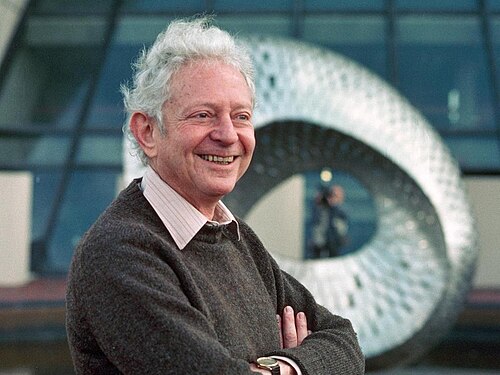

Leon Max Lederman (15 July 1922 – 3 October 2018) was an American physicist, director of Fermilab and one of the most effective communicators of particle physics. In 1988 he received the Nobel Prize in Physics together with Melvin Schwartz and Jack Steinberger.
Origins and beginnings
Lederman grew up in New York as the son of Jewish immigrants from Russia; the family ran a laundry. He studied at the City College of New York, served in the army in the Second World War and took his doctorate at Columbia University in 1951, where he then carried out research for almost three decades.
The detection of two kinds of neutrino
In the 1962 experiment at Brookhaven, Lederman was one of the three physicists in charge. The method — a neutrino beam obtained from pion decays behind massive shielding — is described on the page on Melvin Schwartz.
Lederman's strength lay in the operation of such facilities: in getting a large instrument to run, mastering background and maintaining over months the discipline that was needed for 51 clean events.
The bottom quark
In 1977 Lederman achieved a second discovery of the first rank at Fermilab. His group found the upsilon meson — a bound state of a bottom quark and its antiquark.
The third quark family had thereby been detected, matching the third lepton family that Martin Perl had opened up two years earlier. The symmetry between quarks and leptons that the Standard Model requires was thus confirmed in the third generation as well.
A prehistory is worth noting: in 1976 Lederman's group had already reported a structure that turned out to be a statistical fluctuation. Internally it acquired the nickname "Oops-Leon". The later, genuine discovery was secured all the more carefully.
Fermilab
From 1979 to 1989 Lederman directed the Fermi National Accelerator Laboratory near Chicago. His term of office saw the construction of the Tevatron, which for two decades remained the most powerful accelerator in the world and on which the top quark was detected in 1995.
Fermilab was also where the infrastructure arose from which the NuMI neutrino beam emerged — the beam with which MINOS measured neutrino oscillation, with which the first neutrino communication succeeded in 2012 and on whose successor DUNE builds.
The communicator
Lederman was convinced that physics belongs to everyone. In 1985 he founded the Illinois Mathematics and Science Academy, a public boarding school for gifted young people, and campaigned throughout his life for physics teaching — including teaching at ordinary schools in difficult neighbourhoods.
His book on the Higgs boson, in which he described it as "the God particle", became well known. The expression travelled around the world. Lederman himself later explained that his publisher had rejected the far more disrespectful title originally intended.
Many physicists consider the term unfortunate to this day, because it suggests a significance that the particle does not have. Its spread does show, however, how well Lederman understood how to generate attention — and attention is the currency in which big science is paid.
The last years
In old age Lederman developed dementia. In 2015 he auctioned his Nobel Prize medal in order to cover the costs of his care. He died in 2018 at the age of 96 in a nursing home in Idaho.
The episode attracted much attention at the time — as an indication of how little social recognition carries when it comes to the crunch.
Assessment
Few careers combine so much: two fundamental discoveries, the direction of one of the largest research laboratories in the world and decades of work for education.
For neutrino physics one thing counts above all: Lederman was among those who made an instrument out of a barely detectable particle, an instrument with which fundamental questions of physics can be answered today.
Related
- Melvin Schwartz — the beam idea
- Jack Steinberger
- Martin Perl — the third lepton family
- MINOS — neutrino physics at Fermilab
Sources
- G. Danby et al.: Observation of High-Energy Neutrino Reactions and the Existence of Two Kinds of Neutrinos, Physical Review Letters 9, 36 (1962).
- S. W. Herb et al.: Observation of a Dimuon Resonance at 9.5 GeV, Physical Review Letters 39, 252 (1977).
- Nobel Foundation: Nobel Prize in Physics 1988.