Neutrino Communication
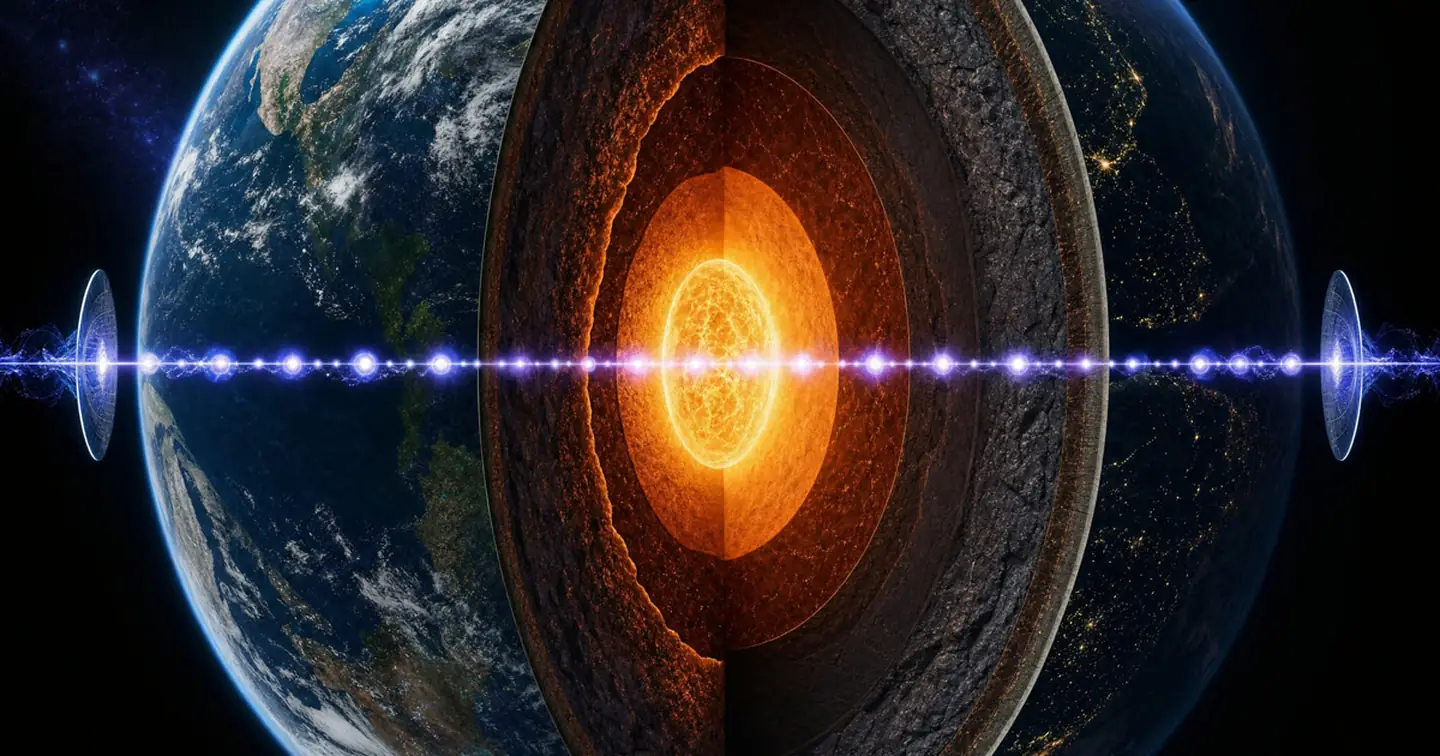
Neutrino communication means the idea of transmitting messages not with electromagnetic waves but with neutrinos. The appeal is plain: radio, light and cable are strongly attenuated by water and stopped by rock, metal and shielding. Neutrinos are not. They cross the Earth almost unimpeded.
That this channel exists physically is not a supposition but a measurement.
The 2012 experiment
In 2012 a group around Daniel Stancil at Fermilab achieved the first transmission of a message using neutrinos. The word neutrino was encoded in binary, sent with the NuMI beam and read out with the MINERvA detector.
| Distance | 1.035 km in total |
| of that solid rock | 240 m |
| Transmission rate | 0.1 bits per second |
| Bit error rate | about 1 % |
| Publication | Modern Physics Letters A, 2012; arXiv:1203.2847 |
A tenth of a bit per second is, measured against today's technology, unimaginably slow — for the word neutrino the apparatus needed more than two minutes. The setup filled an accelerator facility and consumed energy accordingly.
And yet the result is of fundamental significance. It shows: neutrinos can carry information. The channel is not theoretical, it has been used. Everything further is a question of engineering, not of physics.
Why the channel is interesting
There are places where conventional communication reaches its limits, and not for reasons of cost but in principle:
- Under water — seawater attenuates radio waves so strongly that submarines depend on very low frequencies and low data rates.
- Inside rock — in deep mines and tunnels every radio link ends.
- Behind shielding — heavily protected structures are deliberately impermeable to electromagnetic signals.
- Over long distances in space — the greater the distance, the more expensive the transmitting power.
For all these cases a channel that does not recognise matter as an obstacle would be a fundamental gain.
The open tasks
Between the Fermilab experiment and a usable system lies a great deal of work. The challenges are clearly named.
A neutrino beam today requires a particle accelerator. A detector of usable sensitivity weighs tonnes. And the data rate would have to rise by many orders of magnitude. Progress could come from new materials, from more sensitive detection methods, from better modulation and coding, and from AI-assisted signal processing.
One hope rests on coherent scattering off atomic nuclei. Because the cross section there grows with the square of the neutron number, far smaller detectors can be built than before. In 2017 the COHERENT collaboration detected this effect for the first time; 2025 brought detection on germanium and, with the CONUS+ experiment at the Leibstadt nuclear power station, the first detection on antineutrinos from a reactor.
Relation to Project 12742
The Neutrino® Energy Group lists neutrino communication as Phase II of its research programme Project 12742. The group states very clearly that this is a direction of research and not an available product — the Fermilab experiment demonstrates the channel, no more.
This separation between the established and the hoped-for is what makes the subject approachable at all: it allows the vision to be thought big while the state of the art is still named precisely.
Related
- Project 12742 — the research programme behind it
- CEνNS — the effect enabling smaller detectors
- Neutrino — the particle itself
- Cross section — why detection is so difficult
Sources
- D. D. Stancil et al.: Demonstration of Communication using Neutrinos, Modern Physics Letters A 27, 1250077 (2012); arXiv:1203.2847.
- COHERENT collaboration: Observation of Coherent Elastic Neutrino-Nucleus Scattering, Science 357, 1123 (2017).
- CONUS+ collaboration: detection of CEνNS on reactor antineutrinos, Nature (2025).
- Neutrino® Energy Group: Project 12742 — The Evolution of Communication, neutrino-energy.com.