Project 12742
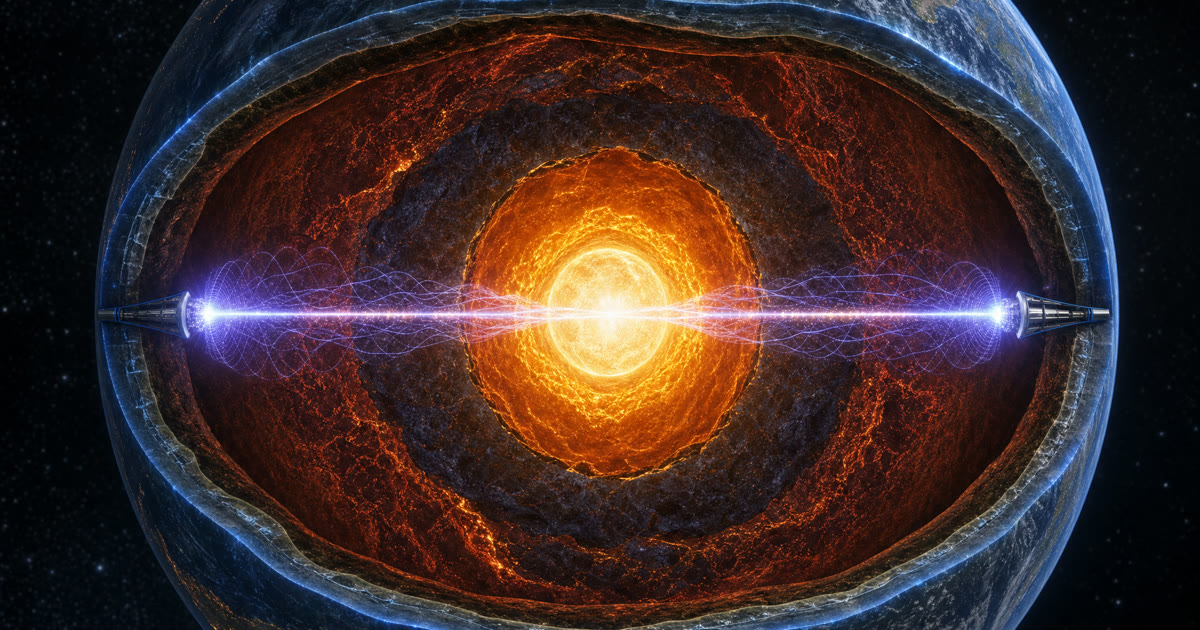
Project 12742 is the long-term research programme of the Neutrino® Energy Group on the future of communication. The name is a number with meaning: 12,742 kilometres is the mean diameter of the Earth.
In it lies the question everything turns on. Almost every communication system humanity has built carries signals around the globe — through cables across continents, via radio masts, via satellites. All these routes follow the surface or arch above it. Project 12742 asks whether the shortest path between two points — the straight line through rock, ocean and mantle — could ever become a route for messages.
Three phases, cleanly separated by maturity
The programme is deliberately arranged in three stages. What is notable is how cleanly the group marks what is buildable today and what remains research.
Phase I — the smart energy network. The thesis is: energy is communication. A self-sufficient power source such as the Neutrino Power Cube is permanently supplied with energy and therefore never dependent on a battery. It could for that reason serve at the same time as a communication node — reporting its own state, receiving updates, coordinating with neighbouring devices. One device is a device; a million are a network; a hundred million are infrastructure. This phase counts as the most concrete, because it builds on existing development.
Phase II — neutrino communication. Here the actual question arises: is there a physical channel for information beyond electromagnetic signals? The anchor point is a real experiment — in 2012 a group around Daniel Stancil at Fermilab transmitted the word neutrino using the NuMI beam over 1.035 kilometres, 240 metres of that through solid rock, at 0.1 bits per second. The channel therefore exists. A usable system it is not.
Phase III — an open horizon. The third stage is expressly named as a vision and promises nothing. It asks whether communication might one day develop itself further, and whether there are general principles of communication independent of any particular technology. Artificial intelligence is envisaged as a research partner that evaluates literature at scale, computes simulations and proposes new materials.
How the phases connect
The order is no accident. Phase I creates a foundation of permanently supplied, intelligent devices. That very foundation would be the testbed on which the research of Phase II could be tried. Phase III then asks what happens when the research process itself becomes faster.
The physics cited
Project 12742 rests on established results and names them precisely: the Nobel Prize 2015 for neutrino oscillation, the first detection of coherent scattering off atomic nuclei by COHERENT in 2017, and more recent work on germanium detectors and reactor antineutrinos.
For the energy side of Phase I the group refers to the work of Paul Thibado on the rectification of thermal fluctuations in graphene — expressly as a contribution to energy generation, not to communication.
Whom the programme addresses
Because Project 12742 connects energy and communication, it addresses several groups at once: researchers in 6G looking for channels beyond the electromagnetic spectrum; engineers of the Internet of Things who need permanently supplied nodes; planners in shipping and critical infrastructure, where water, rock and shielding put an end to conventional radio; and spaceflight.
The message to all of them is the same and deliberately plain: a research programme and a map, not a delivered technology. What makes the undertaking worth reading is not a promise for today but the seriousness with which it treats what might one day be possible.
Related
- Neutrino Power Cube — the node from Phase I
- Neutrino® Energy Group — the organisation behind it
- CEνNS — the effect behind smaller detectors
Sources
- Neutrino® Energy Group: Project 12742 — The Evolution of Communication, neutrino-energy.com/communication/project-12742/.
- D. D. Stancil et al.: Demonstration of Communication using Neutrinos, Modern Physics Letters A 27, 1250077 (2012); arXiv:1203.2847.