Nobel Prize in Physics 2015
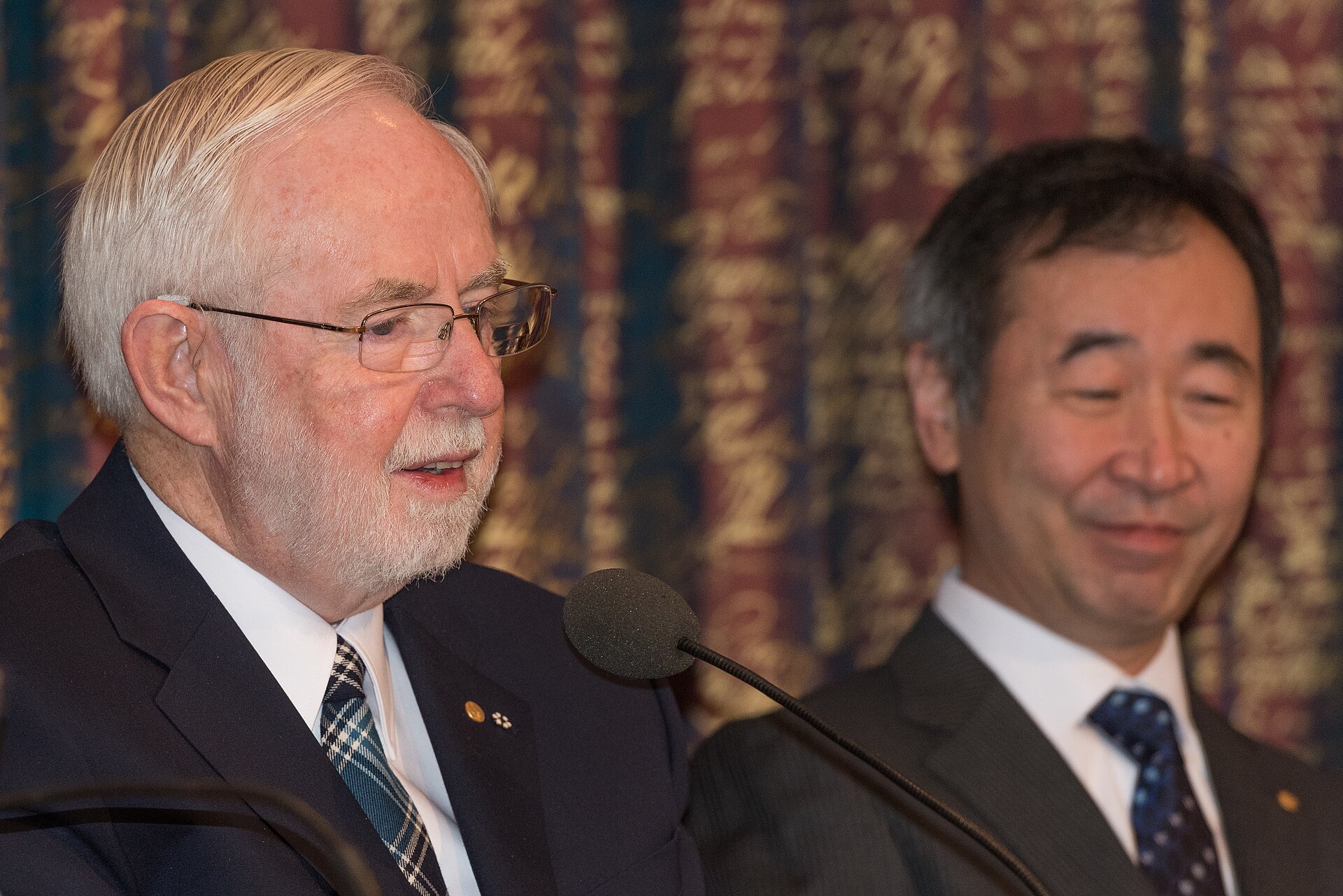

On 6 October 2015 the Royal Swedish Academy of Sciences announced that the Nobel Prize in Physics would go in equal parts to Takaaki Kajita and Arthur B. McDonald — "for the discovery of neutrino oscillations, which shows that neutrinos have mass".
It is one of those awards where the citation already tells the whole story: two teams on two continents had independently shown the same thing, and what they showed corrected a textbook.
The two experiments
Super-Kamiokande lies a thousand metres deep in a zinc mine near Hida in Japan: a tank holding 50,000 tonnes of ultra-pure water, lined with more than 11,000 photomultipliers. They register the faint flashes of light that arise when a neutrino does, exceptionally, interact with an atomic nucleus. In 1998 Kajita's group compared neutrinos arriving from above with those that had crossed the entire Earth. Those from far away were missing — and missing exactly as oscillation predicts.
The Sudbury Neutrino Observatory worked 2,100 metres underground in a nickel mine in Ontario. Its trick was the filling: heavy water, borrowed from Canadian reactor stocks. With it McDonald's team could measure two things at once — the electron neutrinos alone, and all three kinds together. The result of 2001 was unambiguous: the electron neutrinos from the sun were missing, while the total number was complete. The missing ones had not vanished, they had been transformed.
Why the discovery weighed so heavily
The Standard Model of particle physics carried neutrinos as massless. It had passed practically every prediction for decades. Oscillation, however, is possible only if neutrinos have mass — so the model had to be extended.
This discovery therefore belongs among the few of recent decades that did not confirm a prediction but exposed a gap. It remains one of the most important signposts towards a physics beyond the Standard Model.
What it means for neutrinovoltaic technology
For any technology seeking to obtain energy from the neutrino flux, 2015 is the year of the foundation. A particle without mass moves at the speed of light and cannot be slowed; a particle with mass carries momentum and can give momentum up. Only through this does the question of a conversion become a physical question at all.
The Neutrino® Energy Group therefore lists the 2015 prize as the first of three anchors of its work. The other two are the measurement of coherent scattering by COHERENT in 2017 and the detection of a current from graphene vibrations by Thibado in 2020.
The laureates
Takaaki Kajita, born in 1959 in Higashimatsuyama, was at the time of the award director of the Institute for Cosmic Ray Research at the University of Tokyo.
Arthur Bruce McDonald, born in 1943 in Sydney, Nova Scotia, was Professor Emeritus at Queen's University in Kingston, Ontario, and for many years head of the SNO collaboration.
Both stressed in their Nobel lectures the work of the collaborations — several hundred scientists were involved in Super-Kamiokande and in SNO respectively.
Related
- Neutrino oscillation — the phenomenon honoured
- CEνNS — the second anchor, measured in 2017
- Graphene — the material of the third anchor
- Neutrinovoltaic technology — the approach built on these three results
Sources
- Royal Swedish Academy of Sciences: press release on the Nobel Prize in Physics 2015, 6 October 2015, and Scientific Background: Neutrino Oscillations.
- Y. Fukuda et al. (Super-Kamiokande): Physical Review Letters 81, 1562 (1998).
- Q. R. Ahmad et al. (SNO): Physical Review Letters 89, 011301 (2002).