Sudbury Neutrino Observatory
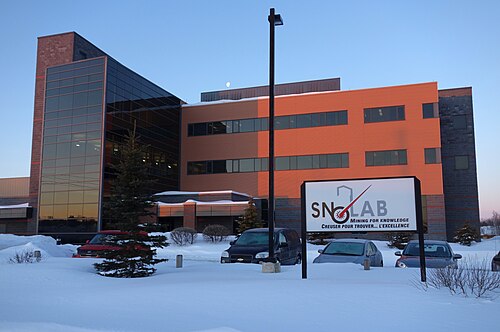

The Sudbury Neutrino Observatory (SNO) was a neutrino detector two kilometres deep in a nickel mine near Sudbury in Ontario. In 2002 it ended a debate that had been running since 1968, and it earned Arthur B. McDonald the Nobel Prize in 2015.
The question
Since the Homestake experiment it had been established that only about a third of the expected solar neutrinos arrive. What lay behind this was unclear.
Two explanations were in the air. Either the solar model was wrong — in which case astrophysics had a problem. Or the neutrinos were transforming on the way — in which case particle physics had one.
No detector could distinguish between the two, because all of them responded only to electron neutrinos. A weaker Sun and transformed neutrinos produce the same picture in such an instrument: too few events.
The solution: heavy water
SNO got around this with a piece of ingenuity. The detector contained 1,000 tonnes of heavy water in a transparent acrylic vessel twelve metres across, surrounded by 9,600 photomultipliers and a shell of ordinary water.
Heavy water contains deuterium, and deuterium can react with neutrinos in three ways:
Charged current. Only an electron neutrino can split the deuteron into two protons and an electron. This reaction therefore counts solely those neutrinos that have kept their original kind.
Neutral current. Every kind of neutrino can break the deuteron into a proton and a neutron. This reaction counts all neutrinos, whatever their kind.
Elastic scattering off electrons. All kinds contribute, but electron neutrinos far more strongly. This reaction additionally supplies the direction.
Comparing the first two numbers answers the question directly — and does so without having to invoke the solar model at all. Therein lies the elegance of the set-up: it measures a ratio, and ratios are more robust than absolute values.
That 1,000 tonnes of heavy water could be obtained at all is owed to a Canadian peculiarity. The CANDU nuclear power stations there work with it; the state atomic energy authority lent out the stock. Its value ran to several hundred million dollars.
The three measurement phases
The neutral current produces a free neutron — and neutrons are hard to see. SNO tackled the problem three times with different means, which made the detection independent of any single procedure:
| Phase | Period | Detection of the neutrons |
|---|---|---|
| pure heavy water | 1999–2001 | capture on deuterium |
| salt phase | 2001–2003 | two tonnes of table salt added, capture on chlorine |
| counter phase | 2004–2006 | proportional counters with helium-3 |
All three phases came to the same result. That is a form of control an experiment can seldom afford itself.
The result
Via the charged current about a third of the expected rate arrived — precisely the deficit Davis had found thirty years earlier. Via the neutral current the full rate arrived.
With that both things were proved at once: the Sun emits exactly as many neutrinos as John Bahcall had calculated. And two thirds of them transform on the way into other kinds.
The decisive publication appeared in June 2002. Bahcall, who had held on to his calculation for three decades, later compared the feeling to having maintained for thirty years that the Earth is a sphere — and then somebody returns from a voyage around the world.
Why it had to lie so deep
The Creighton Mine offers 2,092 metres of rock above the detector, which corresponds to around 6,000 metres of water. Only in this way could the background from cosmic muons be pushed down to a few events per day.
Added to this was a demand for purity that bordered on obsession: every gram of dust in the acrylic vessel would have produced neutrons through its natural radioactivity and thereby falsified the neutral-current signal. The vessel was assembled underground under clean-room conditions.
Afterlife
SNO was shut down in 2006. The facility became SNOLAB, one of the deepest underground laboratories in the world. SNO+ runs there today, searching for neutrinoless double beta decay, alongside several dark matter experiments.
Related
- Arthur B. McDonald — the director
- Solar neutrino problem — the question that was solved
- Homestake experiment — the initial finding
- MSW effect — the explanation of the transformation
Sources
- SNO Collaboration (Q. R. Ahmad et al.): Direct Evidence for Neutrino Flavor Transformation from Neutral-Current Interactions in the Sudbury Neutrino Observatory, Physical Review Letters 89, 011301 (2002).
- SNO Collaboration: Combined Analysis of all Three Phases of Solar Neutrino Data from the Sudbury Neutrino Observatory, Physical Review C 88, 025501 (2013).