Arthur B. McDonald
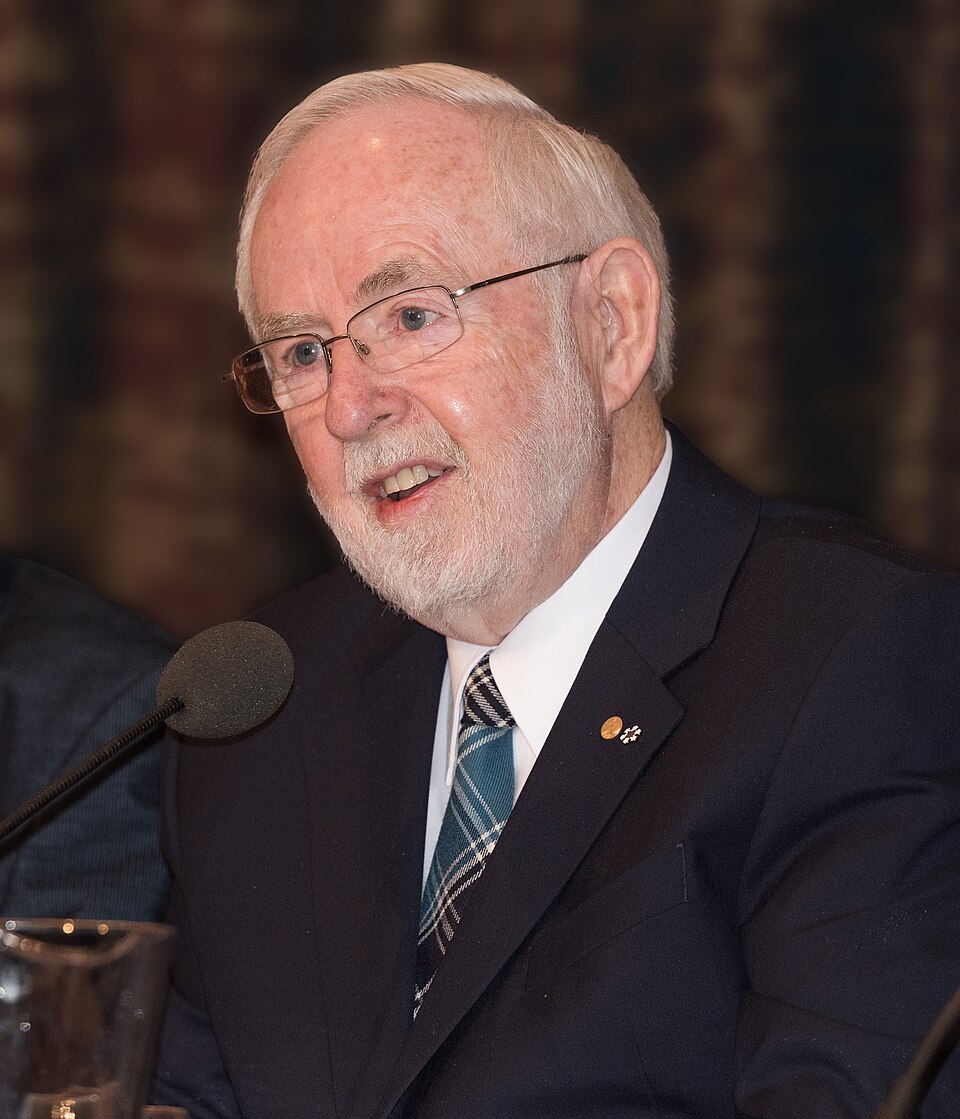

Arthur Bruce McDonald (born 29 August 1943 in Sydney, Nova Scotia) is a Canadian physicist. He directed the Sudbury Neutrino Observatory, which in 2001 and 2002 settled the question of where the missing solar neutrinos disappear to. In 2015 he received the Nobel Prize in Physics together with Takaaki Kajita.
Career
McDonald grew up on Cape Breton Island and studied at Dalhousie University in Halifax. In 1969 he took his doctorate at the California Institute of Technology. After years at the Canadian nuclear research centre Chalk River and a professorship at Princeton, he returned to Canada in 1989, to Queen's University in Kingston, Ontario.
In the same year he took over the leadership of the undertaking that would make him known.
The problem that stayed open for thirty years
Ever since Raymond Davis began presenting results from the Homestake experiment in 1968, a figure had been in the room that nobody could explain: only about one third of the solar neutrinos calculated by John Bahcall were arriving.
There were two explanations for this solar neutrino problem. Either the solar model was wrong — in which case the astrophysicists had overlooked something fundamental. Or the neutrinos changed along the way — in which case the particle physicists had overlooked something.
No experiment could distinguish between the two. All detectors up to that point responded only to electron neutrinos, that is, to the kind the Sun produces. If the particles turned into another kind along the way, the detectors saw the same thing as they would with a weaker Sun: fewer events. The cause remained hidden.
The idea: heavy water
McDonald's facility solved this with a device that rested on a Canadian peculiarity. Canada operates nuclear power stations of the CANDU type, which work with heavy water. 1,000 tonnes of it could be borrowed — worth several hundred million dollars.
Heavy water contains deuterium, and deuterium reacts with neutrinos in two different ways:
Via the charged current. Only electron neutrinos can split the deuteron into two protons and an electron. This reaction therefore counts how many neutrinos have retained their original kind.
Via the neutral current. Every kind of neutrino can break the deuteron up into a proton and a neutron. This reaction counts all neutrinos, whatever their kind.
Comparing the two numbers answers the question directly — and without having to invoke the solar model at all. That is precisely where the elegance of the set-up lies.
The result
The detector lay two kilometres deep in the Creighton nickel mine near Sudbury, Ontario. Construction took nine years.
The measurements showed: via the charged current, about one third of the expected rate arrived — exactly the deficit Davis had found. Via the neutral current, the full rate arrived.
Both things had thereby been shown at once. The Sun emits exactly as many neutrinos as Bahcall had calculated. And along the way two thirds of them change into other kinds.
The solar neutrino problem was solved after more than three decades — not by an error in the calculation, but by a property of the particles that nobody had assumed.
Why both laureates were needed
Kajita had shown with atmospheric neutrinos that muon neutrinos disappear. McDonald showed with solar neutrinos that electron neutrinos transform and into what.
Only together do the two findings produce a closed picture: neutrinos turn into one another, so they possess mass. The Standard Model has to be extended at this point.
In 2015 the Nobel Foundation honoured precisely this connection.
Afterwards
McDonald is emeritus but still active. The Sudbury observatory became the underground laboratory SNOLAB, which today searches for dark matter and with SNO+ investigates neutrinoless double beta decay.
He is a Companion of the Order of Canada, the country's highest civilian honour.
Related
- Sudbury Neutrino Observatory — the facility
- Solar neutrino problem — the question that was solved
- Takaaki Kajita — his co-laureate
- John Bahcall — whose calculation was confirmed
Sources
- SNO collaboration (Q. R. Ahmad et al.): Direct Evidence for Neutrino Flavor Transformation from Neutral-Current Interactions in the Sudbury Neutrino Observatory, Physical Review Letters 89, 011301 (2002).
- Nobel Foundation: Nobel Prize in Physics 2015, citation and Nobel lecture Arthur B. McDonald.