Takaaki Kajita
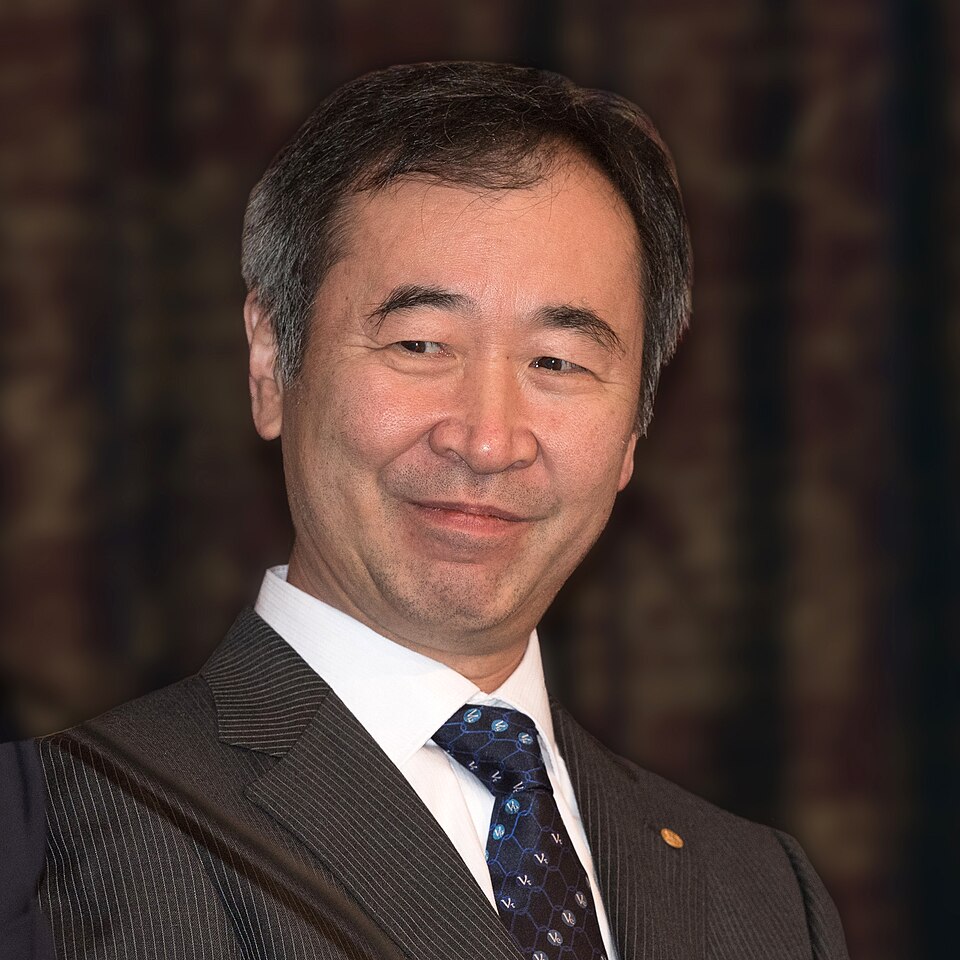

Takaaki Kajita (梶田 隆章, born 9 March 1959 in Higashimatsuyama, Saitama Prefecture) is a Japanese physicist. In 1998 he demonstrated that neutrinos transform into one another along their path — and thereby that they possess mass. For this he received the Nobel Prize in Physics in 2015, jointly with Arthur B. McDonald.
Career
Kajita studied at Saitama University and moved to the University of Tokyo for his doctorate, which he completed in 1986 under Masatoshi Koshiba. From the outset he thus belonged to that research group which operated one of the world's most unusual detectors in a zinc mine near Kamioka.
Since 1988 he has worked at the Institute for Cosmic Ray Research of the University of Tokyo, whose leadership he took over in 2008.
The riddle that awaited him
The Kamiokande detector had originally been built for a quite different question: one wanted to see whether protons decay. Proton decay failed to appear — to this day. Instead those involved noticed something else.
Atmospheric neutrinos arise when cosmic radiation strikes the atmosphere. From the decay chain of the pions produced in the process there follows a clear expectation: for every electron neutrino there should be two muon neutrinos. This ratio hardly depends on how strong the cosmic radiation happens to be — so one does not have to know the source precisely in order to have a sharp prediction.
Kamiokande, however, measured markedly too few muon neutrinos. The finding had been on the table since the mid-1980s and was called the atmospheric neutrino anomaly. At first it was not taken seriously. The obvious supposition was that the detector was not distinguishing the particle species cleanly enough.
The trick: the Earth as a yardstick
Kajita's contribution was to pose the question differently. Instead of asking how many muon neutrinos are missing, he asked from which direction they are missing.
The thought behind it is of great simplicity. A detector deep beneath the Earth receives neutrinos from all directions — but these have very different paths behind them. What comes from above arose about 15 kilometres above the detector. What comes from below arose on the other side of the planet and has travelled some 13,000 kilometres.
One and the same facility thus measures a very short and a very long distance at the same time. And since neutrino oscillation depends on the path length, the effect must show up as a dependence on the angle of incidence — if it exists.
A detector fault would not have behaved like that. It would have acted the same way above as below.
The decision of 1998
For the answer a larger detector was needed. Super-Kamiokande began operating in 1996: 50,000 tonnes of very pure water, surrounded by more than eleven thousand photomultipliers, 1,000 metres beneath Mount Ikeno.
After two years of measuring time the result was in. From above the expected number of muon neutrinos arrived. From below came about half. Electron neutrinos showed no such deficit — they came from both directions as calculated.
The muon neutrinos had therefore not disappeared on the long path through the Earth. They had transformed, predominantly into tau neutrinos, which the detector did not see.
Kajita presented the finding in June 1998 at the Neutrino 98 conference in Takayama, Japan. Witnesses report that the hall applauded for minutes after the talk — unusual for a specialist conference.
Why this weighed so heavily
The detection of oscillation has a consequence that reaches far beyond neutrino physics. Only something that has mass can oscillate — and indeed different masses for the different species.
The Standard Model of particle physics had for decades listed neutrinos as massless. It was the most successful theory in physics, confirmed in hundreds of measurements. Kajita's result showed that it is incomplete at this point.
To this day this is the only established laboratory finding that points beyond the Standard Model. Where the neutrino masses come from is open; the seesaw mechanism is the best-known attempt at an explanation.
Afterwards
Kajita remained true to basic research, but changed field. He leads the construction of KAGRA, a Japanese detector for gravitational waves, which likewise lies underground in Kamioka — in the same mountains in which the neutrinos are measured.
From 2020 to 2023 he was president of the Science Council of Japan. In this role he spoke several times about the freedom of research and about the responsibility of scientists towards society.
Related
- Super-Kamiokande — the detector
- Atmospheric neutrinos — the source
- Neutrino oscillation — the process
- Masatoshi Koshiba — his teacher
- Arthur B. McDonald — his co-laureate
Sources
- Super-Kamiokande Collaboration (Y. Fukuda et al.): Evidence for Oscillation of Atmospheric Neutrinos, Physical Review Letters 81, 1562 (1998).
- Nobel Foundation: Nobel Prize in Physics 2015, citation and Nobel lecture Takaaki Kajita.