Atmospheric Neutrinos
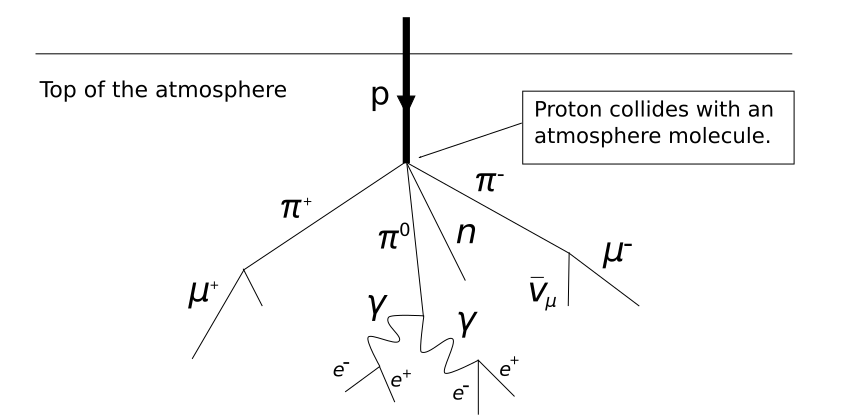

Atmospheric neutrinos arise when cosmic radiation strikes the atmosphere of the Earth. They are the source with which neutrino oscillation was first detected in 1998 — and to this day they provide one of the most elegant measurement arrangements in physics.
How they arise
Protons and atomic nuclei of high energy strike the Earth constantly from space. At a height of about 15 to 20 kilometres they collide with nitrogen and oxygen nuclei and produce a shower of secondary particles, predominantly pions and kaons.
A charged pion decays into a muon and a muon neutrino. The muon in turn decays into an electron, an electron neutrino and a further muon neutrino.
Adding it up, one expects twice as many muon neutrinos as electron neutrinos.
Why this ratio is so valuable
The absolute flux of cosmic radiation is known only to about twenty per cent. For a measurement in which a few per cent matter, that would be worthless.
The ratio of 2 to 1, by contrast, follows from the decay chain alone. It scarcely depends on how strong the cosmic radiation happens to be or what its composition looks like. One therefore does not have to know the source precisely in order to have a sharp prediction.
That is exactly what makes atmospheric neutrinos usable for precision measurements, although nobody controls them.
The Earth as a yardstick
The second peculiarity is geometrical. A detector deep underground receives neutrinos from all directions — but these have very different journeys behind them.
Neutrinos from above arose 15 kilometres above the detector. Neutrinos from below arose on the other side of the planet and have covered around 13,000 kilometres.
One and the same detector thus measures a very short and a very long distance at the same time — a ratio of almost a thousand to one, and that without an accelerator, without a second site, without cost.
Since the oscillation depends on the path length, the effect shows up as a dependence on the angle of incidence.
The discovery of 1998
Super-Kamiokande used exactly that. The detector found the expected number of muon neutrinos from above — from below only about half. Electron neutrinos showed no such deficit.
This angular dependence was the actual proof. A detector fault would have acted the same above as below; a conversion that depends on the path length acts in exactly this way.
Takaaki Kajita presented the result in June 1998. It was the first robust proof that neutrinos oscillate and therefore possess mass. In 2015 the Nobel Prize followed.
The beauty of this measurement lies in how little it needed: a detector, the sky and the globe as a yardstick.
Use today
Atmospheric neutrinos continue to be measured. IceCube and the ORCA part of KM3NeT use them to determine the ordering of the neutrino masses — because on passing through the Earth the MSW effect acts differently depending on which mass is the largest.
The energy range extends from a few hundred megaelectronvolts up into the petaelectronvolt range. At the highest energies, decays of particles containing charm quarks contribute in addition — a contribution that has not yet been reliably measured.
The unwanted twin
At the same time, atmospheric neutrinos are a background everywhere that one is looking for something else.
For experiments on proton decay and on dark matter they form the limit of what is feasible. They cannot be shielded — no rock in the world stops them. Above a certain detector size they inevitably cover up the signal being sought.
In technical language this barrier is called the neutrino floor and marks where the sensitivity of an entire class of instruments ends.
Related
- Super-Kamiokande — the discovery
- Cosmic muons — the same origin
- Neutrino oscillation
- Takaaki Kajita
Sources
- Super-Kamiokande Collaboration: Evidence for Oscillation of Atmospheric Neutrinos, Physical Review Letters 81, 1562 (1998).