KM3NeT
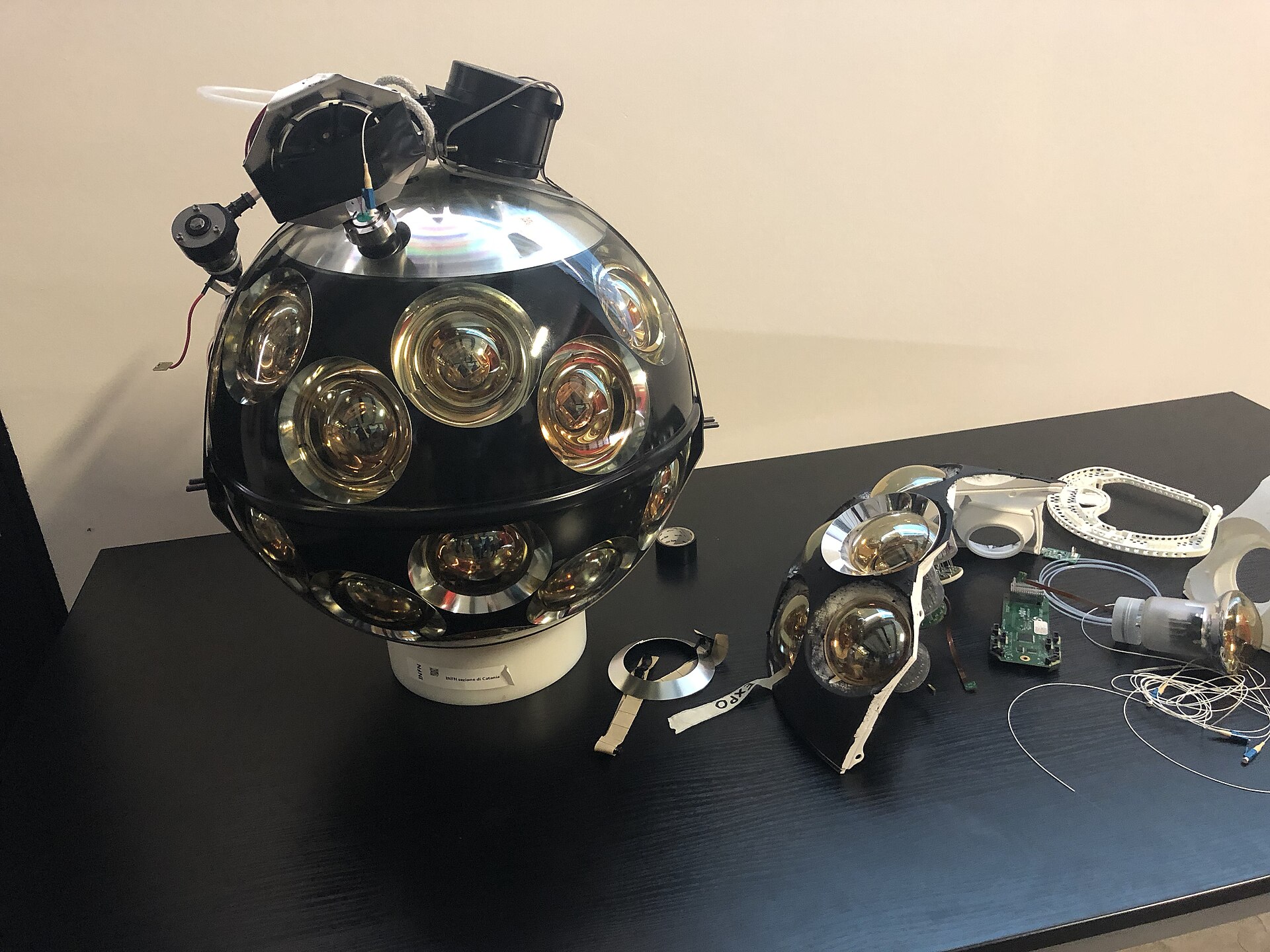

KM3NeT is a neutrino telescope in the Mediterranean. Instead of building a detector, it uses the sea itself: light sensors hang from mooring lines in the water and wait for a neutrino to trigger a flash of light in the depths.
The project is the European counterpart to IceCube at the South Pole.
Two facilities, two tasks
KM3NeT consists of two parts with different purposes — the same technology, only with different spacings between the sensors.
ARCA lies around a hundred kilometres off Sicily at a depth of about 3,500 metres. The lines stand far apart so that as large a volume as possible is monitored. ARCA searches for neutrinos from space — from active galactic nuclei, supernova remnants and other cosmic accelerators. That is neutrino astronomy.
ORCA lies off Toulon at a depth of about 2,450 metres. Here the sensors stand close together, in order to capture neutrinos of lower energy as well. ORCA measures atmospheric neutrinos that have crossed the Earth, and from them determines, via the MSW effect, the ordering of the neutrino masses.
Two entirely different research programmes thus arise from the same design.
Why the sea
Seawater is clear, deep and available at no cost. The water column above keeps out most of the cosmic muons, which would otherwise swamp any signal.
The method also has drawbacks. Seawater contains potassium-40, which is radioactive and glows in the process. And organisms live in the deep sea that bioluminesce. Both produce a constant background that has to be subtracted out.
In return, water is optically clearer than ice and scatters light less. Antarctic ice contains grain boundaries and dust layers from past climatic epochs, at which light changes direction. KM3NeT therefore determines a particle's direction more sharply than IceCube — which is decisive for assigning it to a source in the sky.
The design of the sensors
The light sensors sit in glass spheres about 43 centimetres in diameter, which withstand the pressure of the deep sea. Each contains 31 small photomultipliers instead of a single large one.
This design is a peculiarity of KM3NeT and has a solid reason: even from a single sphere one can read off which direction the light came from, because the tubes look in different directions. Furthermore, a genuine particle signal, which strikes several tubes at once, differs clearly from the noise of a single one.
The lines are brought to the seabed rolled up and unfurl there by themselves — a technique that saves the use of submersibles.
An extraordinary event
In February 2025 the collaboration reported in Nature on an event of 13 February 2023, recorded in the ARCA detector.
A muon crossed the facility almost horizontally and with extraordinary brightness. The estimated energy of the triggering neutrino lies in the region of about 220 petaelectronvolts — the most energetic neutrino ever observed, more than an order of magnitude above anything IceCube had seen up to that point.
Where it comes from is an open question. Possibilities are an extremely energetic cosmic accelerator, or a so-called cosmogenic neutrino, which arises when cosmic rays strike the microwave background radiation.
It is remarkable that a single event of this kind should carry a publication in Nature at all. It shows how thin the data situation still is at the highest energies.
Status
Both facilities are being expanded step by step and are already taking measurements while they do so. This design has one advantage: every additional line anchored enlarges the detector without operation having to be interrupted.
Related
- IceCube — the counterpart in the ice
- Neutrino astronomy — the research field
- Atmospheric neutrinos — the source for ORCA
- Cherenkov radiation — the detection principle
Sources
- KM3NeT Collaboration: Observation of an ultra-high-energy cosmic neutrino with KM3NeT, Nature 638, 376 (2025).
- KM3NeT Collaboration: Letter of Intent for KM3NeT 2.0, Journal of Physics G 43, 084001 (2016).