MSW Effect
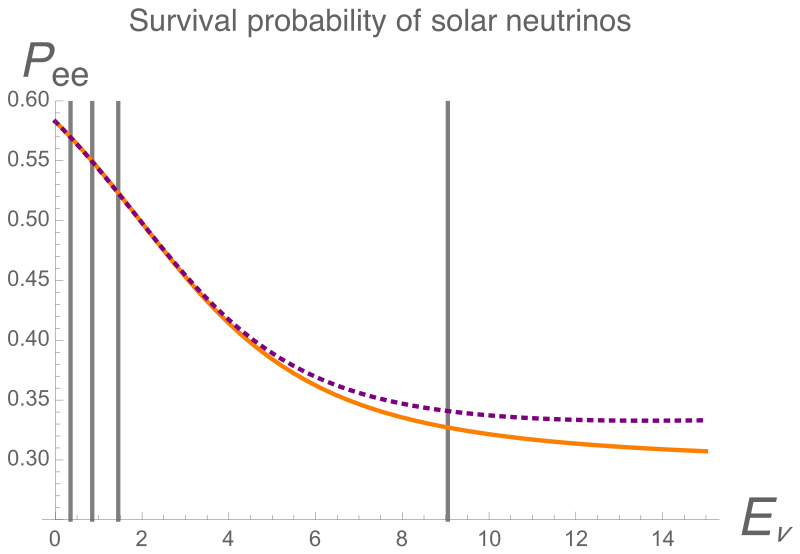

The MSW effect explains why neutrinos behave differently in matter than in vacuum. It is the resolution of the solar neutrino problem and is named after Mikheyev, Smirnov and Wolfenstein.
The basic idea
A neutrino crossing matter constantly encounters electrons, protons and neutrons. Interactions are rare — but even without a real collision the particle feels its surroundings, much as light is slowed in glass without losing individual photons.
What is decisive is an unequal treatment. All three kinds of neutrino can scatter off matter via the Z boson. But only the electron neutrino can additionally interact with electrons via the W boson — for only for this one is there a suitable partner in ordinary matter.
The electron neutrino thereby experiences an additional potential. It moves, as it were, through a different medium than its two siblings.
Lincoln Wolfenstein described this effect in 1978.
The resonance
Stanislav Mikheyev and Alexei Smirnov showed in 1985 that something remarkable follows from this inside a star.
In the solar core the density is enormously high. On the way outwards it decreases steadily until the neutrino emerges into vacuum. Somewhere along this way it passes through a density at which the additional potential exactly balances the mass difference.
At this point the mixing becomes maximal — the conversion from one kind into the other proceeds there most effectively. If the transition happens slowly enough, the neutrino follows the changing surroundings and leaves the sun predominantly as a different kind from the one in which it was created.
Why this depends on energy
Here lies the point at which the effect could be proved.
The resonance density depends on the energy of the neutrino. High-energy neutrinos find their resonance deep in the solar core and are strongly converted. Low-energy neutrinos no longer reach the appropriate density at all — they simply oscillate as in vacuum.
From this follows a prediction that can be measured:
| Energy range | expected survival as electron neutrino |
|---|---|
| below 1 MeV, e.g. pp neutrinos | about 55 per cent, vacuum behaviour |
| above 5 MeV, e.g. boron-8 | about 30 per cent, MSW regime |
Exactly this pattern is what the experiments found. The Homestake experiment with its high threshold saw one third, GALLEX and SAGE with their low threshold about 60 per cent. Borexino later measured the transition region in between and confirmed the predicted curve.
Why this is so convincing
A model error concerning the sun would have affected all energies equally. A simple vacuum oscillation would likewise have produced a different pattern.
The MSW effect predicted the shape of the energy dependence before it was measured — and it agreed. That is the strongest kind of evidence physics knows.
Where it plays a role today
The effect has long ceased to be a special case of the sun and has become a tool.
The mass ordering. In passing through the Earth's crust the effect acts differently depending on which neutrino mass is the largest. DUNE uses precisely this on its 1,300-kilometre baseline, as does the ORCA part of KM3NeT with atmospheric neutrinos.
Supernovae. In a collapsing stellar core densities prevail at which the effect reshapes the entire neutrino spectrum. In a future supernova this could be used to infer the processes going on inside.
Related
- Solar neutrino problem — the riddle that was solved
- Neutrino oscillation — the process in vacuum
- Solar neutrinos — the particles concerned
- Sudbury Neutrino Observatory — the proof
Sources
- L. Wolfenstein: Neutrino oscillations in matter, Physical Review D 17, 2369 (1978).
- S. P. Mikheyev, A. Yu. Smirnov: Resonance amplification of oscillations in matter and spectroscopy of solar neutrinos, Soviet Journal of Nuclear Physics 42, 913 (1985).