DUNE
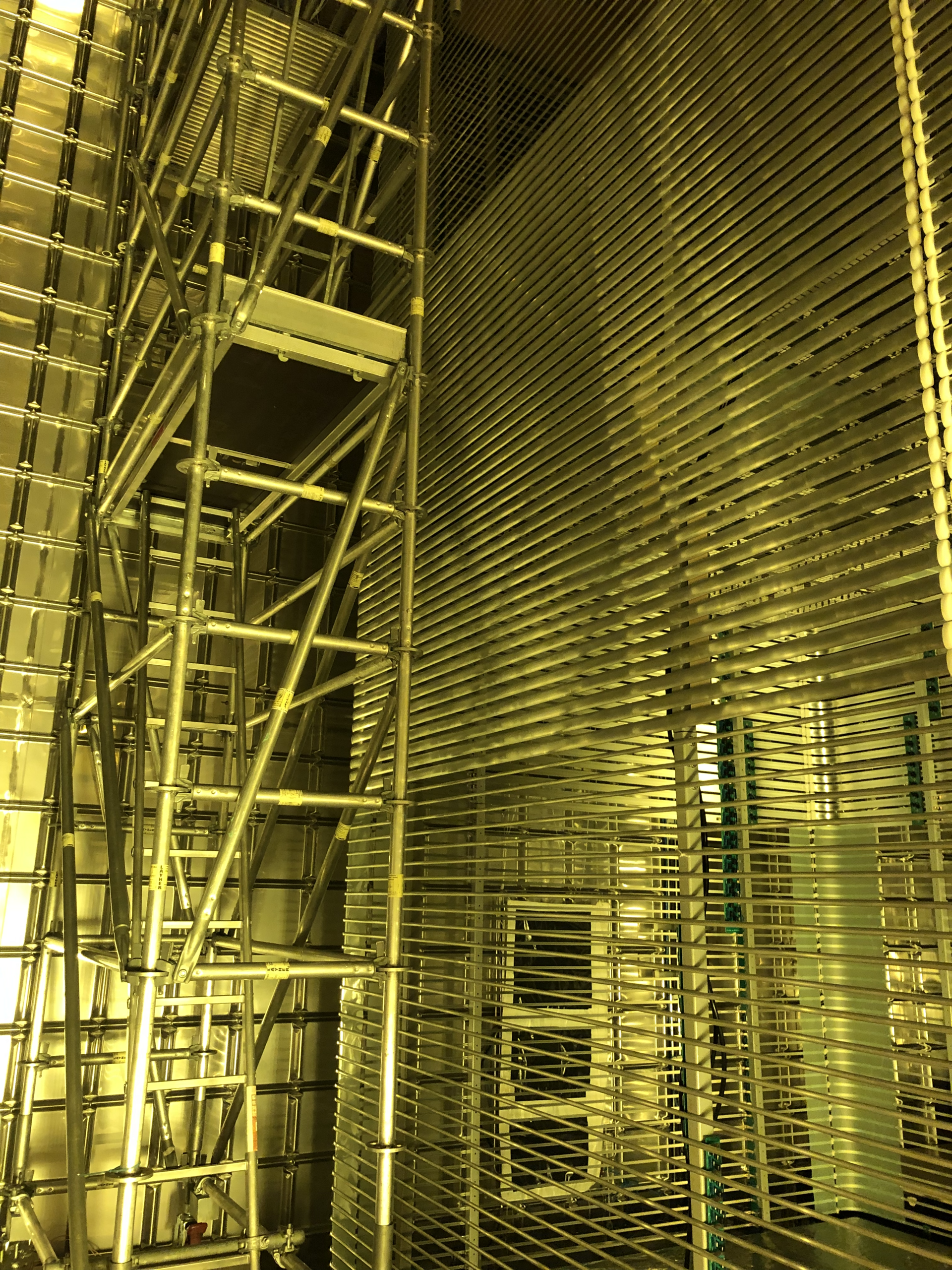

DUNE — Deep Underground Neutrino Experiment — is the largest neutrino undertaking currently under construction. A beam from Fermilab near Chicago is to be sent 1,300 kilometres to South Dakota and received there in a former gold mine.
The facility
At Fermilab a new beam facility is being built with LBNF. It is to operate initially at 1.2 megawatts and later be upgraded to more than double that — which would be the most intense neutrino beam in the world. A near-detector complex measures there what is being sent off.
The far detector lies 1,480 metres deep in the Sanford Underground Research Facility in Lead, South Dakota — in the same tunnels in which Raymond Davis once operated the Homestake experiment. More than 800,000 tonnes of rock were excavated for the caverns; the excavation was completed in 2024.
Four modules are planned, each with around 17,000 tonnes of liquid argon, cooled to about minus 186 degrees Celsius.
Why liquid argon
Earlier detectors such as MINOS consisted of steel and scintillator. They basically see only where a muon has travelled — one track, one direction, one energy.
A time projection chamber with liquid argon achieves more. When a charged particle traverses the argon, it leaves behind a trail of free electrons. An electric field draws these over several metres to a wire plane. From the position on the plane and the arrival time the trajectory is reconstructed in three dimensions — with a resolution in the millimetre range.
The result resembles a photograph of the event. One recognises not only that something has happened, but which particles were involved and how they branched.
The price for that is the purity: even traces of oxygen capture the drifting electrons. The argon has to be kept clean to within a few parts per trillion.
The three questions
Do neutrinos violate CP symmetry? If neutrinos and antineutrinos behave differently, that would be a building block for explaining why there is matter in the universe. T2K has provided first indications; DUNE is to decide the question.
The long distance is not an end in itself. Over 1,300 kilometres the MSW effect acts so strongly that its contribution can be cleanly separated from the CP violation being sought — over shorter distances the two influences become mixed.
Which neutrino mass is the largest? The same effect simultaneously answers the question of the ordering of the neutrino masses.
Does the proton decay? Grand unified theories predict an extremely rare proton decay. Liquid argon is more sensitive than water to certain decay channels, which is why DUNE and Hyper-Kamiokande complement each other here.
In addition there is a readiness that cannot be planned: if a supernova explodes in our galaxy, DUNE would catch thousands of neutrinos from it — and preferentially electron neutrinos, which water detectors see less well. The two designs together would yield a more complete picture of the core collapse than either on its own.
Status
The caverns have been excavated, the assembly of the first modules is under way. At CERN the prototype ProtoDUNE has tested the technology at the scale of several hundred tonnes — with two different designs of the drift chamber, each of which will be used in one of the first two modules.
According to current planning, measuring operations are to begin towards the end of this decade. With projects of this size, experience shows that dates shift. The collaboration comprises more than 1,400 scientists from more than 30 countries.
Related
- Hyper-Kamiokande — the Japanese counterpart
- T2K — the first CP indications
- Homestake experiment — the same mountain, a different time
- MSW effect — why the distance is so long
Sources
- DUNE Collaboration: Long-baseline neutrino oscillation physics potential of the DUNE experiment, European Physical Journal C 80, 978 (2020).
- Fermilab: LBNF/DUNE — project description and construction status.