MINOS
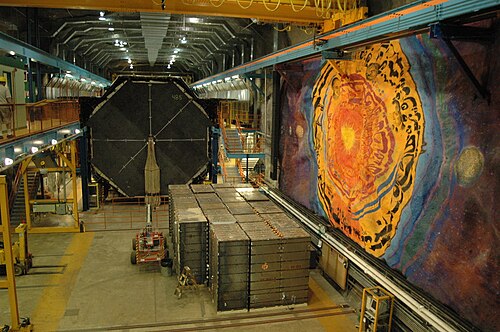

MINOS — Main Injector Neutrino Oscillation Search — was a neutrino experiment between Fermilab near Chicago and a disused iron mine in Minnesota. It ran from 2005 to 2016 and turned neutrino oscillation into a precision measurement.
From discovery to measurement
In 1998 Super-Kamiokande had shown that neutrinos oscillate. The source was atmospheric neutrinos — free of charge, but uncontrolled: one knows neither their exact number nor their spectrum particularly well.
A precise measurement requires a source that one has in hand oneself. It was for exactly this that Melvin Schwartz had invented the neutrino beam in 1960. MINOS used it to turn a qualitative finding into a number.
Two detectors, one beam
The decisive idea is the double measurement.
At Fermilab the NuMI beam produces muon neutrinos: protons strike a graphite target, the pions that result are focused by magnetic horns and decay over a 675-metre stretch. A first detector of 980 tonnes stands there in a cavern, only one kilometre from the origin — too close for oscillation to play any role. It therefore measures what was sent off.
735 kilometres further on, 705 metres deep in the Soudan mine, stands the second detector with 5,400 tonnes, measuring what arrives.
The comparison of the two measurements is the real trick. How strong the beam was, what its spectrum looked like, how well the detectors respond — all these uncertainties act equally on both measurements and cancel out in the ratio. What remains is the difference, and that is the oscillation.
Both detectors were also built identically, from the same alternating layers of steel and scintillator. That too serves the goal of having systematic errors cancel one another.
The magnetised steel
One peculiarity distinguished MINOS from all other neutrino detectors: the steel was magnetised.
A magnetic field bends the path of charged particles, and from the direction of curvature one reads off the charge. MINOS could therefore distinguish muons from antimuons — and hence neutrinos from antineutrinos.
That permitted a test nobody had been able to carry out before: do the two oscillate alike? A difference would have been an indication of a violation of CPT symmetry, one of the deepest principles in physics. MINOS found none — within the accuracy of the measurement, neutrinos and antineutrinos behave alike.
The results
MINOS determined the squared-mass difference Δm²₃₂ to within a few per cent. That figure is to this day among the best-measured quantities in neutrino physics.
More important still than the value was the pattern. Neutrinos of certain energies were missing more strongly than others, and precisely in the form that an oscillation predicts: a trough in the spectrum whose position depends on energy and distance.
That ruled out competing explanations. Had the neutrinos simply decayed or escaped into an additional dimension — both had been seriously considered — the spectrum would have looked different.
A side result on velocity
MINOS also measured how fast its neutrinos covered the 735 kilometres, and found the result compatible with the speed of light. The same question briefly earned the OPERA experiment worldwide headlines in 2011, until an error in the timing measurement was found there.
Succession
Since 2014 NOvA has used the same beamline, though 14 milliradians off the axis and with a 14,000-tonne detector in Ash River, Minnesota. The off-axis arrangement delivers a narrower energy spectrum — the same device that T2K also uses in Japan.
The next step on the same site is DUNE, with 1,300 instead of 735 kilometres of baseline and liquid argon instead of steel.
Related
- Neutrino oscillation — the process measured
- T2K — the Japanese counterpart
- DUNE — the successor at the same site
- Melvin Schwartz — the beam method
Sources
- MINOS Collaboration: Measurement of Neutrino and Antineutrino Oscillations Using Beam and Atmospheric Data in MINOS, Physical Review Letters 110, 251801 (2013).
- MINOS Collaboration: Measurement of the neutrino velocity with the MINOS detectors, Physical Review D 92, 052005 (2015).