OPERA
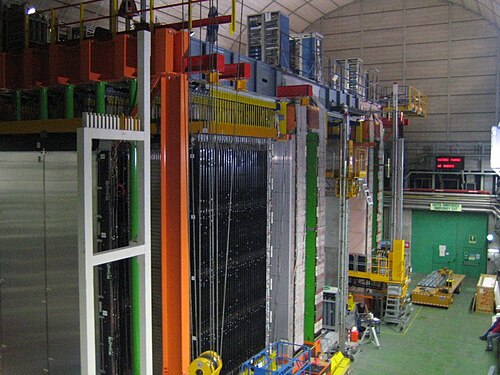

OPERA was a neutrino experiment at the Gran Sasso underground laboratory which from 2008 to 2012 received a beam from CERN — 730 kilometres straight through the Alps and the Apennines. Its task: to see the transition from muon neutrinos to tau neutrinos directly.
Appearance instead of disappearance
Most oscillation experiments measure that neutrinos are missing. Super-Kamiokande had shown in 1998 that muon neutrinos disappear on their way through the Earth. Where they go, the detector did not see.
OPERA set out to show exactly that. To do so it had to detect tau neutrinos — and these give themselves away only by producing a tau lepton.
This lepton lives around 0.3 trillionths of a second and travels less than a millimetre in that time before it decays. One therefore has to recognise a very short track and within it a kink — the point at which the tau decays and its daughter particles fly on in a different direction.
No electronic detector resolves that. The finest wire chambers manage a few tenths of a millimetre.
Bricks of lead and film
OPERA's solution was a return to an old technique. The detector consisted of about 150,000 bricks. Each was a stack of 56 lead plates with photographic emulsion layers in between, weighed a good eight kilograms and was roughly the size of a shoebox. Together they came to 1,250 tonnes.
The lead supplies the mass so that an interaction takes place at all. The emulsion records the tracks with a resolution of under a micrometre — a thousand times finer than any electronic detector.
The procedure behind it
Emulsion has one decisive drawback: it stores everything and cannot be read out like a chip. A film that lies in the detector for years collects millions of useless tracks.
The solution was a division of labour. Between the brick walls hung electronic detectors that indicated roughly where and when something had happened. A robot then fetched the brick in question out of the wall, the films were developed and automatically examined under the microscope.
With that the emulsion was no longer a passive store, but part of a search process. The procedure made it possible to pick out of 150,000 bricks precisely the one that contained something.
The result
The first tau candidate was found in 2010. By 2015 there were ten.
Ten events from years of running sounds like little and is a triumph. The expected background lay below one event; the statistical significance reached 6.1 standard deviations — far above the threshold of five, from which particle physics speaks of a discovery.
With that the transition νμ → ντ was directly established. Together with DONUT, which had detected the tau neutrino in the first place, and the disappearance measurements, the picture of neutrino oscillation was complete.
The matter of the speed of light
In 2011 OPERA reported that its neutrinos had arrived around 60 nanoseconds earlier than light would have. The news went around the world.
What is remarkable is how the collaboration dealt with it. It published the finding explicitly as unexplained, asked the scientific community to examine it and did not claim to have refuted Einstein. The spokesman said, in essence, that they had searched for an error for months and found none — which was why they were putting the matter into the open.
The examination found the cause: a fibre-optic connector in the timing system that had not fully clicked into place, together with an oscillator running inaccurately. After the correction the neutrinos moved at the speed of light. In 2012 three other Gran Sasso experiments confirmed this independently, and OPERA itself presented a corrected measurement.
The episode is regarded today as an object lesson — not because of the error, which anyone can make, but because of the openness with which it was handled.
Related
- DONUT — the first detection of the tau neutrino
- Neutrino oscillation
- Martin Perl — discoverer of the tau lepton
- MINOS — the American counterpart
Sources
- OPERA Collaboration: Discovery of τ Neutrino Appearance in the CNGS Neutrino Beam with the OPERA Experiment, Physical Review Letters 115, 121802 (2015).
- OPERA Collaboration: Measurement of the neutrino velocity with the OPERA detector in the CNGS beam, JHEP 2012, 093 — corrected version.