Coherent Elastic Neutrino-Nucleus Scattering (CEνNS)
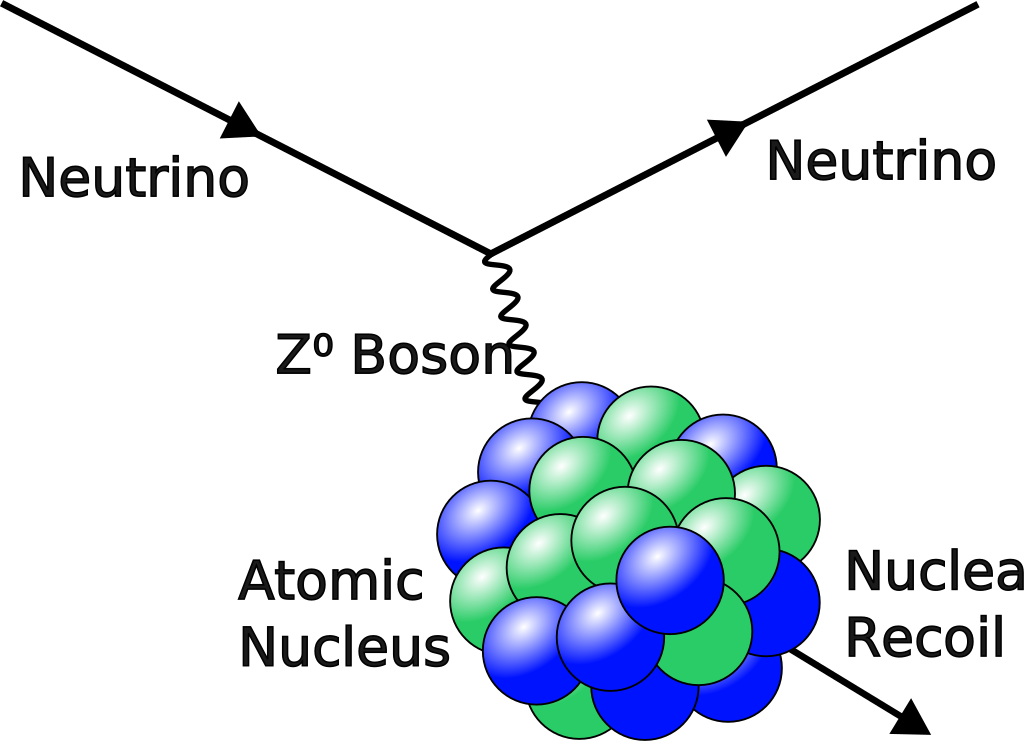

Coherent elastic neutrino-nucleus scattering — abbreviated CEνNS and pronounced "sevens" — is a process in which a neutrino scatters off an atomic nucleus without breaking it apart and without being absorbed itself. The nucleus responds as a whole: no single proton or neutron is struck, the entire nucleus takes up a small recoil.
That transfer of momentum is the point at which the neutrinovoltaic approach connects to established physics.
What "coherent" means
The word carries the whole idea. At low energies the wavelength of the incoming neutrino is larger than the nucleus. The neutrino no longer "sees" the individual constituents separately, but the nucleus as a single unit. The contributions of all nucleons add in phase — and because quantum mechanics adds probabilities through amplitudes, the cross section grows roughly with the square of the neutron number.
This is why the process has by far the largest cross section of all neutrino couplings at low energy.
Predicted in 1974, measured in 2017
Daniel Z. Freedman predicted the process in 1974 in Physical Review D. He also named the difficulty that would delay its detection for so long: the recoil the nucleus receives is extraordinarily small. A detector has to resolve energies of a few kiloelectronvolts while running essentially free of background.
It took 43 years. The COHERENT collaboration detected CEνNS for the first time and published the result on 15 September 2017 in Science:
| Significance | 6.7 σ |
| Detector | 14.6 kg CsI[Na] scintillator |
| Source | Spallation Neutron Source, Oak Ridge National Laboratory |
| Publication | Science 357, 1123–1126 |
The characteristic signatures in energy and timing that the Standard Model predicts for this process were confirmed.
Why the detection was so demanding
These figures are the yardstick against which every application idea has to be measured, and they are worth setting side by side.
CEνNS has the largest cross section of all neutrino couplings at low energy. And even this largest of all cross sections escaped detection for four decades. Success came only with an artificial, extraordinarily intense neutrino source — a spallation neutron source, of which only a handful exist worldwide — and a purpose-built, low-background detector.
The reverse is also true, however. What was considered practically unmeasurable in 1974 has since become routine. The COHERENT collaboration has measured the cross section on CsI precisely (Physical Review Letters 129, 081801, 2022) and detected the process on germanium in 2025 (Physical Review Letters 134, 231801). The path from "predicted in theory" to "measured repeatedly" has been walked in full.
Significance beyond fundamental physics
The Science paper itself names a practical by-product: because the cross section is so large, CEνNS permits considerably smaller detectors than other neutrino detection methods. Where conventional neutrino detectors need water tanks of tens of thousands of tonnes, 14.6 kilograms sufficed here.
That miniaturisation is why the process attracts attention outside pure fundamental research as well — for monitoring nuclear reactors, for instance, or, as the Neutrino® Energy Group pursues it, as a starting point for energy conversion.
Related
- Cross section — the area measure for interactions
- Neutrino — the particle itself
- Neutrinovoltaic technology — the application approach
- The master equation — CEνNS as a contribution to σ_eff
- Graphene — the converter material
- Timeline — 1974 predicted, 2017 measured
Sources
- D. Z. Freedman: Coherent effects of a weak neutral current. Physical Review D 9, 1389 (1974).
- D. Akimov et al. (COHERENT): Observation of coherent elastic neutrino-nucleus scattering. Science 357, 1123–1126 (15 September 2017).
- COHERENT: Measurement of the CEνNS Cross Section on CsI. Physical Review Letters 129, 081801 (2022).
- COHERENT: Evidence of CEνNS with COHERENT's Germanium Array. Physical Review Letters 134, 231801 (2025).