Cross Section
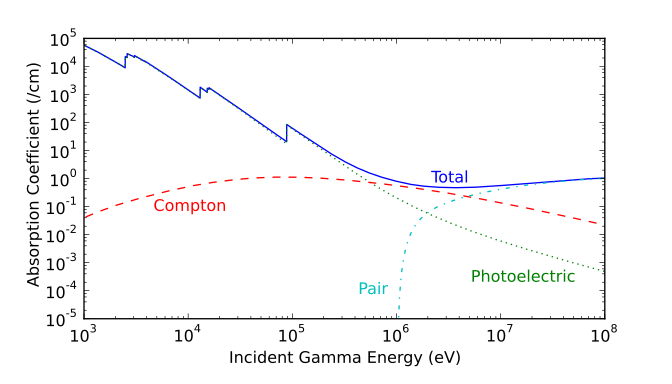

The cross section is the measure of how likely it is that an incoming particle interacts with a target particle. It carries the symbol σ and has the dimension of an area — hence the name.
In the master equation of the neutrinovoltaic approach it appears as σ_eff(E).
The intuitive picture
Picture the target particle as a disc facing the incoming particle. If the particle hits the disc, an interaction occurs; if it misses, the particle flies on undisturbed. The cross section is the area of that imagined disc.
The disc has little to do with the geometric size of the target, however. It can be far smaller than the nucleus — for neutrinos it dramatically is — or, under particular conditions, larger. It measures coupling strength, not extent.
The customary unit is the barn: 1 barn = 10⁻²⁴ cm². The name is a piece of physicists' humour from the Manhattan Project — a nucleus that size was said to be as easy to hit as the broad side of a barn. For neutrinos the typical values are many orders of magnitude smaller.
Why σ depends on energy
The cross section is not a fixed number but a function of energy — which is why the master equation writes σ_eff(E) and not σ_eff. The same species of particle can couple with strengths differing by many orders of magnitude at different energies.
The authoritative survey is by J. A. Formaggio and G. P. Zeller: From eV to EeV — Neutrino cross sections across energy scales (Reviews of Modern Physics 84, 1307, 2012). It spans some twenty orders of magnitude in energy and is the standard reference whenever neutrino interaction rates are estimated.
The special case of coherent scattering
In coherent elastic neutrino-nucleus scattering an effect appears that raises the cross section considerably: because the nucleus reacts as a whole, the contributions of the individual nucleons add in phase. The cross section therefore grows roughly with the square of the neutron number rather than merely with their sum.
For a heavy nucleus such as caesium or iodine — the COHERENT collaboration used caesium iodide — that makes a difference of several orders of magnitude. It is the reason this process has the largest cross section of all neutrino couplings at low energy.
What "effective" means in σ_eff
The master equation writes not σ but σ_eff. According to the Neutrino® Energy Group the qualifier stands for a combined quantity: it is meant to contain not only the pure neutrino-nucleus coupling, but the entire effective coupling of the material used to the incoming fluxes — including the properties of the nanostructures.
Among the further contributions to this quantity the group cites work on flexoelectricity in two-dimensional materials (Small, 2024).
σ_eff is therefore not a measured literature value but a model quantity of the approach. Its numerical value largely decides the outcome of the equation.
Related
- CEνNS — the process with the largest low-energy cross section
- Weak interaction — why the cross section is so small
- The master equation — σ_eff as a factor in the integral
- Neutrinovoltaic technology — the application approach
- Neutrino — the particle itself
Sources
- J. A. Formaggio, G. P. Zeller: From eV to EeV: Neutrino cross sections across energy scales. Reviews of Modern Physics 84, 1307 (2012).
- D. Z. Freedman: Physical Review D 9, 1389 (1974).
- D. Akimov et al. (COHERENT): Science 357, 1123–1126 (2017).
- Neutrino® Energy Group: list of publications, neutrino-energy.com, retrieved 2 September 2026.