COHERENT

COHERENT is the collaboration that in 2017 settled a 43-year-old prediction backlog: it detected coherent elastic neutrino-nucleus scattering for the first time. The work appeared on 15 September 2017 in Science and ranks among the widely cited results of neutrino physics.
The experimental set-up
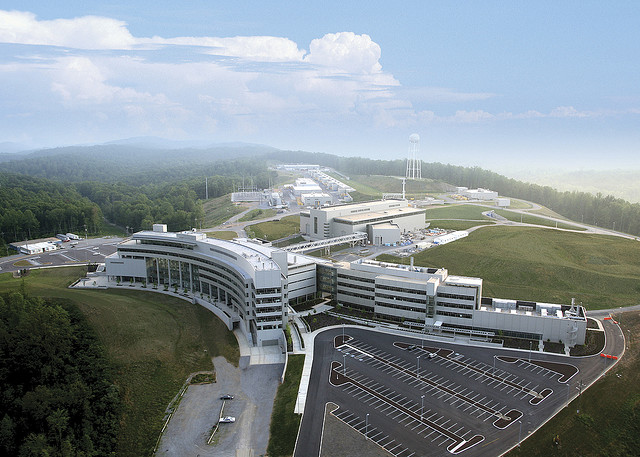
The detection was achieved at the spallation neutron source of Oak Ridge National Laboratory in Tennessee. There a pulsed proton beam strikes a mercury target; alongside neutrons this produces pions, which decay into muons and neutrinos. The result is one of the most intense sources of neutrinos in the range of a few tens of MeV — precisely the energy window in which coherent scattering takes place.
The detector was remarkably small: a scintillation crystal of caesium iodide with a sodium admixture, weighing 14.6 kilograms. By comparison, other neutrino experiments need thousands of tonnes. That is exactly the point of coherent scattering — its cross section is so much larger that a detector the size of a watermelon suffices.
The pulsed beam was the second trick. Because the neutrinos arrive in sharply defined time windows, the signal could be separated from the background simply by looking only at the right nanosecond.
The result
After fifteen months of measuring time the detection stood at 6.7 σ — well above the 5 σ that count as the discovery threshold in particle physics. The number of observed events agreed with the prediction of the Standard Model.
This also confirmed the characteristic signature of the process: the cross section grows with the square of the neutron number of the target nucleus. That is not a detail but the fingerprint of coherence — the nucleus responds as a whole, not as a collection of individual nucleons.
In 2020 the collaboration followed up with argon and detected the process on a second nuclear material. In 2022 came the measurements on caesium iodide with considerably improved statistics.
Why it took so long
Daniel Z. Freedman predicted the process in 1974 and wrote even then that its detection would be difficult — not because the interaction is rare, but because it leaves so little behind. The struck atomic nucleus moves by only a few kiloelectronvolts, a recoil in the range of a few nanometres. Measuring such signals required four decades of progress in detector technology, cooling and background suppression.
That in the end it was a detector of 14.6 kilograms that decided the matter belongs among the fine turns of this story.
Significance
For fundamental physics COHERENT opened a new window: coherent scattering is sensitive to physics beyond the Standard Model and now serves as a tool for measuring the weak nuclear charge and possible new interactions. It is moreover the unavoidable background for detectors searching for dark matter — the so-called neutrino fog.
For neutrinovoltaic technology COHERENT is the second of the three anchors. The 2015 Nobel Prize showed that neutrinos carry mass and therefore momentum; COHERENT showed in 2017 that this momentum is indeed transferred to an atomic nucleus — and through the largest channel that exists at low energies.
Related
- Coherent elastic neutrino-nucleus scattering — the process detected
- Cross section — why the N² dependence matters
- Nobel Prize in Physics 2015 — the first anchor
- Neutrino oscillation — the discovery behind it
- The master equation — where this cross section enters
Sources
- D. Akimov et al. (COHERENT Collaboration): Observation of coherent elastic neutrino-nucleus scattering. Science 357, 1123–1126 (2017).
- D. Akimov et al.: First measurement of coherent elastic neutrino-nucleus scattering on argon. Physical Review Letters 126, 012002 (2021).
- D. Akimov et al.: Measurement of the coherent elastic neutrino-nucleus scattering cross section on CsI. Physical Review Letters 129, 081801 (2022).
- D. Z. Freedman: Physical Review D 9, 1389 (1974).