Melvin Schwartz
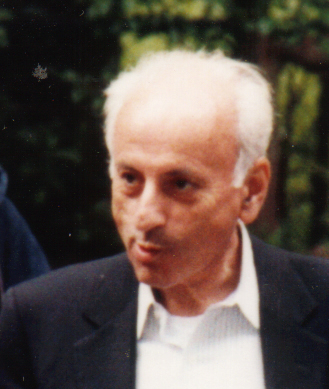

Melvin Schwartz (2 November 1932 – 28 August 2006) was an American physicist. From him came the idea that turned the neutrino into a tool: to build a neutrino beam.
For this idea and the experiment that followed from it he received the Nobel Prize in Physics in 1988, jointly with Leon Lederman and Jack Steinberger.
The idea of 1960
Until then one took neutrinos where one found them — from the Sun or from nuclear reactors. Both sources deliver what they deliver; energy and direction cannot be chosen.
Schwartz, then at Columbia University, thought the other way round. A particle accelerator produces pions. Pions decay and in doing so release neutrinos. If one places a sufficiently thick wall behind the decay section, everything is stopped — except the neutrinos. What comes through is a directed beam of known energy.
By his own account the thought came to him during a discussion about the question of how the weak interaction might be investigated at high energies. The answer was: with the only particle that interacts only weakly.
With that the neutrino was no longer merely an object of observation but a means of investigation.
The experiment of 1962
The idea was implemented at the Alternating Gradient Synchrotron at Brookhaven.
The shielding consisted of 13.5 metres of steel. The material came from the armour of a decommissioned battleship — a solution that was both practical and cheap, since such steel is free of the slight radioactivity that modern steel carries with it from the era of nuclear weapons.
A spark chamber of ten tonnes served as the detector.
After months of running time, 51 analysable events were available. What was decisive was what did not occur among them: all the particles produced were muons, not a single one was an electron.
If there were only one sort of neutrino, both would have had to occur roughly equally often. The finding thus proved that the neutrino which is produced together with a muon is a different particle from the one from beta decay.
The muon neutrino had been discovered — and with it the notion of particle families in the Standard Model was established.
What came of it
The method still carries the whole of accelerator neutrino physics today. From MINOS through T2K and OPERA to the future DUNE, all beam experiments work to this pattern: protons onto a target, focus pions, let them decay, shield everything else.
The neutrino communication achieved at Fermilab in 2012 also rests on a beam of this construction. What began in 1960 as a thought is standard equipment today.
The unusual path afterwards
Schwartz went to Stanford University in 1966. In the early 1970s he left research and founded Digital Pathways, a company for data security.
For a future Nobel laureate this was a remarkable step. He justified it by saying that the task appealed to him — and he led the company for almost twenty years.
In 1991 he returned to physics and became associate director for high energy physics at Brookhaven National Laboratory, that is, at the very place where his experiment had taken place. Later he taught again at Columbia University.
Placing
Schwartz's contribution shows how a methodological idea can achieve more than a single discovery. The question "Can neutrinos be produced deliberately?" sounds modest. Answering it opened up a field of research that is still growing today.
Related
- Leon Lederman — his fellow campaigner
- Jack Steinberger — the third of the group
- T2K and DUNE — today's beam experiments
- Standard Model — the three neutrino families
Sources
- G. Danby, J.-M. Gaillard, K. Goulianos, L. M. Lederman, N. Mistry, M. Schwartz, J. Steinberger: Observation of High-Energy Neutrino Reactions and the Existence of Two Kinds of Neutrinos, Physical Review Letters 9, 36 (1962).
- Nobel Foundation: Nobel Prize in Physics 1988.