Jack Steinberger
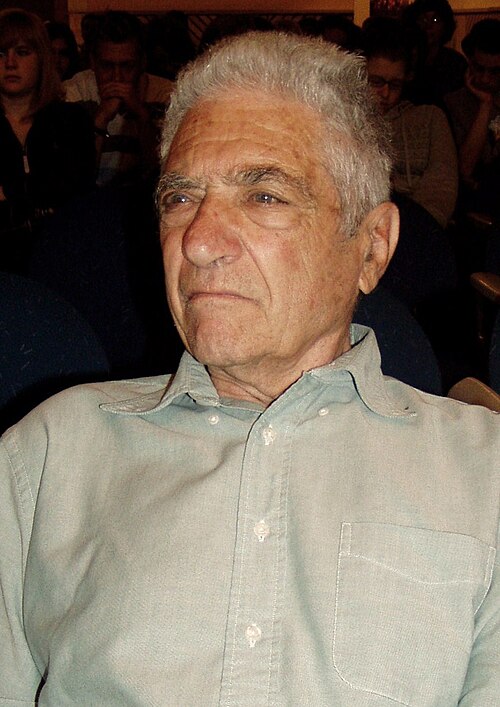

Jack Steinberger (25 May 1921 – 12 December 2020) was a German-American physicist. He was one of the three discoverers of the muon neutrino and received the Nobel Prize in Physics for it in 1988.
His career spans almost the entire age of particle physics — from the first accelerators of the 1940s to the Large Electron-Positron Collider at CERN.
Flight and education
Steinberger was born Hans Jakob Steinberger in Bad Kissingen in Franconia, where his father was cantor of the Jewish community.
In 1934 his parents brought him and his brother to the United States through a relief programme for Jewish children. A family in Chicago took him in and made schooling possible for him. His parents were able to follow later.
He first studied chemistry, worked for a time as a chemist at a pharmaceutical company and only afterwards moved to physics. In 1948 he took his doctorate at the University of Chicago under Enrico Fermi.
His doctoral thesis already had to do with neutrinos: he showed that two neutral particles arise in the decay of the muon and not one — an early indication that the neutrino world is more complicated than it appeared.
The experiment of 1962
At Columbia University, Steinberger belonged to the trio that built the first neutrino beam and thereby showed that there is more than one kind of neutrino. The setup is described on the page on Melvin Schwartz.
Steinberger's contribution lay above all in the analysis: in deriving with certainty, from 51 events, that the absence of electrons was no accident. With numbers this small it is statistical care that decides whether a finding holds — and that was his hallmark throughout his life.
CERN
In 1968 Steinberger went to CERN in Geneva and stayed there for the rest of his career. He led the CDHS experiment, which used neutrino beams to measure the internal structure of the proton and tested the theory of the strong interaction.
His last major undertaking was ALEPH, one of the four detectors at the Large Electron-Positron Collider.
The number three
There, from 1989 onwards, a measurement of fundamental importance succeeded.
A Z boson can decay into various particle pairs, among them into a neutrino and its antiparticle. Such decays are not seen — but they shorten the lifetime of the Z and thereby broaden its resonance curve.
From the measured width it was therefore possible to read off how many light kinds of neutrino there are at all.
The answer was: three. Not two, not four — exactly three. With that, the number of particle families was no longer an assumption but a measured value.
The nature of the measurement is remarkable. One counts something that one does not see by observing how quickly something else decays. The question of sterile neutrinos remains untouched by this, because they would not couple to the Z boson.
Attitude and old age
In old age Steinberger spoke out regularly on climate questions and on the responsibility of science. He signed appeals for disarmament and for climate protection and was present at CERN into his nineties.
He died in 2020 in Geneva at the age of 99 — as one of the last people who had still known Fermi personally.
Assessment
Steinberger's work draws a line through neutrino physics: from the recognition that two neutral particles arise in muon decay, by way of the detection of the second kind of neutrino, to the finding that there are exactly three.
With that, the stage was set on which neutrino oscillation could later be discovered. Without the certainty about the number of kinds, the PMNS matrix would have remained a conjecture.
Related
- Melvin Schwartz and Leon Lederman
- W and Z boson — the measurement of the number of families
- Enrico Fermi — his doctoral supervisor
- Sterile neutrinos
Sources
- G. Danby et al.: Observation of High-Energy Neutrino Reactions and the Existence of Two Kinds of Neutrinos, Physical Review Letters 9, 36 (1962).
- ALEPH Collaboration: Determination of the Number of Light Neutrino Species, Physics Letters B 231, 519 (1989).