Sterile Neutrinos

Sterile neutrinos are hypothetical particles: a fourth kind of neutrino that does not even take part in the weak interaction. They would thus be even more reticent than ordinary neutrinos — noticeable only through the fact that they mix with them.
They have not been detected. But there are several measurements that could be explained by them.
Why exactly three — and why perhaps not after all
In 1989 the decay width of the Z boson was measured at CERN. From it follows how many light kinds of neutrino it can couple to. The result was unambiguous: three.
This measurement, however, excludes a fourth kind only if that kind behaves like the others. A neutrino that does not couple to the Z boson at all would remain invisible. That is exactly what the word sterile means.
Such a particle would take part in none of the known forces apart from gravity. It could make itself noticed only through neutrino oscillation: an ordinary neutrino would pass temporarily into the sterile state and would then have vanished for any detector.
The indications
Several independent measurements show a deficit that does not fit the picture:
The gallium anomaly. During the calibration of SAGE and GALLEX with artificial sources of chromium-51 and argon-37, the measured rate was 10 to 20 per cent below the calculated one. The follow-up experiment BEST confirmed this in 2022.
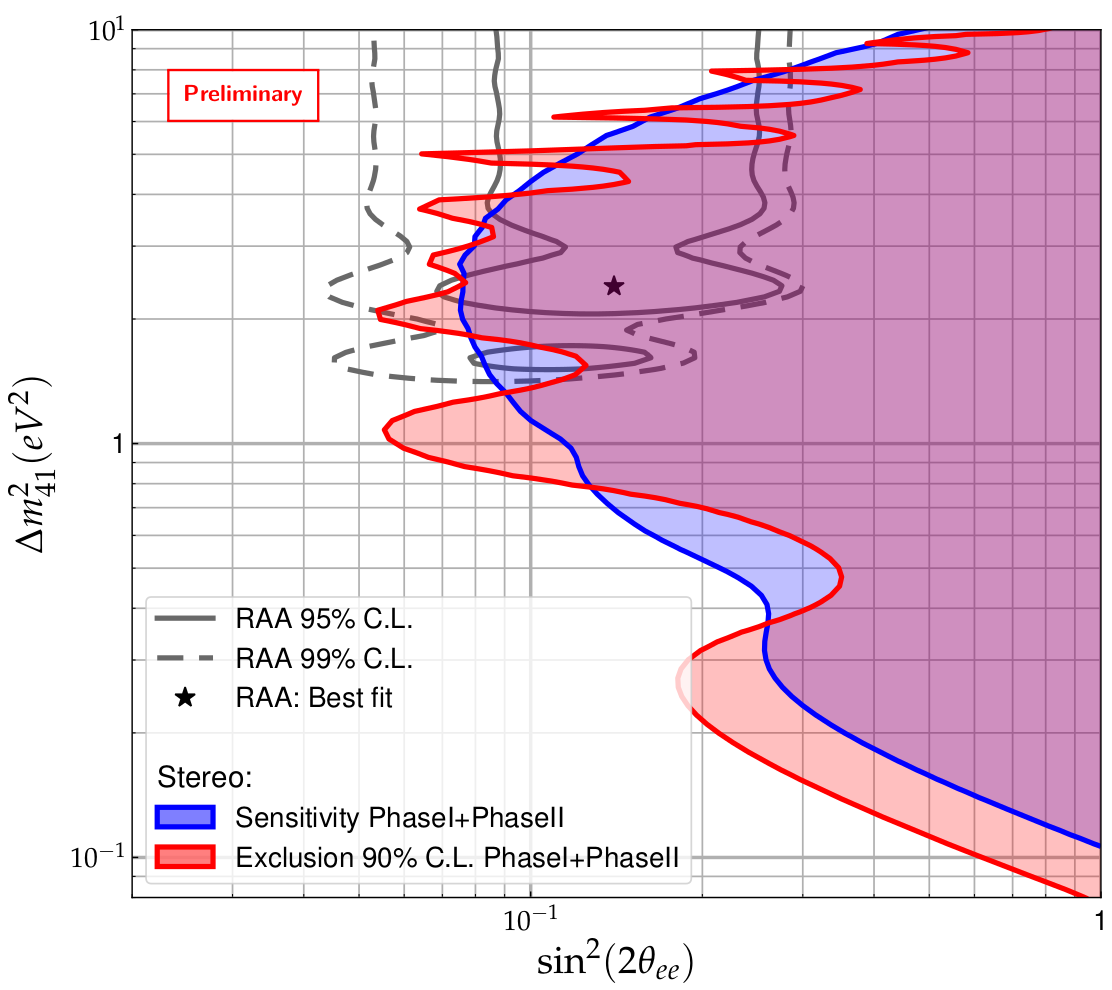
The reactor anomaly. According to a recalculation from 2011, reactors deliver around six per cent fewer antineutrinos than expected.
LSND and MiniBooNE. Two American accelerator experiments found more electron neutrinos than predicted — LSND in the 1990s, MiniBooNE later with a similar finding.
It is striking that all these deviations occur over short distances. A sterile neutrino with a mass in the range of one electronvolt would act precisely there — over the long distances of the established experiments it would long since have been averaged out.
The counter-arguments
The matter is by no means settled, and several things speak against it.
Experiments such as MINOS+, IceCube and Daya Bay have searched specifically for the corresponding oscillation pattern and found nothing. Their exclusion regions overlap with the area suggested by the anomalies — so the findings are not compatible with one another.
Cosmology also sets limits. An additional light kind of particle would have accelerated the expansion of the early universe and altered the formation of the light elements. The observations leave little room for that.
And finally the anomalies are individually explicable. With the gallium anomaly the underlying nuclear transition is under discussion, with the reactor anomaly the beta spectra of uranium-235, which have since been corrected.
It is the most unsatisfying situation a research field can have: several weak indications that are individually explicable but together remain conspicuous.
The heavy variant
Besides the light form, heavy sterile neutrinos are also considered, with masses in the range of kiloelectronvolts or far above.
Such particles would come into question as dark matter. And in the seesaw mechanism they occur anyway — there the heavy right-handed partners are nothing other than sterile neutrinos.
In this form the idea is by no means exotic but part of one of the most respected explanations for the smallness of the neutrino mass. The difference lies in the mass: a heavy sterile neutrino would be theoretically well motivated but unreachable; a light one would be measurable but theoretically hard to accommodate.
Why the search continues
A light sterile neutrino would be the first particle beyond the Standard Model that could be produced in the laboratory. The stakes are high enough to pursue a deviation of several per cent — even if the probability is low.
Related
- SAGE — the gallium anomaly
- Reactor neutrinos — the reactor anomaly
- Seesaw mechanism
- Neutrino mass
Sources
- BEST Collaboration: Results from the Baksan Experiment on Sterile Transitions, Physical Review Letters 128, 232501 (2022).
- Particle Data Group: Review of Particle Physics, section Sterile Neutrinos.