IceCube
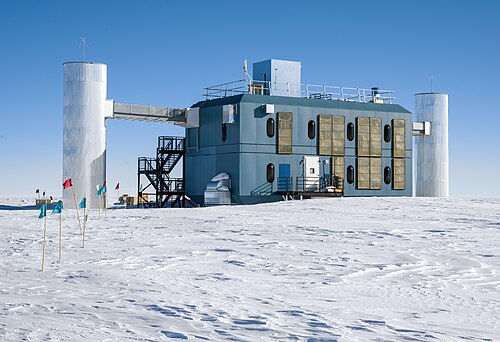

IceCube is the largest neutrino telescope in the world. It consists not of a tank but of a cubic kilometre of Antarctic ice — interspersed with light sensors hanging deep in boreholes.
The facility lies at the geographic South Pole, right beside the Amundsen-Scott station, and was completed in December 2010.
The set-up
5,160 spherical light sensors hang from 86 steel cables at depths between 1,450 and 2,450 metres. Each sphere contains a photomultiplier and the associated electronics; it has to withstand the pressure and must not fail over decades, because it can never be reached again.
The boreholes were melted with hot water — a hole 2.5 kilometres deep in about two days. Afterwards the water freezes solid again around the sensors and encloses them forever.
Detection works via Cherenkov radiation. A neutrino produces a charged particle in an interaction in the ice, and the sensors catch its cone of light. From the arrival times at the various spheres, direction and energy are reconstructed.
Why ice
Antarctic deep ice is astonishingly clear — clearer than any artificially purified water, because the pressure has squeezed out all air bubbles over thousands of years.
It is also free, available in any quantity, and dark. And it shields: above the sensors lie one and a half kilometres of ice, which intercept most of the cosmic muons.
The disadvantage compared with water is scattering. Ice contains grain boundaries and dust layers from past climatic epochs, at which light changes direction. Determining direction is therefore less sharp than with KM3NeT in the Mediterranean.
The Earth as a filter
One trick is what makes the telescope usable in the first place. From above, muons rain in constantly from the atmosphere — a millionfold more frequent than any neutrino event.
IceCube therefore looks downwards. Neutrinos coming from the northern hemisphere cross the entire Earth and enter the detector from below. Everything else is stopped by the planet.
The South Pole thus looks at the northern sky.
What has been found
2013 — the first cosmic neutrinos. The collaboration reported events with energies in the petaelectronvolt range, a thousandfold above anything accelerators produce. Their distribution across the sky showed that they must originate from outside our galaxy. The first three were given nicknames from Sesame Street.
2017 — the first named source. On 22 September, IceCube registered a high-energy neutrino and issued an automatic alert to observatories worldwide within minutes. Telescopes turned towards the spot and found a blazar there — the active nucleus of a distant galaxy designated TXS 0506+056, which was in the middle of an outburst.
For the first time a single cosmic neutrino could be assigned to a named source. The episode is regarded as a model example of multi-messenger astronomy.
2023 — the Milky Way in neutrinos. Ten years of data produced a map of our own galaxy, drawn not with light but with particles. On it the galactic disc glows — the same structure one sees in the night sky as the Milky Way, only in an entirely different messenger.
What else IceCube does
The detector measures atmospheric neutrinos and determines oscillation parameters from them. The more densely instrumented inner region DeepCore lowers the detection threshold for this purpose.
In the case of a supernova in our galaxy, the simultaneous brightening of all sensors would give a signal, even without resolving individual events.
IceCube-Gen2 is planned, with about eight times the volume.
Related
- Neutrino astronomy — the research field
- KM3NeT — the counterpart in the Mediterranean
- Cherenkov radiation — the detection principle
- Cosmic muons — the background
Sources
- IceCube Collaboration: Evidence for High-Energy Extraterrestrial Neutrinos, Science 342, 1242856 (2013).
- IceCube Collaboration et al.: Multimessenger observations of a flaring blazar, Science 361, eaat1378 (2018).
- IceCube Collaboration: Observation of high-energy neutrinos from the Galactic plane, Science 380, 1338 (2023).