W and Z Boson
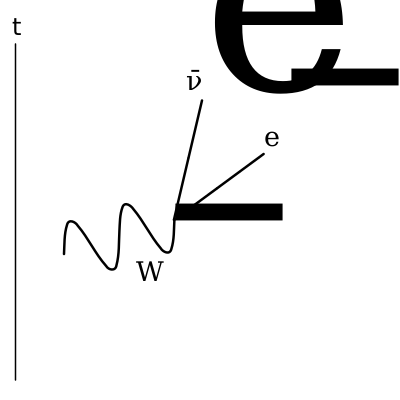

The W boson and the Z boson are the messenger particles of the weak interaction. Every interaction of a neutrino with matter runs via one of the two.
The masses
Their most striking property is their weight:
| Particle | Mass | Charge |
|---|---|---|
| W⁺ and W⁻ | about 80.4 GeV/c² | +1 and −1 |
| Z⁰ | about 91.2 GeV/c² | 0 |
A proton weighs just under one gigaelectronvolt. These messenger particles are thus around eighty to ninety times as heavy as an entire proton — while the photon, which carries the electromagnetic force, has no mass at all.
From this mass follows the tiny range of the weak force and with it the sluggishness of all neutrino processes.
What they do
The W boson changes identity. In beta decay a down quark in the neutron converts into an up quark and in doing so emits a W⁻, which immediately decays into an electron and an antineutrino. Such processes are called charged currents.
The Z boson changes nothing about identity but transfers only energy and momentum. A neutrino can scatter off an atomic nucleus and remain a neutrino. These neutral currents were predicted by the electroweak theory, and Gargamelle found them in 1973.
A neutral current is also the basis of coherent scattering off atomic nuclei, which makes today's small detectors possible.
The discovery of 1983
Both were detected in 1983 at CERN, in the experiments UA1 and UA2.
The route there is remarkable. To produce particles of this mass, collisions of hitherto unattained energy were needed. Carlo Rubbia pushed through the rebuilding of an existing accelerator: instead of firing protons at a fixed target, protons and antiprotons were to run against each other.
The problem was collecting enough antiprotons and bundling them into a usable beam. For this Simon van der Meer developed stochastic cooling — a procedure that continuously measures the motion of the particles and damps it by targeted corrections until the beam is narrow enough.
Both received the Nobel Prize for it as early as 1984, one of the fastest awards in the history of the prize.
The order is remarkable: Glashow, Salam and Weinberg had received the prize back in 1979 for the theory, that is before their particles had been found. The finding of Gargamelle had been enough to convince the specialist world.
The number of neutrino kinds
The Z boson has supplied neutrino physics with one of its most important numbers.
A Z boson can decay into various pairs of particles, among them into a neutrino and its antiparticle. Such decays are not seen — but they shorten the lifetime of the Z and thus broaden its resonance curve.
From the measured width one can therefore read off into how many invisible channels it can decay. The measurements at the Large Electron-Positron Collider, in which Jack Steinberger took part among others, gave a clear value from 1989 onwards: three light kinds of neutrino.
That is a model example of an indirect measurement. One counts something one cannot see by measuring how quickly something else decays.
This measurement does not exclude sterile neutrinos, for by definition those would not couple to the Z. For all ordinary neutrinos, however, the number is thereby fixed — and the PMNS matrix has exactly three rows and three columns because this measurement demands it.
A number that caused unrest
In 2022 the CDF Collaboration at Fermilab presented a very precise measurement of the W mass — and the value lay clearly above the prediction of the Standard Model, far outside the stated uncertainties.
That would have been a crack in the edifice, for the W mass is connected through the theory with other measured quantities and is therefore not freely selectable.
Later measurements at CERN, however, arrived at values that are compatible with the Standard Model. The deviation is today predominantly regarded as an analysis effect of a single experiment.
The episode is instructive: a single very precise measurement is not enough as long as it has not been independently confirmed — not even when its statistical significance is impressive.
Related
- Weak interaction
- Gargamelle — the neutral currents
- Jack Steinberger — the number of families
- Standard Model
Sources
- UA1 Collaboration: Experimental observation of isolated large transverse energy electrons with associated missing energy, Physics Letters B 122, 103 (1983).
- ALEPH, DELPHI, L3, OPAL: Precision electroweak measurements on the Z resonance, Physics Reports 427, 257 (2006).