Gargamelle
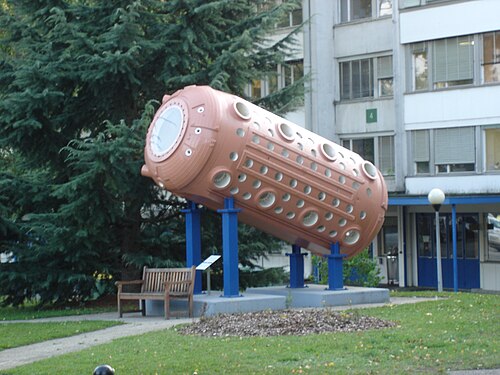

Gargamelle was a bubble chamber at CERN which in 1973 delivered one of the most important findings of particle physics: the detection of neutral currents.
With that, the theory of the electroweak interaction went from an elegant conjecture to tested physics — and the way to the W and Z bosons was clear.
What a bubble chamber is
A bubble chamber contains a liquid just below boiling point. When a charged particle traverses it, tiny vapour bubbles form along its path. A flash of light and several cameras record the track.
The method has an advantage that no electronic detector of the time could offer: one sees the event. Every track is present as an image, with all its branchings, curvatures and gaps.
And it has a drawback: every image had to be evaluated by people. At CERN whole departments of scanners worked on this, going through exposure after exposure.
The construction
Gargamelle was built in France and operated at CERN from 1970. The vessel measured around 4.8 metres in length and just under two metres in diameter and held about 12 cubic metres of heavy freon.
The choice of liquid was decisive. Freon is dense, and density means more atomic nuclei per volume — thus more opportunities for a neutrino to interact at all. With a particle of this cross section, every gram counts.
The name comes from Rabelais' novel: Gargamelle is the giantess who gives birth to Gargantua.
The question
The electroweak theory formulated in 1967 by Glashow, Salam and Weinberg predicted something unusual.
Known were processes in which a neutrino transforms into a charged lepton — the charged currents. The theory additionally required processes in which the neutrino remains a neutrino and only transfers energy: neutral currents.
Nobody had ever observed such events. Had they not existed, the theory would have been refuted — and with it the prospect of a unification of the weak and electromagnetic forces.
The detection
The image sought is peculiar. A neutrino comes in, invisible. It strikes a nucleon, produces a shower of hadrons — and disappears again, likewise invisible.
On the film one therefore sees a spray of tracks that arises out of nothing and to which no muon belongs. With a charged current a long, continuous muon track would be seen instead.
Exactly such exposures were found by the collaboration — about a hundred events without a muon against a few hundred with one. The ratio matched the prediction.
The real difficulty
The difficult part was not the finding but the ruling out.
Neutrons from the surroundings can produce the same image: they too are neutral, likewise invisible, and a collision likewise produces a shower.
The collaboration resolved this via the spatial distribution. Neutrons come from outside and are quickly stopped in the liquid — their events would have to cluster at the edge. Neutrinos penetrate everything and produce their events uniformly throughout the entire volume.
The events found were uniformly distributed.
In addition Franz Josef Hasert found a single exposure on which an electron changes its direction without any recognisable cause — the purest conceivable form of a neutral current, in which a neutrino scatters off an electron. A single event, but one without any alternative interpretation.
The consequences
In July 1973 CERN announced the detection. The finding made the electroweak theory credible, and Glashow, Salam and Weinberg received the Nobel Prize in 1979 — before the bosons themselves had been found. Their detection was achieved in 1983, likewise at CERN.
For neutrino physics Gargamelle has immediate significance. Coherent scattering off atomic nuclei, on which today's small detectors rely, is a process via neutral currents. And the Sudbury Neutrino Observatory solved the solar neutrino problem by comparing charged and neutral currents against each other.
Without the finding of 1973 there would be neither the theory for it nor the expectation that such a thing can be measured.
Legacy
The chamber was rendered unusable in 1979 by a crack. Today it stands in the open grounds of CERN and is one of the few large instruments of particle physics that can be viewed from outside.
Related
- W and Z boson — the carriers of the force
- Weak interaction
- CEνNS — a neutral current in present-day application
- Sudbury Neutrino Observatory
Sources
- F. J. Hasert et al. (Gargamelle Collaboration): Observation of neutrino-like interactions without muon or electron in the Gargamelle neutrino experiment, Physics Letters B 46, 138 (1973).
- F. J. Hasert et al.: Search for elastic muon-neutrino electron scattering, Physics Letters B 46, 121 (1973).